
Steppenwolf - Hermann Hesse
 Andres Aguilar
Hesse wrote this book with a razor blade on the table and the date of his own suicide marked on the calendar. What came out wasn't a farewell note but one of the strangest and most widely read novels of the twentieth century. Why does Steppenwolf keep ...
Hermann Hesse. Zurich, 1926. Fifty years old, separated from his second wife, barely speaking to anyone, locked in a small room in the home of an acquaintance. And every night before falling asleep, he makes himself the same promise: on the day he turns fifty, he's going to cut his own throat with a straight razor. Not a metaphor. An actual plan. He has the date marked and the blade sharpened.
Hesse didn't go through with it, obviously. What he did instead was take all of that — every last drop of that black void — and write the strangest and most unsettling book of his career. He published it in 1927 and called it Der Steppenwolf, Steppenwolf. Forty years later, in the nineteen-sixties, hippies in California would read it tucked into their backpacks, slip it onto university library shelves, and a rock band that would go on to sell millions of records would name itself after the book — Steppenwolf, the one that gave us "Born to Be Wild." And Hesse, who by then had already died, would be forever associated with that strange thing that is being strange — feeling split down the middle, belonging nowhere.
In this episode we're going to talk about what Steppenwolf is actually about. Why it's a book that fascinates and confuses in equal measure. How a middle-aged, depressed, nearly suicidal man ended up writing one of the most widely read novels of the twentieth century. And why today, almost a hundred years later, it still has something important to say about the feeling of never quite fitting in anywhere.
Let's start with the author. Hermann Hesse was born in 1877 into a very religious, very strict family in southern Germany. His father was a missionary, his mother the daughter of missionaries. His entire childhood was saturated with the Bible, psalms, and prayer. And from an early age, Hermann rebels. At fourteen he escapes from a seminary, attempts suicide for the first time, and is committed to a psychiatric facility. His entire adolescence goes like this: depressions, escapes, institutionalizations. They diagnose him with "melancholia." Today they would call it major depressive disorder.
But also from an early age he has one thing going for him: he loves to read and loves to write. He starts publishing poetry young, and at twenty-seven brings out Peter Camenzind, which becomes a hit. It buys him a house. He marries, has three kids, seems to be on track. But underneath that facade, he's still the same melancholic kid he always was.
World War One breaks out. Hesse publicly opposes the war. Germany crucifies him for it — he's branded a traitor. His father dies. His wife has a psychotic breakdown. His son falls gravely ill. And Hesse collapses. He ends up in psychoanalysis with J.B. Lang, a disciple of Carl Jung — the Swiss theorist of archetypes and the collective unconscious. Later he also goes to be analyzed by Jung himself.
This matters because all of Hesse's work from that point forward…
This matters because all of Hesse's work from that point forward would be soaked through with Jung. The idea that we carry multiple layers inside us — that there is an unconscious which speaks in images, symbols, and dreams. The idea that the path of growth means descending into those basement rooms of the soul and integrating what you find there. In Steppenwolf, that's present everywhere.
By 1926, Hesse is separated from his second wife, Ruth. He lives alone. He's nearly fifty years old. And that is precisely the situation the book opens with.
So what is the book about? The novel has an odd structure — like Russian nesting dolls. It opens with a preface written by a narrator who claims to be the nephew of the boarding house owner where a man named Harry Haller once lived. He explains that Harry, one day, left without leaving a forwarding address — and left behind a manuscript. That manuscript is what we're about to read. Inside the manuscript there's another text, a pamphlet Harry is handed on the street, titled "Treatise on the Steppenwolf." And nested inside all of that, at the very end, is the famous scene of the Magic Theater.
Meet Harry Haller. Fifty years old, an intellectual, a writer, living alone in a boarding house in an unnamed German city. He's an extraordinarily cultured man. He reads Goethe, listens to Mozart, knows Latin, reads Greek. But he can't stand the world he's been born into. He hates jazz, hates automobiles, hates the radio, hates neon lights, hates the cinema, hates the idiotic optimism of the postwar years, hates the German middle class acting as though nothing happened between 1914 and 1918.
And yet — massive paradox — he lives embedded in the very bourgeoisie he so despises. He rents a room in a house where the landlady has little potted plants in the living room and cleans the hallways on Wednesdays. When he walks up the stairs, Harry stops to smell the plants and contemplates the perfectly arranged doormat, and he feels something strange — because all of it gives him something close to tenderness. There's a beautiful scene where he thinks: he, a wild wolf, what he misses most in the end is exactly this. The order, the warmth, the smell of wax on the polished floor.
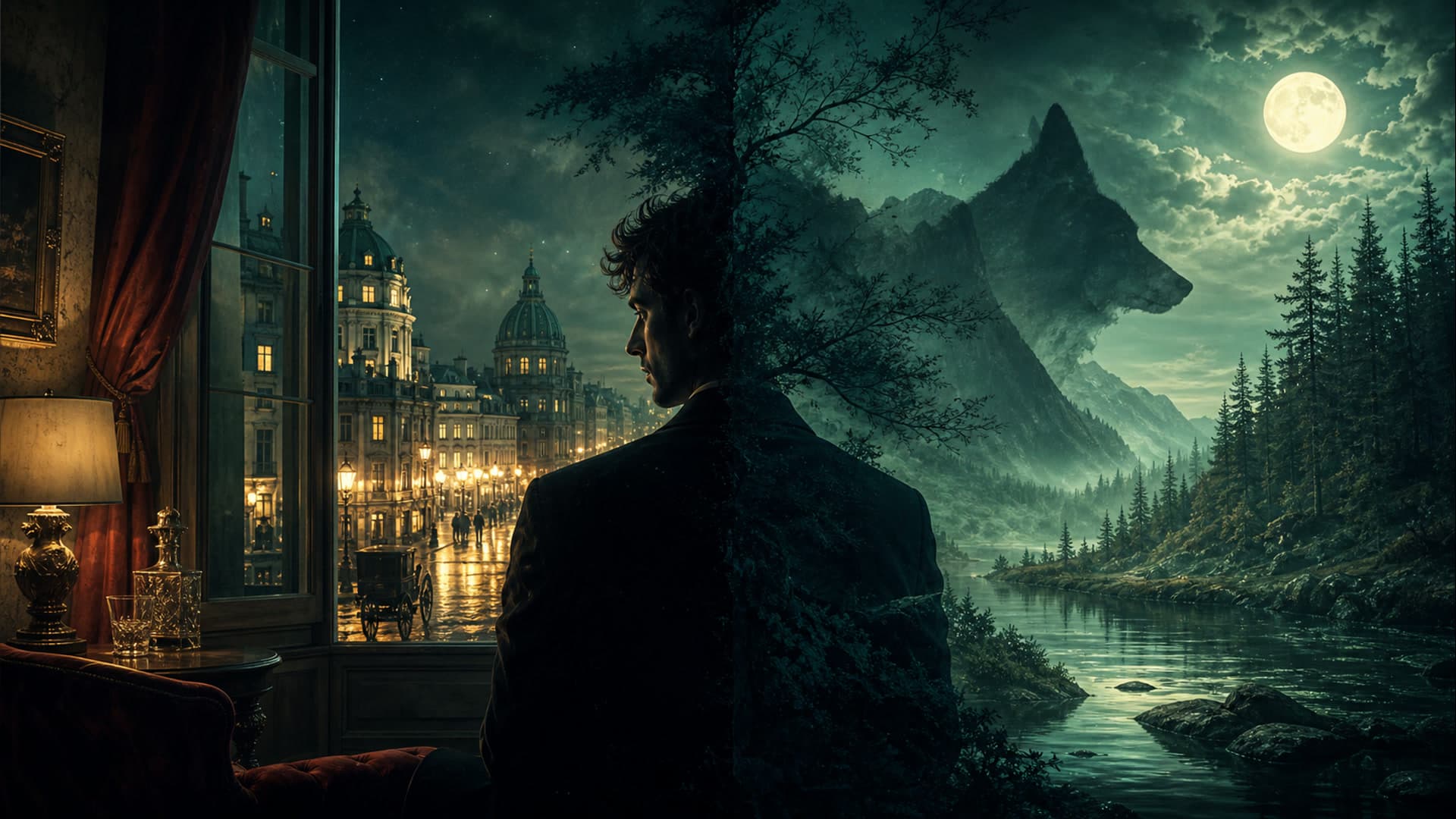
That contradiction is the engine of the entire book. Harry sees himself as a double being. On one side, a cultivated, sensitive, spiritual man. On the other, a wolf of the steppe — a wild animal, instinctive, that will never be fully domesticated. When the human side enjoys Mozart, the wolf laughs with contempt. When the wolf wants to run outside and howl at the moon, the man holds it back through education and good manners. And they hate each other. Harry lives in a permanent, exhausting internal civil war.
> Inside there is an entire theater — dozens, hundreds of characters who coexist, argue, contradict each other.
> Mental health isn't choosing one and killing the rest. It's learning to move among all of them, getting to know them, integrating them, letting each one occupy its space.
One night, depressed, wandering through the city, he passes a strange sign pasted on an old wall. It reads: "Magic Theater. Entrance not for everybody. For madmen only." When he approaches to read it, the letters disappear. He keeps walking, and a man with a portable sign hands him a pamphlet. When he gets back to his room and opens it, he realizes it's not advertising: it's a strange, profound text titled "Treatise on the Steppenwolf." And there, in the third person, someone describes him — with meticulous precision — for who he is.
That treatise — that small book inside the book — is probably…
That treatise — that small book inside the book — is probably the most famous and most quoted section in all of Hesse's work. What it essentially says is this: Harry is wrong to think he is only two things, man and wolf. That's a simplification — a myth he invented to make himself bearable. In reality, we are all a multitude of different selves, built from layer upon layer of interior characters. People believe they are a unity, a single solid self. But that's an illusion. Inside there is an entire theater — dozens, hundreds of characters who coexist, argue, contradict each other. Mental health isn't choosing one and killing the rest. It's learning to move among all of them, getting to know them, integrating them, letting each one occupy its space.
The treatise also says something else — something brutal: Harry has a tendency toward suicide, and it doesn't come from the terrible things that happen to him, but from his personality being structured that way. There are people who are wired to consider suicide as an always-available exit, and that accompanies them like a shadow. The good news, says the pamphlet, is that knowing this actually frees you a little. If you understand it as a compulsion and not a conclusion, it frightens you less.
Harry finishes reading it — devastated and, at the same time, relieved. Someone understood him. Someone wrote about him — about him — what he never dared to think about himself.
Days pass. Harry is getting worse. One night, after a dreadful dinner with an old acquaintance — a university professor they fight with because the man is a German nationalist and Harry is not — he makes up his mind: tonight's the night. He goes back to the boarding house, picks up the razor, gets himself mentally ready. But first, not wanting to die in his room and leave a mess for the poor landlady, he goes out for a walk. It's a freezing night. He walks with no direction. And almost by accident he ends up walking into a horrible, popular joint — jazz, smoke, neon lights.
At the bar, a girl approaches him. She asks what's wrong, why does he have that look on his face. She offers him something to drink. She talks to him with a mix of tenderness and firmness. That girl is Hermine.
Hermine is one of the strangest and most beautiful characters in the novel. She's a kind of free-spirited prostitute, a dancer, a woman who lives from day to night and who seems, at different moments, like a sister, a mother, a lover, a mirror. Hesse draws her as slightly androgynous, with a short haircut, and at one point Harry even thinks she resembles a male childhood friend named Hermann. In fact, "Hermine" is just the feminine form of "Hermann." The girl is, for him, a projection. A part of himself that has come looking for him.
Hermine makes him a deal. She says: I will save you. But in exchange, you have to learn to live the way people actually live. You're going to learn to dance, you're going to learn to have fun, you're going to learn to have sex without guilt, you're going to learn to listen to that jazz you despise so much. And when you've learned all of that — when you're in love with me — I'm going to ask you for one thing, just one last thing, and you're going to do it without question. Deal? And Harry, fascinated, says yes.
And so a second life begins
And so a second life begins. Hermine introduces him to a friend named Maria, who becomes his lover. She introduces him to a saxophone player named Pablo — slightly androgynous too, beautiful, who plays jazz, barely speaks, always carries a mysterious smile. Pablo is a kind of shamanic figure. He knows about drugs, he knows the Magic Theater, he looks at Harry as if he knows things about him that Harry doesn't yet know about himself.
For months, Harry dances the foxtrot, learns the tango, surrenders to Maria, does things he has never done. The stiff intellectual loosens up. The steppe wolf laughs. And his head fills with new ideas. He realizes that what he despised as vulgar was, in fact, life. That his lofty culture had disconnected him from something elemental.
Everything comes to a head at a huge masquerade ball, a carnival party that lasts all night. At the end of the ball, Hermine and Harry end up in each other's arms. And Pablo appears and invites them both to his place. He says: "Now it's time — let's go to the Magic Theater." He offers them a strange cigarette, has them drink from a flask. He leads them into a hallway full of doors. Each door has a sign: "Jolly Hunt — The Great Automobile Hunt," "Course in How to Build a Personality," "Marvelous Taming of the Steppenwolf," "All Girls Are Yours," "How to Kill for Love."
And the Magic Theater begins. That final sequence — nearly hallucinatory — is the most experimental section of the book. Harry opens doors, enters, lives through different scenes. Each door is a possibility of his own life, a version of himself, a fantasy. Behind one he meets all the women he could have loved and didn't. Behind another he's a hunter in a civil war between humans and machines, where men with cars are the enemy. Behind another he sees his own personality as a chessboard, where a master player rearranges the pieces: each piece is one of his selves, and he learns that the pieces can be moved, added, shuffled, rearranged — that there isn't just one Harry, there are infinite possible ones, and they're all waiting there.
But Hesse doesn't stop at the beautiful part. The last door is brutal. Behind it he finds Hermine and Pablo naked, asleep in each other's arms after making love. And Harry — the sensitive intellectual, the one who had learned so much, the one who believed himself enlightened — instead of laughing or leaving them in peace, picks up a knife and kills Hermine. He wounds her in the heart. Blood stains the girl's white skin. And as he realizes what he's done, he falls to his knees.
Then Mozart appears. Yes, Mozart — the composer — in the Magic Theater, listening to music through a terrible radio that distorts the whole piece. And Mozart laughs. He tells Harry something like: you understood nothing. The Magic Theater is for laughing, not for taking seriously. So is life. You took everything too solemnly, too dramatically — you cast yourself as the tragic protagonist of a German novel and didn't realize this is all a game.
Harry is symbolically put on trial. He's sentenced to "go on living and learn to laugh." Mozart disappears, Pablo appears, Hermine wasn't really dead — she was a figure, a symbol, a projection. The Magic Theater dissolves. And Harry, in the last line of the book, says something like: someday I will know how to play the game of figures better. Someday I will learn to laugh. Pablo is waiting for me. Mozart is waiting for me.
And there it ends
And there it ends. No explicit moral, no shouted lesson. But with one clear key: the way out for the Steppenwolf is neither suicide nor total dissolution into bourgeois life. The way out is humor, plurality, the capacity not to take oneself too seriously.
When the book came out in 1927, it was an odd phenomenon. It sold well, but the critics received it with a certain skepticism. They accused it of being confusing, self-indulgent, too strange. Hesse himself, in later years, said repeatedly that he felt this was the most misunderstood book in his entire output. That people stopped at the first third — the dark part, the duality of wolf and man — and never made it to the end, where all of that gets dismantled. That many readers identified with Harry as a lonely martyr, when the book is actually gently mocking that very identification.
There's an interesting footnote. Hesse won the Nobel Prize in Literature in 1946, but not for Steppenwolf — for his complete body of work, where Siddhartha and The Glass Bead Game carried more weight. And yet Steppenwolf, thirty years later, in the sixties, ended up being the most widely read of his books on the planet — especially among young American university students. The counterculture found a handbook of initiation in it. The Canadian rock band Steppenwolf, formed in 1967, took its name directly from the novel. And chroniclers of the hippie movement cited Hesse constantly.
That sixties reading was, in part, a selective one. Many people read the Magic Theater as a metaphor for the psychedelic trip. Pablo was the initiator, the doors were chemical doors, the fragmentation of the self was what it felt like on LSD. Hesse — who by then was an elderly man in his eighties living in retirement in Switzerland — heard about all of this through letters and laughed a little, worried a little. He said he hadn't written a drug manual. That the journey he was writing about was an interior journey — symbolic, spiritual.
It's worth stopping on a detail that often gets overlooked. Midway through the book, Harry Haller has an intense scene with Goethe. Yes, Goethe — the German writer who had been dead for a hundred years, the sacred monster of German literature. Harry dreams about him, calls him out for having been too solemn, too monumental, for having sold out to the court and to success. And Goethe, in the dream, laughs at him. He says something like: boy, you took everything far too seriously — I, on the other hand, laughed a great deal, far more than any of you imagine. That oneiric conversation with Goethe is like a preview of what will later happen with Mozart. Hesse seems to insist, again and again, on the same idea: the great immortals — the Mozarts, the Goethes, the Buddhas — are not the serious and tragic figures that posterity painted. They are the ones who learned to laugh. The ones who understood that life is an enormous, terrible, and somehow funny game, and that the only possible health lies in playing that game well.
There's also a political critique that often gets lost. Steppenwolf is a book written in Weimar Germany — that fragile, wounded republic, full of hatred and revanchism, where Nazism hadn't yet reached power but was already stoking its engines. Harry, in his arguments with the nationalist professor, fights against exactly that: the idea that the war was glorious, that Germany must rearm, that the enemies of the fatherland are within. Hesse, before almost anyone else, saw what was coming. And the novel carries a layer of political denunciation that tends to go unread — but it's there. The bourgeoisie Harry hates isn't just the kind with little plants in the living room. It's also the kind that applauds war and gets ready for the next one.
But beyond the hippie reading, what the book touches is something far more universal. It touches the feeling of not fitting in. The feeling of carrying contradictory voices inside. The feeling of hating the world and at the same time wanting to be part of it. The idea that education, culture, and intelligence can dry you out — can cut you off from life itself. And the idea that the solution isn't to renounce intelligence but to integrate what's been left out: the body, desire, dancing, popular music, laughter.
In today's context, Steppenwolf remains a book that speaks to anyone who…
In today's context, Steppenwolf remains a book that speaks to anyone who feels divided. The person who feels too strange for the normals and too normal for the strange. The one who has a flawless social media profile and a fierce internal crisis. The one who has a comfortable life and yet dreams of blowing it all up. The novel speaks to them, puts their conflict on stage, and above all suggests something: your self is not just one. You don't have to choose one character and kill the rest. You can be many. And the more you're able to inhabit all those characters with humor, the lighter life is going to feel.
Hermann Hesse died in Switzerland in 1962, at eighty-five years old, from a stroke, in his sleep. By then, the Steppenwolf fever was only just beginning. His books would be translated into sixty languages. And the Treatise on the Steppenwolf — that strange pamphlet inside the book — still circulates today as a standalone piece across blogs, forums, and social media, as if it were the best diagnosis ever written of a certain kind of modern sadness: the sadness of the person who has everything and can't.
The book stands as a map of a possible way out. It doesn't prescribe anything. It doesn't tell you what to do. But it whispers that inside you there are more people than you think — that some of them know how to dance, that your own solemnity is your enemy, and that laughter — the kind Mozart laughs at the end, the laughter of the immortals as Hesse calls it — is probably the closest thing we have to a cure.
> Inside you there are more people than you think — that some of them know how to dance, that your own solemnity is your enemy.
Related episodes

In this article we are going to see what it is about. Who was Chris Voss and why his story matters.

One night in crisis, a Cambridge student asked himself such a strange question that it changed his life: who is the one observing the one who suffers? What he found in answering that question became one of the bestselling spirituality books of the cent...

Everyone cites Adam Smith but almost nobody has read him. The same book that coined the invisible hand also warned that businessmen conspire against the public whenever they get the chance. Which Adam Smith is the real one, and why does it matter?