
Work - James Suzman
 Andres Aguilar
In 1930 John Maynard Keynes predicted that by the year 2030 we would be working fifteen hours a week. Here we are in 2025 with an average workweek of forty-five. Anthropologist James Suzman wants to know why, and to find the answer he travels three hun...
Sometime in 1930, one of the most influential economists of the twentieth century sat down to write an essay that would turn out to be the most famous — and most embarrassingly wrong — of his entire career. John Maynard Keynes — the guy who basically invented modern macroeconomics, the man who helped pull much of the Western world out of the Great Depression — took a moment to make a prediction about the future. And his prediction was this: by the year 2030, human beings would work, at most, fifteen hours a week. Technology, Keynes said, would solve the economic problem so definitively that our grandchildren would have more leisure time than they'd know what to do with.
Well. Here we are in 2025, and the average workweek in the developed world hovers around forty-five hours. In many countries — including ours — people work even more than that, and they take work home with them on their phones over the weekend. Keynes was brilliant at almost everything. On this one, he missed by a mile.
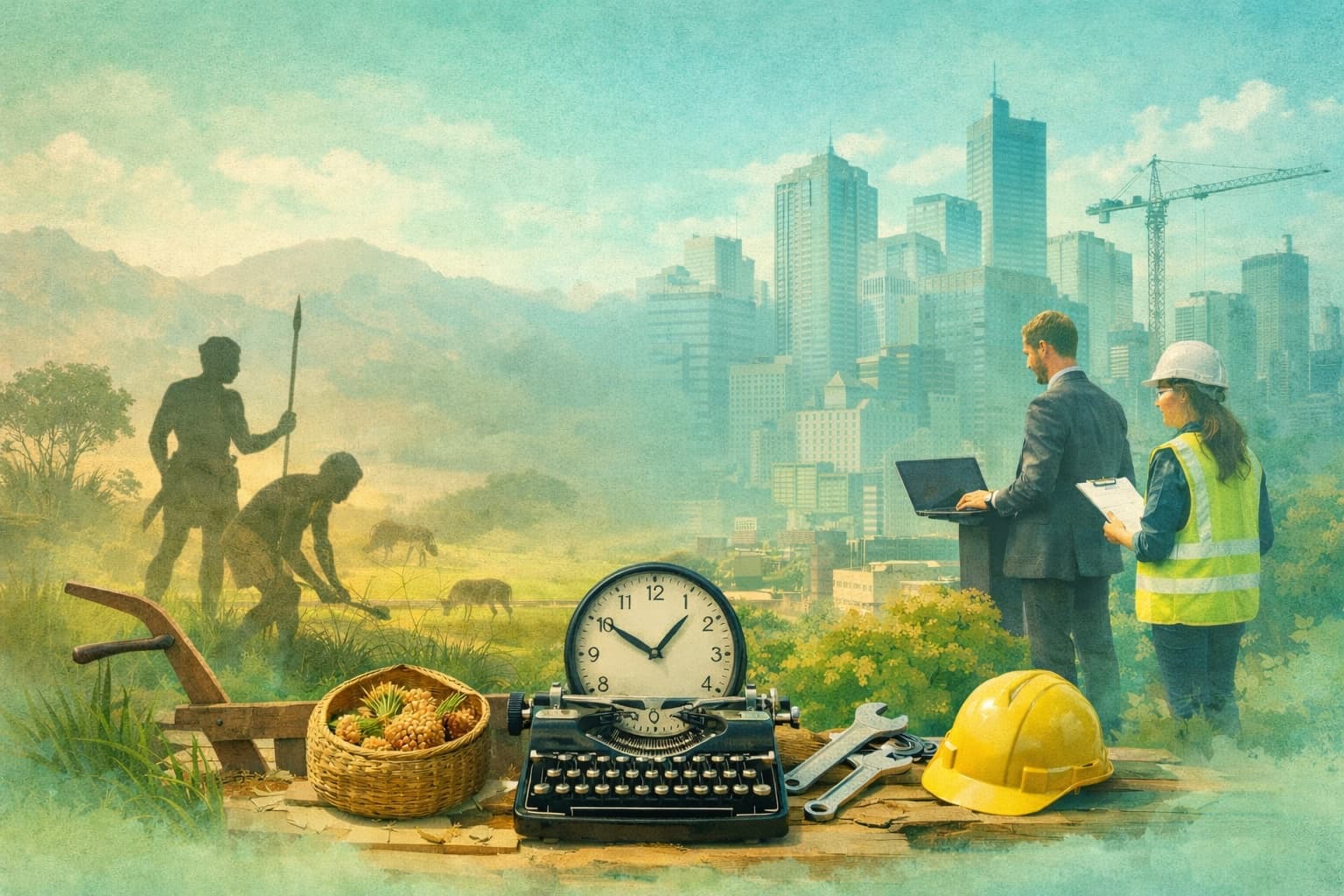
That paradox — technology grows, productivity explodes, but we keep working just as much or more than before — is exactly the starting point of today's book. It's called Work, written by Scottish anthropologist James Suzman, published in 2021, and it proposes something fairly radical: to understand why we work so much, and why it's so hard to stop, you have to go back. Not a hundred years. Not a thousand. You have to go back about three hundred thousand years, to the very origins of our species. And then move forward, step by step, to the present.
Suzman isn't a desk economist. He's an anthropologist who spent decades living with the Ju/'hoansi, a hunter-gatherer people of the Kalahari Desert in what is now Namibia and Botswana. And what he witnessed in that time turned his thinking upside down so profoundly that he ended up writing this book to try to explain it.
Before getting into the meat of it, it's worth pausing on the central question, because it seems obvious but isn't. Why do we work? The answer most of us would give is: to survive, to earn a living, to pay the bills. And yes, there's something to that. But Suzman points out that answer doesn't explain the full picture. Because there are people who work even when they already have more money than they could spend in several lifetimes. There are people who retire and three months later are looking for something to do. And there are entire cultures — like ours — where work has become a source of identity and personal meaning, not simply a means to get things.
To understand how we got here, Suzman widens the lens as far as it will go. The book starts not with humans, not with primates, not even with animals. It starts with bacteria. It starts with the origin of life itself. Because for Suzman, work — understood in its most basic sense as the expenditure of energy to transform the environment — isn't a human invention or a social construct. It's a direct consequence of the laws of physics.
The Second Law of Thermodynamics says that every system tends toward disorder, toward entropy. Energy disperses, structures fall apart. Life, then, is basically a process that fights against that current. To survive means to capture energy from the environment and use it to maintain internal order. Bacteria do it. Trees do it. Lions do it. And humans do too. From this perspective, working is the same as living.
This idea can sound abstract, but Suzman uses it as an anchor for something very concrete: if work has existed as long as life has, the interesting question isn't "why do we work?" but "how has our relationship with work changed throughout history?" And that's where the book gets really fascinating.
Back to the Ju/'hoansi, because they're the heart of the argument. When Suzman arrived in the Kalahari for the first time in the 1980s, he encountered a community living more or less the same way their ancestors had lived for tens of thousands of years. They hunted, gathered fruit and roots, and built temporary settlements that they abandoned and rebuilt according to the movement of animals and the seasons. No agriculture, no livestock, no accumulation of material goods.
The first thing that stands out when you read Suzman's observations — and those of other anthropologists who studied similar societies — is how much free time these people had. The Ju/'hoansi spent between fifteen and twenty hours a week obtaining food. The rest of the time they spent resting, talking, telling stories, playing with their kids. They had no anxiety about productivity. When they had food, they ate. When they didn't, they trusted they'd find some.
Anthropologist Marshall Sahlins described this with a phrase that became famous: hunter-gatherer societies are the original affluent society. Not because they had many things — they had very few — but because their needs were perfectly calibrated to what their environment could provide. They didn't want more than they could get. And that meant they worked very little and rested a lot.
Suzman adds a detail that says a lot about the social logic of these groups. The Ju/'hoansi had a fairly unusual cultural rule around hunting: when a hunter came back with an animal, the animal didn't belong to him. It belonged to whoever had made the arrow that killed it. And arrows were constantly traded, lent, and gifted. The practical result was that nobody could accumulate more than anyone else simply by being a better hunter. The system was designed to automatically redistribute success. Anyone who tried to accumulate or show off their skills was met with mockery — a very effective social pressure to maintain equality.
Back to the Ju/'hoansi, because they're the heart of the argument.
When Suzman arrived in the Kalahari for the first time in the 1980s, he encountered a community living more or less the same way their ancestors had lived for tens of thousands of years.
This egalitarianism wasn't an abstract ideal. It was a sophisticated survival strategy. In an environment where resources are variable and unpredictable, sharing is the best collective insurance policy there is. If today I have and tomorrow you have, and we always share, both of us survive.
So the question Suzman asks with great force is: what happened? How did we go from that — fifteen hours of work a week, egalitarianism, abundant leisure time — to this: forty-five hours of work, massive inequality, permanent anxiety about productivity?
The answer lies in one of the most important shifts in all of human history. About twelve thousand years ago, in different parts of the world more or less independently, humans started cultivating plants and domesticating animals. Agriculture was born. And with agriculture came a completely new relationship with work, with property, and with the future — one that would reshape everything that followed.
Suzman is careful here not to romanticize pre-agricultural life or demonize farming. He notes that the shift was gradual and complex, driven by a combination of factors: climate changes at the end of the last ice age, demographic growth pushing groups to seek more stable food sources. But the consequences were enormous and, in many ways, quite hard on the people who lived through it.
The first farmers worked much harder than hunter-gatherers. The archaeological record — analysis of skeletons, marks on bones — shows that early agricultural populations suffered more repetitive stress injuries, more malnutrition, and generally worse health than their predecessors. The diet became more monotonous, and dependence on a single food source created a new vulnerability: if the harvest failed, people starved.
But agriculture did something more. It introduced the idea of scarcity as a permanent horizon. In a hunter-gatherer society, the question is "what's there to eat today?" In an agricultural society, the question is "will we have enough for next winter?" The future becomes a concern. And preparing for that uncertain future requires accumulation. Storing grain. Building silos. Defending what's been stored.
And when there are things to accumulate, inequality appears. Because not everyone accumulates equally. Some have more land, or better land, or more labor. And those differences are inherited and amplified. The first cities, the first kingdoms, the first empires — all of that was made possible by the agricultural surplus. And all of it was built, in large part, on forced labor, on peasants who produced far more than they consumed to sustain an elite that produced nothing.
Suzman covers this history with an eye always on the cultural consequences, not just the economic ones. One of the most interesting transformations is how the meaning of work keeps shifting over time.
In the first agricultural civilizations, manual labor was considered beneath the elite. The Greeks and Romans had slaves to work so that free citizens could devote themselves to politics, philosophy, and warfare. Working with your hands was for inferior people. This attitude persisted for centuries.
The big shift comes with the Protestant Reformation of the sixteenth century. Martin Luther, and then Calvin, introduced something fairly revolutionary: the idea that work is a divine calling. That God calls you to work in the world, that honest labor is a way of glorifying Him, that idleness is a sin. Calvin went a step further and connected material success to divine grace: if your business is doing well, it might be a sign that God favors you. The sociologist Max Weber would later argue that this Protestant work ethic was a key factor in the rise of modern capitalism. In the Anglo-Saxon world — and by extension across the entire West — work acquired a moral dimension it had never had before. Working hard became a virtue. Not working, a vice.
This idea deepened with the Industrial Revolution of the eighteenth and nineteenth centuries. Industrialization radically transformed the nature of work: from a rhythmic activity tied to seasons and sunlight, work became something continuous, measured to the minute, synchronized with the clock and the machine. Factories needed people to arrive at a fixed time, work at a constant pace, and repeat the same operations for hours on end. This temporal discipline was fiercely resisted by workers of the era, who weren't used to that kind of regime.
By the mid-nineteenth century, at the height of the Industrial Revolution, factory workers in Britain were putting in seventy to eighty hours a week. The social pressure to reduce working hours was enormous, and for a hundred years it slowly won ground: first the twelve-hour day, then the ten-hour day, then eight hours. By the mid-twentieth century, the forty-hour week had established itself as the norm in developed countries. And it was in that context — of a century-long, seemingly unstoppable reduction in working hours — that Keynes made his prediction of fifteen hours a week. He projected forward a trend that looked like it couldn't be stopped.
But the trend stopped. And then, in many sectors, reversed.
Why? Why, if technology kept advancing and productivity kept growing, did Keynes's promise go unfulfilled?
Suzman dedicates a significant portion of the book to this question. The first answer has to do with something economists call the Jevons Paradox, formulated in the nineteenth century. Jevons observed that when a more efficient steam engine was invented, instead of less coal being used, more coal was used. Why? Because greater efficiency made steam cheaper and more profitable, which generated more demand. Efficiency expanded the market instead of contracting it.
The same thing happens with human labor: every time technology automates a task, instead of freeing up time, it tends to generate new demands. Washing machines didn't reduce the time spent doing laundry — cleanliness standards simply rose and people washed clothes more often. Computers didn't reduce office work, they multiplied it. Email didn't replace meetings; it got added on top of them.
But there's a second explanation that Suzman considers even more fundamental, and it operates at the cultural level. In modern societies, work isn't just a means to earn money. It's a source of identity and status. When someone asks who you are, the first thing you say is what you do. "I'm a doctor." "I'm a teacher." "I'm a software engineer." Work identity is so central to our culture that retirement can be a profound existential crisis for many people. Some studies show that the risk of depression and cognitive decline increases significantly in the first years after leaving work.
And this isn't just an individual issue. It's structural. The modern economic system needs people to work, to consume, to go back and work again. A world where people worked fifteen hours a week and spent the rest of their time with family, without consuming very much, would be a world with far less economic growth. And economic growth is the god we all pray to, regardless of political ideology.
The book ends by looking at the present and near future: automation, artificial intelligence, the future of work.
There are two classic positions in this debate. The optimistic one says that, just as the Industrial Revolution destroyed millions of jobs and created just as many new ones, today's automation will do the same. The pessimistic one says this time is different: algorithms can replace not just repetitive physical labor but cognitive work too, and that's qualitatively different from anything that came before.
Suzman doesn't take a firm side, but he drops an observation that's fairly uncomfortable for the optimists. In previous eras of technological disruption, the process of adaptation was painful but eventually resolved: the generations that lost their jobs suffered, but their children and grandchildren found new work in new industries. That process takes decades. And if the speed of current automation is greater than before — which isn't out of the question — the time to adapt might be shorter than the time it takes society to create new roles.
But the book's biggest provocation is something else. If automation advanced to the point where we genuinely needed less human labor to produce everything we need, would that be a tragedy or an opportunity? Could we, as a society, learn to live and find meaning outside of work? Or are we so deeply dependent on work identity that a liberation from work would paradoxically become a source of suffering?
That's where the Ju/'hoansi come back to the center of the argument
That's where the Ju/'hoansi come back to the center of the argument. They lived perfectly well without working too much. They found meaning in social relationships, in stories, in a deep knowledge of their environment. They didn't need a work identity to know who they were. Does that mean we can go back to something like that? Suzman doesn't say so. It's neither possible nor desirable to reverse twelve thousand years of history. But the example demonstrates that there's nothing inevitable about the central role work plays in our lives. It's a historical construction. It was different before. It could be different in the future.
There's a particular moment in the book I want to highlight because I think it captures the spirit of everything Suzman is doing. On one of his return trips to the Kalahari — already in the nineties, when the Ju/'hoansi were being pushed to integrate into the formal Namibian economy — Suzman watches a group of young men who had gotten jobs on a nearby farm. They worked long shifts for minimum wage and came back to the settlement exhausted. The community's elders watched them with a mixture of pity and bewilderment. For the elders, that way of living — working so hard for others, for money, away from family — was simply incomprehensible. It was the opposite of everything that made sense to them.
Suzman doesn't romanticize that reaction. The young men needed that money to survive in a world that was no longer their grandparents'. But the contrast is revealing. Something we take as natural, inevitable, even virtuous — working hard, sacrificing for work, defining yourself by your profession — is none of those things. It's a particular way of organizing life, born of specific historical circumstances, that could have been different and that, in fact, was different for most of our species' history.
That's ultimately what this book does: it lifts us out of the water for a moment. Like the fish that doesn't know it's wet, we are so immersed in a culture of work that we can't see from the outside what we're doing or why. Suzman offers that outside perspective, using biology, anthropology, and history to construct a genuinely long view of how we got here.
He doesn't propose concrete solutions. He doesn't say "work less" or "capitalism is bad." It's a book of questions more than answers. But it's the kind of questions that, once you start asking them, are hard to ignore. The next time someone asks who you are and your job is the first thing that comes out, maybe you'll pause for a second. And maybe, just maybe, you'll wonder whether that was always the case, or whether it's simply the water you were born into.
If today's summary sparked your curiosity, Suzman's full book is very much worth your time. There are entire chapters on energy and the evolution of life, on the first Mesopotamian cities, on the medieval economy, and even on the role of boredom as a driver of human progress. Things we barely scratched the surface of here. We recommend it without hesitation.
Related episodes

In this article we are going to see what it is about. Who was Chris Voss and why his story matters.

Hesse wrote this book with a razor blade on the table and the date of his own suicide marked on the calendar. What came out wasn't a farewell note but one of the strangest and most widely read novels of the twentieth century. Why does Steppenwolf keep ...

One night in crisis, a Cambridge student asked himself such a strange question that it changed his life: who is the one observing the one who suffers? What he found in answering that question became one of the bestselling spirituality books of the cent...