
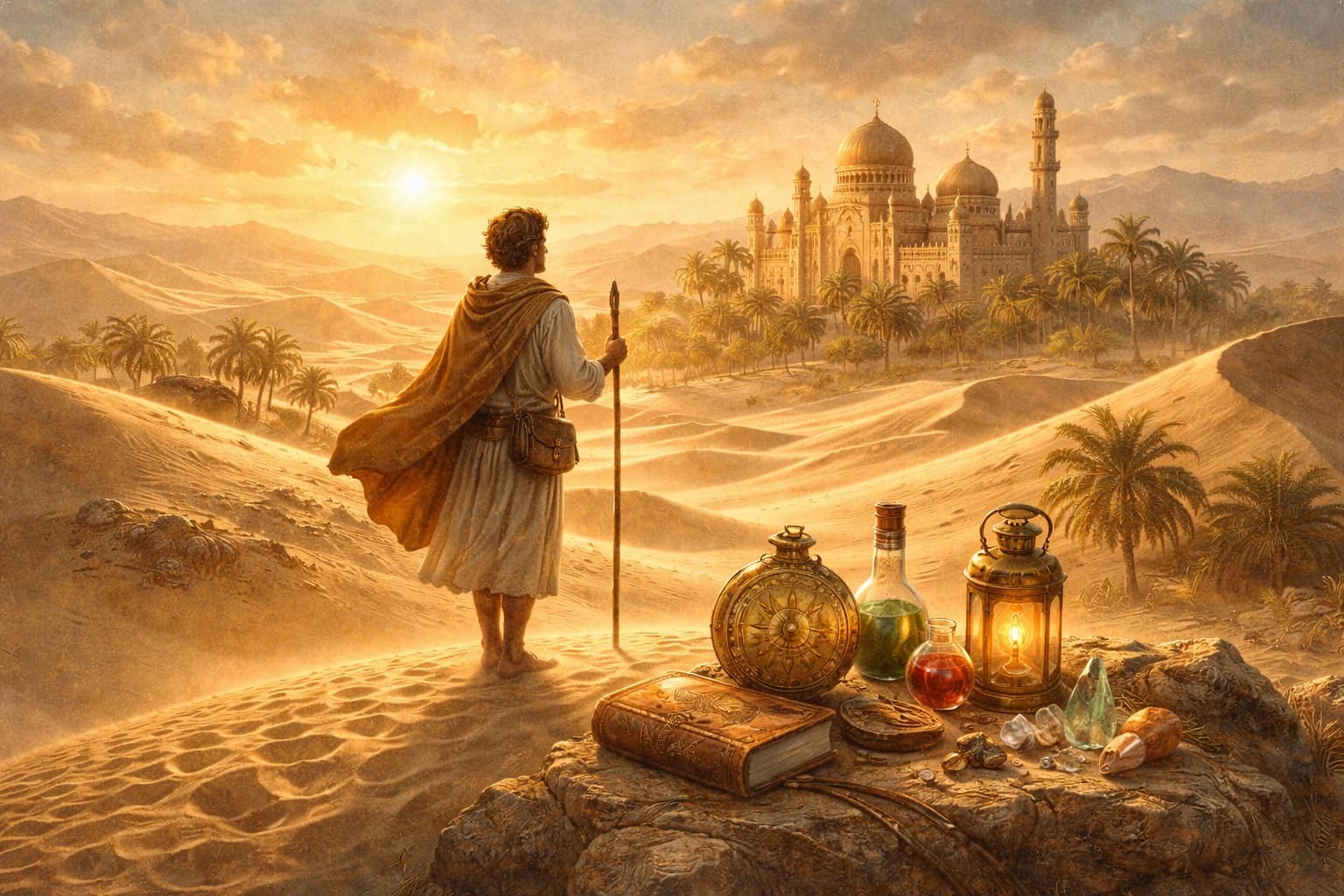
The Alchemist - Paulo Coelho
 Andres Aguilar
There's a book that has sold over 65 million copies worldwide. It's been translated into more than 80 languages. It's the best-selling book by any Latin American author in history. And yet, when Paulo Coelho finished writing it, his publisher dropped i...
Podcast Episode
There's a book that has sold over 65 million copies worldwide. It's been translated into more than 80 languages. It's the best-selling book by any Latin American author in history. And yet, when Paulo Coelho finished writing it, his publisher dropped it within a month of release. They told him it had no future. That nobody was going to read it. Coelho himself was on the verge of giving up. Today that book is called The Alchemist, and it's arguably the most influential novel of the last forty years. That alone should tell you something about what you're about to hear.
Today we're going to talk about what this story is about, why it had the impact it did, and what it contains that keeps resonating with so many people.
The man behind the book
Let's start by getting to know Paulo Coelho a little, because the novel and its author are almost inseparable. Coelho was born in Rio de Janeiro in 1947, into a middle-class family. He wanted to be a writer from childhood, but his family had him committed to a psychiatric institution at 17 because they considered him too peculiar, too much of a dreamer, too far removed from what was expected of a kid in his situation. He was committed three times. That gives you a sense of the intensity of what he lived through.
As a young man he got into the world of rock, wrote lyrics for Brazilian singers, traveled through South America and Europe, got involved with alternative spiritual groups, and led a life that was anything but linear. By the time he was in his forties, after a pilgrimage along the Camino de Santiago in Spain, he wrote his first important book, The Pilgrimage. That was in 1987. A year later, in 1988, he finished The Alchemist. He says he wrote it in just two weeks, because according to him the story was already inside him and just needed to come out.
The first Brazilian publisher to release it dropped it quickly. It sold 900 copies in the first year. Coelho convinced another publisher to take a chance on him, and from there a chain of events began that nobody could have predicted. The book started circulating hand to hand, crossing borders, reaching readers in languages Coelho didn't even know. Today it's a global phenomenon. And the story it tells is, at its core, fairly simple. That's part of its magic.
What the story is about
The Alchemist follows a boy named Santiago, an Andalusian shepherd…
The Alchemist follows a boy named Santiago, an Andalusian shepherd who has a recurring dream. In that dream, a child leads him to the Egyptian pyramids and tells him that's where he'll find a treasure. Santiago isn't a complicated or dark character. He's a young, curious boy who chose to become a shepherd because it gave him the freedom to travel and see the world. He has a quiet life, a girl he likes in a town in Andalusia, his flock, his routine. But that dream won't leave him alone.
The novel begins when Santiago decides to consult a gypsy woman in Tarifa to interpret his dream. She tells him it's a prophetic dream, that he needs to go to Egypt. Santiago laughs it off a little — he doesn't take it entirely seriously. But then, in a plaza, he meets a mysterious old man who introduces himself as the King of Salem. This character, Melchizedek, tells him something that will be central to the entire novel: that Santiago has a Personal Legend — a life mission, something he came into this world to fulfill. And that the universe conspires to help those who dare to follow it.
That idea — the Personal Legend — is the philosophical heart of the book. We'll come back to it, because it's worth spending some time on.
The thing is, Santiago, after that encounter, sells his flock, crosses the Strait of Gibraltar, and arrives in Tangier, Morocco. And here the book gives you a slap of reality: not long after arriving, he's robbed of everything. He's stranded in a country he doesn't know, with no money, unable to speak the language, with nothing. That could have been the end of the adventure. But it isn't.
Santiago finds work in a crystal shop whose owner — an Arab named Al-Fayoum — has spent years dreaming of going to Mecca but never takes the step. Santiago spends nearly a year there. He works hard, learns the language, saves money, and along the way transforms the crystal dealer's business with fresh ideas. That stretch of the novel is quieter, more everyday — but it carries real weight: it shows that the path toward your dreams isn't always epic, that it sometimes requires patience, effort, and learning.
When he finally has enough money to go back to Andalusia and buy more sheep than he had before, Santiago asks himself a question that defines the rest of the book: do I go back to the comfort of what I know, or do I keep going? He chooses to keep going.
The desert and the alchemist
From Morocco, Santiago joins a caravan crossing the Sahara toward Egypt…
From Morocco, Santiago joins a caravan crossing the Sahara toward Egypt. And here the novel shifts in tone. The desert is the book's great philosophical setting. Coelho uses the landscape to talk about silence, about inner listening, about the Soul of the World — another central concept. According to the book, everything in the universe is connected by a common language beyond words, and learning to read that language — the signs, the omens, the coincidences — is part of what it means to live with awareness.
In the caravan, Santiago meets Fatima, a woman of the desert with whom he falls in love. And here there's an important moment: when he tells her he wants to stay with her, that he no longer needs to keep traveling, Fatima says something beautiful and demanding at the same time. She tells him that if he stays out of love for her, he'll eventually grow to resent her. That true love doesn't chain you — it frees you. That she'll wait, because men of the desert always come back. Once again, Santiago chooses to keep going.
In the oasis, he also meets the alchemist. The alchemist is the most enigmatic character in the novel. He's an ancient, wise man who has lived for centuries, who can transform lead into gold, but who above all serves as a mirror for Santiago. He doesn't give him answers — he asks him questions. He doesn't teach him techniques — he teaches him to look. The alchemist accompanies Santiago on the final and most dangerous leg of the journey: crossing the territory of the warring tribes that control that part of the desert.
There's a scene where both are captured by a warrior tribe. The chief tells the alchemist he'll give them three days to escape, but if by then Santiago can't prove he's a wizard or a magician, they'll both be killed. And the alchemist tells Santiago: become the wind. Santiago has no idea how to do that. He panics, he meditates, he talks to the desert, he talks to the wind, he talks to the sun, he talks to what Coelho calls the Hand that wrote everything. And on the third day, he becomes the wind. A storm appears from nowhere, and the warriors are frozen in awe.
Santiago finds work in a crystal shop whose owner, an Arab named Al-Fayoum, has spent years dreaming of going to Mecca but never takes the step.
He works hard, learns the language, saves money, and along the way transforms the crystal dealer's business with fresh ideas.
It's the most fantastical, most symbolic scene in the book. Coelho doesn't present it as magic in the literal sense, but as the ultimate proof that when someone connects with the Soul of the World, they can do things that seem impossible.
The ending that changes everything
Santiago finally reaches the pyramids. He starts digging. He finds nothing. He collapses to the ground, exhausted, and that's when a group of thieves appears, beats him, and steals what little he has left. When the group's leader asks what he was looking for, Santiago — with nothing left to lose — tells him about the dream. The man laughs and says that he too had a recurring dream: that in Spain, in a ruined church where shepherds sleep, there was a treasure buried at the foot of a tree. But dreams are stupid, and he never went to look for it.
Santiago understands
Santiago understands. He goes back to Andalusia. He goes to the ruined church where he used to sleep with his flock. He digs at the foot of the old sycamore tree by the sacristy. And there it is. Gold coins, precious stones. Everything he searched for over years was at the starting point.
It's an ending that can be read in many ways — and that's where its power lies. It's not just a story about the journey as a metaphor. It's a story about how the real treasure is what we learn along the way. If Santiago had stayed in Andalusia and started digging from the beginning, he would have found nothing, because he wasn't ready to find it. He needed to travel the whole road, to live through all of it, before he could come back and recognize what had always been there.
The journey as a universal structure
Before diving into the ideas of the book, it's worth pausing on its structure for a moment, because it's not accidental. The Alchemist follows what narrative scholars call the hero's journey — a pattern that mythologist Joseph Campbell identified across myths and tales from completely different cultures throughout all of human history. The hero leaves his familiar world, faces a series of trials, meets guides and mentors, reaches a moment of supreme crisis, and returns transformed. You find it in Homer's Odyssey, in Indian mythology, in stories of the Buddha, in European fairy tales, in Star Wars.
Coelho didn't invent that structure. He recognized it and used it consciously. And that's part of why the story resonates across such different cultures: because it's tapping into a narrative pattern that human beings have had encoded for millennia. When we hear Santiago's story, something in us recognizes it before we rationally understand it.
There's another element Coelho handles with great skill: time. The novel has no dates. No concrete historical references. It could be taking place in the twelfth century or the twentieth. That makes it timeless by design. By stripping away specific historical anchors, Coelho turns the story into a personal myth — something each reader can project onto their own life.
The ideas that hold the book together
The Alchemist isn't just an adventure novel
The Alchemist isn't just an adventure novel. It's also a book of ideas. Coelho blends traditions from different cultures and eras to build a worldview steeped in universal spirituality. It's worth understanding the main concepts to appreciate what he's really saying.
The Personal Legend is the most important one. According to the book, every person is born with a particular mission — something they came into this life to do. As children we know it clearly, but the world gradually convinces us it's an illusion, that we need to be practical, reasonable, to settle. The book argues that the greatest fear human beings have isn't failure — it's fulfilling their Personal Legend, because that requires leaving behind what's familiar.
The Soul of the World is the idea that there's an intelligence connecting everything that exists, and that when someone is following their Personal Legend, that intelligence helps them, sends them signs, opens paths for them. Coelho draws on Hermetic and Gnostic traditions, but presents it in an accessible, almost poetic way.
The language of omens is the idea that the world is constantly speaking to us, and that learning to read those signals — a coincidence, a dream, an unexpected encounter — is a form of wisdom. Not as superstition, but as a deep attentiveness to what's happening around you.
And then there's alchemy itself, which functions as the central metaphor. Historical alchemy was the attempt to transform base metals into gold. In the book, alchemy is the transformation of the human soul: becoming something purer, more true, through the road and the experience.
Something not everyone knows
There's something about the history of this book worth mentioning. The alchemical tradition Coelho draws on is real. During the Middle Ages and the Renaissance, there was an entire current of thought — primarily in the Arab world and then in Europe — that sought not just to transform metals but to understand the ultimate nature of reality. Figures like Paracelsus, Hermes Trismegistus (a semi-mythical character), and even Isaac Newton — who spent more time studying alchemy than physics — were part of this world.
The title of the book is no accident
The title of the book is no accident. The alchemist is the guide, the teacher, but also a symbol: someone who found their Personal Legend centuries ago and is still living it. Newton, for example, wrote more pages on alchemy than on the laws of motion. Coelho takes that tradition and turns it into a contemporary, accessible, universal story.
Another curious detail: the book is dedicated to a Catalan man referred to only as J., whom Coelho met on the Camino de Santiago. That encounter was pivotal in his spiritual life. Some say that real person is the direct inspiration for the alchemist in the novel.
Why it hit so hard
It's a fair question. What does this book have that made it reach 65 million people from completely different cultures? There are several possible answers.
One is simplicity. Coelho writes clearly, without unnecessary ornamentation, without references that exclude. Anyone can read The Alchemist without needing a college degree. That accessibility democratized it.
Another is the message. In a world that constantly tells you to be practical, adjust your expectations, be realistic, a book that tells you your dreams are valid and the universe will help you fulfill them is an enormous relief for a lot of people. It doesn't matter whether you're in Tokyo, Lagos, or Buenos Aires — the fear that you're not living the life you want is universal.
There's also the historical timing. The Alchemist gained massive popularity in the nineties, when the English-language editions started circulating. It was an era of a crisis of meaning in the West, of spiritual searching, of exhaustion with the material promises of the twentieth century. The book arrived at exactly the right moment.
And then there are the stories it generated
And then there are the stories it generated. Bill Clinton was photographed holding a copy. Madonna talked about it in interviews. Paulo Coelho was invited to the World Economic Forum in Davos. That kind of word-of-mouth from influential figures amplified the phenomenon in a way we'd call viral today.
The criticism also existed
It would be dishonest not to mention it. Plenty of readers and critics pointed out that the book is too simple, its ideas too superficial, its narrative too schematic. There's a famous critique from Harold Bloom, one of the most influential literary critics of the twentieth century, who said Coelho was part of a tradition of writing that appeals to the reader's easiest emotions.
Those critiques exist and have their logic. The book is not Dostoevsky or García Márquez in terms of literary complexity. The characters are more archetypes than flesh-and-blood people. The language is at times almost aphoristic — very declaratory.
But maybe that's exactly what made it work. Not every book needs to be complex to be useful or meaningful. Some books change the way you think, and some books give you permission to feel something you were already feeling but weren't allowing yourself to say out loud. The Alchemist is, for many people, that second kind of book. And that's valuable too.
The legacy
The Alchemist opened a door in popular literature that hadn't previously existed in that form. It legitimized a kind of writing that blends fable, spirituality, and self-help without fully belonging to any of those genres. After Coelho, many authors followed that path. Books like Eckhart Tolle's The Power of Now, or Don Miguel Ruiz's The Four Agreements — which also became global phenomena — belong to a tradition that Coelho helped create.
In Argentina, the book holds a particular place
In Argentina, the book holds a particular place. Coelho has visited the country many times, has thousands of devoted readers, and his quotes circulate on social media with a frequency that shows the book is still an active cultural reference. It's not a book of its time — it's a book that each generation rediscovers.
For many people who read it when they were young, it was the first book that made them think big, the first one that challenged them to ask whether they were living the life they wanted to live. For a book under two hundred pages, that's quite something.
There's one more thing worth mentioning about the book's cultural impact: its relationship with contemporary spirituality. The Alchemist arrived at a moment when the West was searching for something that institutional religion was no longer providing to a lot of people — but that pure materialism wasn't providing either. The book offered a spirituality without dogma, without mandatory rituals, without institutions to mediate it. A personal, individual spirituality, connected to nature and to one's own destiny. That was enormously attractive to a generation that felt orphaned of meaning.
That space between organized religion and strict atheism is where millions of people live today. And The Alchemist inhabits that space with a comfort that few books have managed. It doesn't ask you to believe in any specific god. It asks you to trust that there's something larger than yourself, that the universe has a logic even if you don't understand it, and that your life has a meaning even if you haven't found it yet. For someone in that place of searching, that proposition is a lifeline.
Santiago's story doesn't end at the pyramids or with the treasure he finds. It ends with the last line of the book, when Coelho writes that he's going to find Fatima, because she was also part of his Personal Legend. The treasure was the key — not the final destination.
And that, at its core, is what the book wants to tell you: that the journey and the treasure aren't separate things. That the life you lived while searching for something is just as valuable as what you found. That the losses, the detours, the long stays in places that weren't your destination — all of it had meaning.
Maybe it's a simple idea. But there are simple ideas that need someone to say them out loud.
If the summary hooked you, the full book is worth reading
If the summary hooked you, the full book is worth reading. It's short — you can finish it in an afternoon — and there's something in its rhythm and language that can't fully be captured in a summary. We recommend reading it all the way through.
Related episodes

In this article we are going to see what it is about. Who was Chris Voss and why his story matters.

Hesse wrote this book with a razor blade on the table and the date of his own suicide marked on the calendar. What came out wasn't a farewell note but one of the strangest and most widely read novels of the twentieth century. Why does Steppenwolf keep ...

One night in crisis, a Cambridge student asked himself such a strange question that it changed his life: who is the one observing the one who suffers? What he found in answering that question became one of the bestselling spirituality books of the cent...