
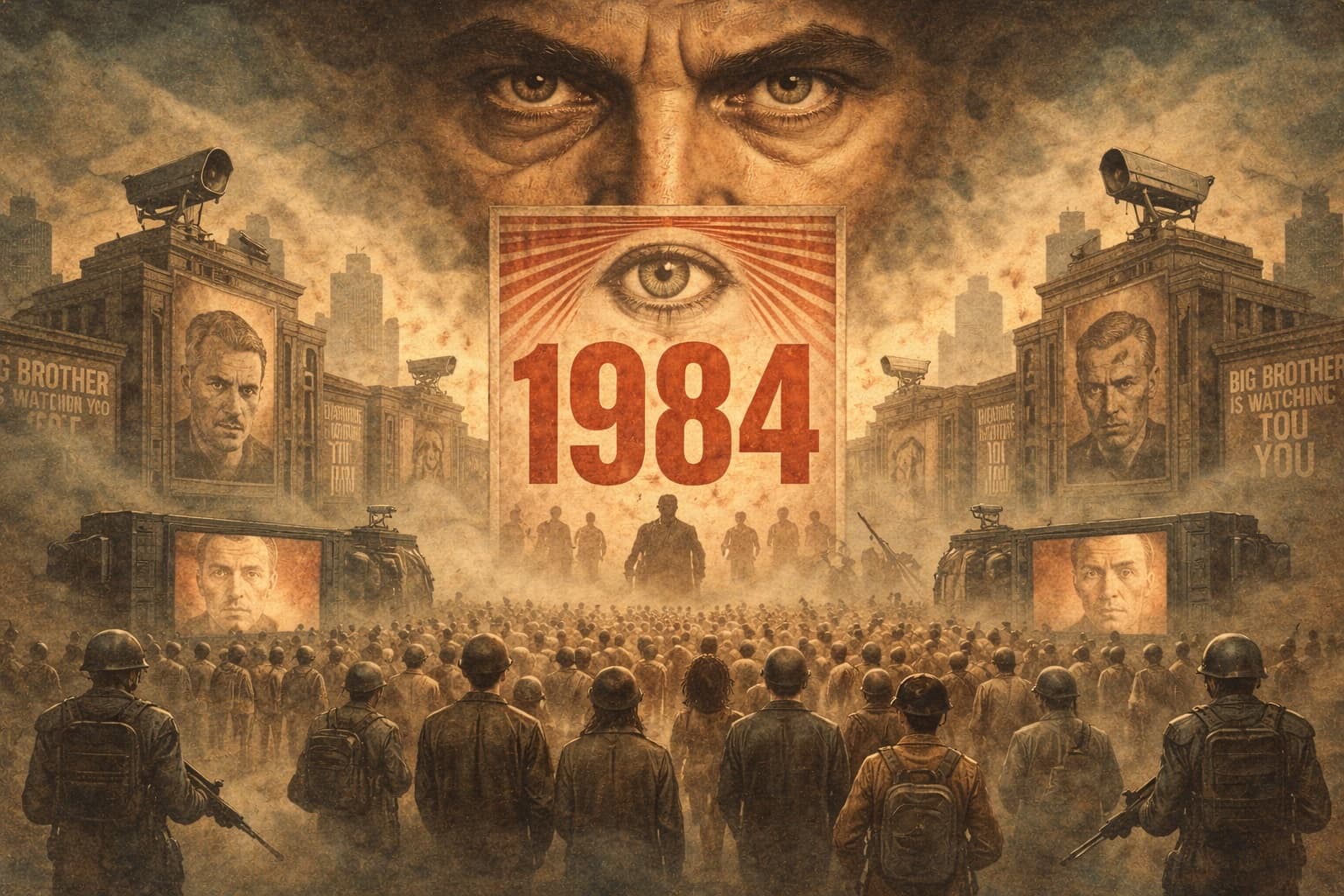
1984 - George Orwell
 Andres Aguilar
Big Brother. Room 101. Doublethink. Newspeak. In 1949, Orwell invented a vocabulary for totalitarianism so precise that we still use it to describe the present. He wrote it dying, on a Scottish island in the rain, knowing he probably wouldn't live to s...
Podcast Episode · ~20 minutes · Dystopia / Political Fiction
In 1948, a sick man — barely strong enough to write, locked away in a remote cottage on a Scottish island with relentless rain and bitter cold — finished what would become the most influential novel of the twentieth century. His name was Eric Arthur Blair, though we all know him by his pen name. And the novel he wrote, coughing through it and knowing he probably wouldn't live to see it published, is called 1984.
To understand what 1984 is, you have to understand a little about who Orwell was and the world he lived in. We're talking about someone who had fought in the Spanish Civil War on the Republican side, who was shot in the throat by a sniper, who saw with his own eyes how Stalinism betrayed the revolution it claimed to defend. He came back from Spain a changed man. He understood something that many people on the left took decades to see: that totalitarianism wasn't exclusively a problem of fascism. That power corrupts, regardless of what color flag it hides behind.
With all of that in his head — the Second World War still smoldering, Stalin's Soviet Union consolidating itself as a superpower, the early years of the Cold War dividing the world into two blocs — Orwell sat down to write what is essentially a warning. A cry. A novel that says: if we're not paying attention, this can happen.
The world of the book
The story takes place in a near future imagined from 1948: the year 1984. The world has split into three superstates that are in permanent war with each other, though none of them actually intends to win. The wars serve a different purpose — but we'll get to that. The territory where the story unfolds is Oceania, which essentially includes what is now Great Britain, the United States, and the English-speaking world. The capital is London, now under the control of the Party.
And the Party controls everything. Absolutely everything. There's no private economy, no private life, no private thoughts. There are cameras everywhere, called telescreens, that don't just broadcast propaganda around the clock — they also watch. Any gesture, any facial expression, any suspicious movement could mean the difference between staying alive and disappearing.
The Party has a leader — or the image of a leader — called Big Brother. His face is on every poster, every screen, every building. "Big Brother is watching you," the posters say. But nobody knows for certain whether Big Brother exists as a real person or is a construction, a symbol. What matters is that his image is everywhere.
The Party's slogan consists of three phrases that flatly contradict each other — and that's precisely the point: "War is Peace. Freedom is Slavery. Ignorance is Strength." If you read them and your brain starts spinning trying to make sense of them, you're reacting exactly the way Orwell intended.
Winston Smith
The protagonist is Winston Smith. A 39-year-old man, an employee of the Ministry of Truth, with a very particular job: rewriting the past. Literally. When the Party says something that later changes — when an alliance that was with one country becomes an alliance with another, when someone falls out of favor and has to be erased from the official record — Winston and his colleagues go into newspaper archives, speeches, documents, and change them. They erase people. They alter figures. They fabricate facts. The past is rewritten so it always aligns with the Party's current version.
The name "Ministry of Truth" is no accident. Orwell was obsessed with language as a tool of domination. The Ministry of Truth produces lies. The Ministry of Love, which is essentially a prison and torture center, produces terror. The Ministry of Plenty administers scarcity. Everything is named in reverse because in that world, words no longer describe reality — they construct it.
Winston lives under the constant pressure of acting as if he believes everything the Party says. Smile when you're supposed to smile. Hate when you're supposed to hate. Because there's something in the book called "thoughtcrime": even thinking something that contradicts Party doctrine is an offense. You don't have to do anything. Thinking wrong thoughts is already enough to deserve disappearance.
But Winston thinks wrong thoughts. He always has, though he's never told anyone. One day, for reasons he can't quite explain, he buys a blank diary at a black-market shop — an act that is already illegal — and starts writing. He doesn't write much at first. Just the date and a few words. And that small private act of putting his own words on paper is the beginning of his rebellion.
Julia and love as a political act
Shortly after starting the diary, Winston notices a woman who works in the same building. Her name is Julia. Young, a member of the Anti-Sex League — an organization of the Party that promotes chastity and hatred of physical pleasure, because individual pleasure creates loyalties that aren't directed toward the Party. At first Winston distrusts her, even fears her. He fantasizes about harming her. That's what the system breeds: paranoia and hostility between people.
But Julia slips him a note. A folded piece of paper that says, blunt and direct: "I love you."
Orwell was obsessed with language as a tool of domination.
The Ministry of Love, which is essentially a prison and torture center, produces terror.
And there begins a clandestine relationship that, in the context of that world, is a deeply political act. Not because Julia is an ideological revolutionary — in fact she's almost the opposite; she has no grand ideas about changing the system, she just wants to live her pleasures in peace. But the act of loving each other, of meeting in secret, of having an inner life the Party doesn't control — that's already subversion. Unregulated sex, genuine affection, intimacy: all of it is the enemy of total power, because total power requires that nothing matter more than the Party.
They meet in forgotten corners of the countryside, far from the telescreens. They find a rented room above an antique shop where there are no cameras — or so they believe. And in that room, which becomes a small refuge from the real world, they talk, eat food stolen from the black market, drink real coffee with real sugar, and for a little while they are people instead of cogs in the machine.
Orwell describes that room as if it were almost a dream: with its bed, its old objects, its window from which you can hear a woman in the courtyard below singing while she hangs laundry. That singing woman becomes a symbol throughout the book. She is the common people, the common humanity that is still alive and breathing even if it doesn't know it.
O'Brien and the trap
There's a third central character: O'Brien. A member of the Inner Party — the real elite of power — whom Winston has been watching for years with a mix of fascination and suspicion. There's something in O'Brien's face that Winston reads as a sign of secret intelligence, of someone who perhaps also thinks for himself and keeps quiet. A misreading — but an understandable one. When you're alone and convinced that everyone is your enemy, you tend to project allies into shadows.
O'Brien approaches Winston carefully, seduces him intellectually, convinces him that he's part of a resistance called the Brotherhood, a clandestine organization led by a certain Emmanuel Goldstein — the regime's number one public enemy. Goldstein is the Leon Trotsky of this universe: a figure who was once close to power, was cast out, and now represents everything the Party hates and blames. Every day there's a ritual called "the Two Minutes Hate" where citizens must face a screen, look at Goldstein's face, and express intense fury. A controlled, directed discharge of aggression.
O'Brien gives Winston a book. Supposedly Goldstein's forbidden book, which explains the true logic of the system. Winston devours it. And the book — which Orwell reproduces at length in the novel — is one of the most brilliant and disturbing passages, because it explains in almost systematic terms why modern dictatorships are different from those of the past. The old dictatorships fell because they wanted people to tolerate them. The Party doesn't need to be tolerated: it needs to be loved. And to achieve that, every anchor to objective reality must be destroyed.
Doublethink and the destruction of reality
Here comes one of the most original and chilling concepts in the book: "doublethink." The ability to hold two contradictory beliefs simultaneously and accept both as true. Knowing that something is a lie while at the same time genuinely believing it's true. Not as conscious hypocrisy, but as a genuine capacity of the brain trained by the system.
The Party's logic goes like this: if the past is controllable, if what happened can be changed to suit whoever holds power at any given moment, then there's nothing firm left to stand on when you say "this is true." Reality isn't something that exists outside of language and consensus — reality is whatever the Party says it is. And if tomorrow the Party says we were always allied with Eurasia and never with Eastasia, then we were always allied with Eurasia and never with Eastasia, even if you remember it differently. Your memory is wrong. And if you can't correct your memory, then something is wrong with you.
Language plays a central role in all of this. The Party is developing a new version of the English language called "Newspeak," whose stated goal is to simplify and reduce vocabulary. Not to make communication easier, but to make dissent unthinkable. If the word doesn't exist to describe a concept, the concept can't be thought. If the political vocabulary is reduced to a handful of approved categories, criticism of power becomes literally inconceivable. Words fall away one by one, like teeth falling from a living language.
A curious fact: Orwell invented so many terms in this book that several have made their way into everyday language. "Big Brother," "telescreen," "doublethink," "Newspeak" are words we use today without thinking about the fact that a sick man on a Scottish island invented them nearly eighty years ago. "Orwellian" has become an adjective in dozens of languages. And the title itself, 1984, is simply 1948 with the last two digits reversed — the year Orwell wrote the book.
The fall
Now comes the hardest part. Winston and Julia are captured. O'Brien turns out to be exactly what he should not be: a Party agent who has been watching and luring them for years. The room above the antique shop had a telescreen hidden behind a painting. The shop owner was a member of the Thought Police. The whole thing was a carefully woven trap.
They're taken to the Ministry of Love. And here the novel enters its most disturbing phase — the one that gives it its true weight as a warning. Because what Orwell describes isn't simply torture to extract information or to punish. What O'Brien explains to Winston, with absolute calm, is something different: the goal isn't for him to confess. The goal is for him to change. To genuinely, authentically, from the deepest part of his being, come to love Big Brother.
O'Brien says something to Winston that Winston cannot refute: that power for its own sake is the only honest answer. The regimes of the past claimed to serve something — God, the nation, the proletariat. The Party doesn't need that excuse. The Party exists to perpetuate itself. Power is not a means to an end. Power is the end. And the proof of that power is the ability to destroy not just a person's body but their mind, their memory, their identity.
Winston's torture proceeds in stages. First physical, brutal and direct. Then more subtle: the manipulation of his perception, making him doubt his own memories, making him question whether what he thinks happened actually happened. Winston tries to hold on by clinging to his love for Julia, to his conviction that there's something inside him the Party cannot touch. But there's a breaking point — and it comes at the end of the book, in the famous Room 101.
Room 101 is the place where each person is confronted with their deepest fear — the fear that can't be rationalized or psychologically survived. For Winston, who has an intense phobia, it's rats. O'Brien puts a cage full of rats, prepared to bite, right in front of his face. And in that moment, Winston does what no one can help but do: he begs for whatever is about to happen to him to happen to Julia instead. He betrays her. Not out of conviction, not out of ideology. Out of pure terror, out of the survival instinct.
And in that moment, the Party wins. Not because Winston says one thing or signs a paper. But because the most human bond he had left — his love for another person — was destroyed by his own betrayal. He has nothing left to defend. There is no longer a "him" separate from the system.
The ending
The book ends in a way that leaves a very particular feeling. Winston is released — or something resembling release. He lives, he continues in the world, but he's no longer the same. He sits in a bar, drinks cheap gin — the drink the Party distributes to the workers — and watches a telescreen reporting a great military victory. And Winston weeps. Not from sadness. He weeps because he finally did it: he loves Big Brother.
The last line of the book is exactly that: "He loved Big Brother." An ending with no hope. No redemption. No hero who escapes. The machine won completely.
And that — which can seem nihilistic or too bleak for some readers — is actually Orwell's most honest wager. Because he wasn't writing an adventure novel where good triumphs in the end. He was writing a warning. A "this can happen if we're not careful." And for the warning to work, for it to stay burned into you, the horror needed to be total.
The context and the legacy
Orwell finished the book in 1948 and died in January 1950, at age 46, from tuberculosis. He didn't live to see the impact his work would have. But the world he had imagined as a warning very quickly began to resemble the real world. The Cold War brought with it sealed blocs, systematic propaganda, state surveillance, secret files on citizens, lists of enemies. In the Soviet Union and the countries of the Eastern Bloc, people reading Orwell in clandestine copies felt that the book was describing their lives.
But the book doesn't endure because it only describes those regimes. It endures — or rather, remains urgently relevant — because it describes mechanisms. The manipulation of language, the rewriting of the past, the creation of external enemies to maintain internal cohesion, surveillance as a form of social control: these mechanisms aren't exclusive to any particular political system. We find them in different forms and different intensities across many contexts.
With the rise of the internet and then social media, the conversation about Orwell came roaring back. Because if someone had described in the 1940s a world where people voluntarily carry devices that record their location, their conversations, their preferences, their contacts — and where that data is stored and analyzed by large organizations — Orwell could have put his name on it. The Big Brother of the book was imposed by force. Ours, to a large extent, is welcomed. And in some ways, that's even more disturbing.
We're not saying we live in the world of 1984. That would be an overstatement and an unfair one. But the questions the book raises — who controls the narrative of what happened, who defines the words we use to think, how much of our private life actually exists outside some record — are very concrete and very contemporary questions. And that's what makes a book a classic: not that it has definitive answers, but that it asks the right questions.
It's worth noting that 1984 is inseparable from Orwell's other great dystopia, Animal Farm, published in 1945. That's the shorter, more allegorical version: a farm where the animals rebel against the human farmer and end up reproducing exactly the system they overthrew, with pigs who gradually come to resemble their former oppressors more and more. Together, the two books form a coherent vision of power: how it's seized, how it corrupts, how it perpetuates itself.
As for the book's reception: it was an immediate success. It sold out within weeks. And it has never gone out of print. Every time some country's government starts to smell like authoritarianism, sales of 1984 spike. It happened in the United States in 2017. It's happened in various European countries at different moments. The book functions like a detector: when people start buying it in large numbers in a society, it's a sign that something in the air is reminding them of the book.
There are film adaptations, stage adaptations, operas, even video games that borrowed its aesthetic and ideas. The series Black Mirror is a direct descendant of Orwell, updated for the contemporary technological world. And the name "Big Brother" was taken — perhaps ironically, perhaps not — for a global reality TV format where people live under constant camera surveillance. The creator of the format said he chose the name consciously. There's something deeply strange about taking the symbol of totalitarian surveillance and turning it into voluntary entertainment.
Why it matters to read it today
1984 is not an easy book. Parts of it are slow; there are long stretches of political text within the text that can feel heavy. And the ending gives you no relief. But it's one of those books that changes the way you look at the world. Not because it gives you answers, but because it trains you to ask questions you weren't asking before.
After reading it, you start paying attention to the words used to describe things. To who benefits from each version of the past. To what happens when facts are replaced by "narratives." To what it means that someone or something can observe you even when you're doing nothing wrong. These questions are uncomfortable — but they're exactly the kind of questions a democracy needs its citizens to ask, constantly.
Orwell wrote it sick, alone, convinced that it needed to be said even if nobody wanted to hear it. That totalitarianism wasn't something that happened to "other people," in distant countries with strange cultures. That it was a possibility written into the nature of power when nothing limits it. And that the only real defense was clarity. Calling things what they are. Remembering what actually happened. Keeping alive the ability to think for yourself, even when everything pushes in the opposite direction.
That's 1984. A book written nearly eighty years ago that remains completely necessary.
Related episodes

In this article we are going to see what it is about. Who was Chris Voss and why his story matters.
Hesse wrote this book with a razor blade on the table and the date of his own suicide marked on the calendar. What came out wasn't a farewell note but one of the strangest and most widely read novels of the twentieth century. Why does Steppenwolf keep ...

One night in crisis, a Cambridge student asked himself such a strange question that it changed his life: who is the one observing the one who suffers? What he found in answering that question became one of the bestselling spirituality books of the cent...