
Freakonomics - Steven Levitt and Stephen Dubner
 Andres Aguilar
In the 1990s, every prediction pointed toward the same disaster: the United States was heading straight into an unprecedented crime wave. Experts, politicians, criminologists — everyone agreed. Violent youth was going to tear American cities apart. The...
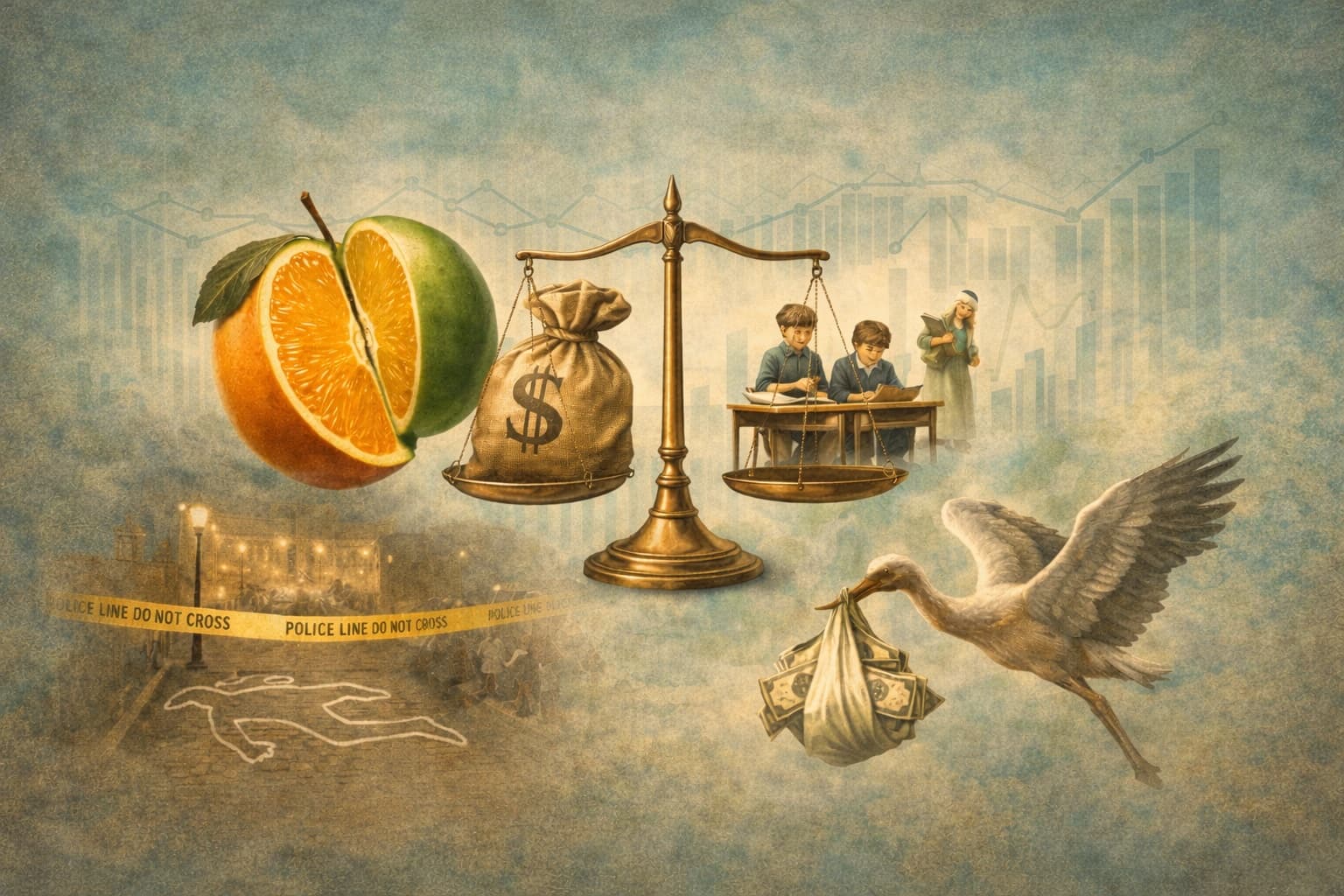
In the 1990s, every prediction pointed toward the same disaster: the United States was heading straight into an unprecedented crime wave. Experts, politicians, criminologists — everyone agreed. Violent youth was going to tear American cities apart. There were mathematical models, projections, studies. Everything pointed to the worst being just around the corner. And then something completely unexpected happened: crime started dropping off a cliff. Not a little. A lot. And nobody could figure out why.
This is exactly the kind of mystery that fascinates Steven Levitt, an economist at the University of Chicago who decided to use the tools of his discipline to study things that, on the surface, have nothing to do with economics. Together with journalist Stephen Dubner, Levitt wrote Freakonomics in 2005 — a book that became a global phenomenon because it basically turns your worldview upside down and makes you question everything you thought you knew about how the world works.
The central premise of the book is simple but powerful: economics, at its core, is the study of incentives. How people respond to rewards and punishments, to carrots and sticks. And if you understand incentives, you can start to understand behaviors that seem inexplicable. Even better, you can discover that many things that seem unrelated are actually connected in surprising ways.
Back to that crime drop nobody saw coming. When the statistics started showing that violent crime was falling dramatically in the nineties, everyone came out with their theories. Some said it was the new policing strategies, like New York's famous "zero tolerance" policy. Others pointed to the growing economy. Some mentioned the aging population, new gun laws, or even the shift in the crack market that had devastated poor neighborhoods in the eighties.
Levitt looked at all of this and did what he does best: analyzed the data with cold, ruthless logic. And he found something nobody had considered: the connection traced back to a Supreme Court decision made twenty-two years earlier. In 1973, Roe v. Wade legalized abortion in the United States. And this, according to Levitt's analysis, was the single most significant factor in the crime drop two decades later.
The logic is brutal but hard to argue with: the women most likely to seek an abortion were those in extreme poverty, with addiction problems, in violent relationships, or simply too young or without the resources to raise a child. The children who were not born would have grown up, in many cases, in environments where the probability of ending up involved in criminal activity was high. Not because there's anything inherently wrong with being unwanted, but because the conditions of extreme poverty, lack of parental supervision, and all the factors associated with those unwanted pregnancies are, in turn, strong predictors of future criminal behavior.
When this research came out, it landed like a bomb…
When this research came out, it landed like a bomb in the public debate. People were outraged — from the left and from the right. Nobody wanted to touch this topic because it's uncomfortable, politically dangerous, and raises complicated moral questions. But for Levitt, that's precisely the point: economics doesn't make moral judgments. It measures correlations, looks for causes and effects, analyzes data. And the data showed this.
What's fascinating about the Freakonomics approach is that it doesn't tell you what to think about abortion. It doesn't tell you whether legalizing it was right or wrong. It shows you a connection that exists, explains why it makes sense, and then lets you do whatever you want with that information. And this is a through-line in the entire book: separating morality from empirical analysis.
Now, if you think the abortion-and-crime topic is controversial, wait until you see what comes next. Because Levitt also dug into something everyone hates but almost nobody really understands: cheating. Systematic fraud. And he found it's far more widespread than we think — even in places you'd never suspect.
He took the case of teachers in Chicago's public schools. In the nineties, Chicago implemented a high-stakes testing system: if students didn't hit certain scores on standardized tests, the school could be shut down and teachers fired. Suddenly there were enormous incentives for those scores to go up. And they went up. A lot. Too much, in some schools.
Levitt developed an algorithm to detect suspicious patterns in test answers. He looked for classrooms with improbably identical answer blocks, or where students got hard questions right but missed easy ones. What he found was clear evidence that some teachers were altering their students' answers. Not all of them, not even most — but a significant percentage.
And what does this have to do with economics? Everything. Change the incentives, change the behavior. You told a teacher that their job, their livelihood, their entire career depended on their students scoring well on a test — and some decided the easiest way to make that happen wasn't to teach better, but to cheat. It's not that these teachers were inherently dishonest people. It's that you gave them an incentive so powerful that some of them crossed the line.
And this brings us to another, even more exotic example: sumo wrestlers in Japan. Sumo is a sacred sport with hundreds of years of tradition, full of rituals and honor. But Levitt found a strange statistical pattern: in tournaments, when a wrestler needed one more win to preserve his ranking and faced an opponent who had already secured his, he won with suspiciously high frequency. Much more often than his past record would suggest.
The explanation is fascinating
The explanation is fascinating. In sumo, falling below a certain ranking means losing privileges, money, prestige. It's devastating. So in that crucial final bout, there's an enormous incentive for the wrestler who needs the win, and very little at stake for his opponent. And the sumo community is small and tight-knit. Everyone knows each other. They face each other again and again. So implicit arrangements start to emerge: today you let me win because I desperately need it, and the next time I'm in good shape and you need a win, I'll return the favor.
Levitt found evidence of this in the data: when those same wrestlers faced each other in the following tournament, the one who had "won" previously lost with much higher frequency than normal. It was as if they were settling accounts. And the most incredible part is that this was happening in one of the most revered and traditionally honorable sports in the world. But incentives are stronger than tradition.
The book also explores the drug trade from an angle you'd never expect. Levitt got access to the financial records of a gang selling crack in Chicago. You read that right — financial records. Turns out this gang kept books like any business: income, expenses, salaries, everything written down. And what they showed was a fascinating — and brutal — corporate structure.
Levitt developed an algorithm to detect suspicious patterns in test answers.
He looked for classrooms with improbably identical answer blocks, or where students got hard questions right but missed easy ones.
Most of the street-level drug dealers — the ones on the front lines — were earning less than minimum wage. They lived with their mothers because they couldn't afford rent. They had regular jobs in addition to selling drugs. So why did they do it? For the same reason thousands of kids audition to be actors in Hollywood or try to become professional athletes: because there's a chance — however slim — of making it to the top. The leaders of these organizations were making fortunes. They were running the equivalent of several million dollars a year.
It's the tournament economy model: a system where most people earn little or nothing, but the ones who reach the top take everything. Like soccer, like the film industry, like many entertainment industries. And this explains why so many young men were willing to stand on street corners, risking their lives, for a pittance. Because they were betting on making it to the top someday.
It also explains why the drug business is so violent. It's not just the illegality, which obviously plays a huge role. It's that in a tournament economy, competition is fierce. You can't go to court if someone steals your territory or doesn't pay you. So violence becomes the tool for settling disputes and maintaining order. It's a brutal economy — but it's an economy.
One of the most entertaining chapters in the book is about real estate agents and how they're basically not working for you when you sell your house. That sounds harsh, but Levitt has the numbers. When a real estate agent sells their own home, they keep it on the market an average of ten days longer than when they sell yours, and they get a price about three percent higher. Doesn't sound like much, but on a $300,000 house, that's nearly $10,000.
Why does this happen?
Why does this happen? Again, incentives. When the agent sells your house, they earn a typical commission of three percent. So if they get you $10,000 more, their commission only goes up by $300. That's not worth the extra effort of waiting around, turning down low offers, continuing to market the place. But when it's their own house, those $10,000 go straight into their pocket. Then it's worth the wait.
The book makes you see that information is power, and that experts have an incentive to keep that information as a secret only they control. Real estate agents, auto mechanics, doctors — they all have information you don't, and that gives them an advantage. It doesn't mean they're all dishonest, but the incentive to exploit that information asymmetry is definitely there.
There's an entire chapter dedicated to names and what they say about us. Levitt studied decades of birth records in California and found fascinating patterns. The names chosen by upper-class parents eventually migrate down the socioeconomic ladder. A name that sounds elegant and aspirational today will be common across all social strata in twenty years. And by then, upper-class parents will have already moved on to different names.
This doesn't mean guns aren't dangerous
This doesn't mean guns aren't dangerous. They are. But it does mean that our perceptions of risk are completely distorted. We worry about things that are statistically rare while ignoring far more common and deadly dangers. And this affects all kinds of public and private decisions.
The book also goes deeper on why street-level drug dealers still live with their mothers — something we touched on earlier, but worth unpacking. The popular image of the wealthy drug dealer with gold chains and fancy cars is the exception, not the rule. That's the CEO of the organization, not the front-line employee. And this holds true in almost every tournament economy.
Levitt compares it to rock and roll. For every Mick Jagger who becomes a millionaire, there are a thousand musicians playing in bars for tips, waiting tables during the day, living with five roommates in a tiny apartment. But they all keep trying because they've seen that it's possible to make it. The visibility of the winners makes the game look more attractive than it actually is for the average person.
Another fascinating section explores how criminal organizations work, using the Ku Klux Klan as a case study. Levitt describes how Stetson Kennedy, a civil rights activist, infiltrated the Klan in the 1940s and then revealed all their secrets — their passwords, their rituals — on the radio show The Adventures of Superman. Superman literally fought the KKK on the radio using real information Kennedy had gathered.
By exposing all those secrets, Kennedy destroyed the Klan's power. It turned out that much of their influence came from mystery, from fear of the unknown, from the secret rituals that made them seem more powerful and organized than they actually were. Once all those secrets became public and were made to look ridiculous, the Klan lost its appeal. Information was their power, and once they lost it, they crumbled.
This connects to a central theme of the book: information matters enormously. And those who control information hold disproportionate power. Experts, professionals, those with access to data you don't have — they can use that asymmetry to their advantage. They don't always do it, but the incentive is there. And one of the best defenses against this is making information more transparent and accessible.
The book also tackles parenting, debunking a lot of popular beliefs. Levitt analyzes massive datasets of educational outcomes and finds that many of the things we believe matter for kids' success don't actually have as much impact as we think. Reading to your child before bed, for example, shows a correlation with better school outcomes, but it's probably not causal. Parents who read to their kids tend to be more educated, better resourced, and to value education in general. It's that whole package that matters, not the specific act of reading before bed.
What does matter, it turns out, includes: whether parents are educated…
What does matter, it turns out, includes: whether parents are educated, whether they have higher incomes, whether the mother waited until her thirties to have her first child, and whether the child had a low birth weight (that one is a strong negative predictor). These are things that speak more to who you are as a parent than what you specifically do as a parent.
This frustrates a lot of parents because it implies there's less control than we'd like. You can't just buy the right books or enroll your kid in the right activities and guarantee success. What matters most are structural characteristics of your family and life that are hard to change. But the upside is that it also means you don't need to stress out over every small parenting decision.
Throughout Freakonomics, there's a recurring theme: the world is far more complicated and strange than it appears on the surface. Conventional explanations are often wrong. Experts frequently don't know more than you do — they just know how to sound convincing. And if you really want to understand how something works, you have to look at the incentives, follow the data, and be willing to land on uncomfortable conclusions.
Levitt's style is brutally empirical. He doesn't care if a conclusion is politically incorrect or morally complicated. He cares whether the data backs it up. And this has generated controversy, especially around the abortion-and-crime argument. But it has also inspired an entire generation of economists and social scientists to apply rigorous methods to weird and fascinating questions.
One of the more subtle but important points in the book is about the difference between correlation and causation. Levitt is careful to separate the two, though the line sometimes gets blurry. With the abortion-and-crime argument, the correlation is clear. But proving causation is harder. Levitt presents several arguments that strengthen the causal case: the effect was more pronounced in states that legalized abortion earlier, the timing lines up perfectly, and other factors don't explain the magnitude of the change. But he acknowledges that proving definitive causation in social science is nearly impossible.
The book also explores the concept of conventional wisdom and how often it's completely wrong. Conventional wisdom is comfortable. It tells us what we want to hear, reinforces our prejudices, and makes the world seem simpler and more predictable than it really is. But Levitt shows that if you truly want to understand something, you have to be willing to question the conventional wisdom, even when doing so makes you uncomfortable.
For example, the conventional wisdom said that crack would permanently destroy America, that it would create an unstoppable criminal class. It didn't. The conventional wisdom says that distinctively African-American names hurt those children. The data doesn't show that. The conventional wisdom says more police means less crime. The data shows that's true, but that other factors — like legalized abortion — had a much larger impact.
Toward the end, the book discusses the concept of natural experiments…
Toward the end, the book discusses the concept of natural experiments. As a social scientist, you can't put people in laboratories and run controlled experiments like you can in physics or chemistry. But sometimes the world creates natural experiments for you. The legalization of abortion at different times in different states is a natural experiment that lets you compare outcomes. The ranking system in sumo creates experimental situations that reveal behavior. The implementation of high-stakes testing in Chicago lets you see what happens when you dramatically change the incentives.
Levitt is a master at finding these natural experiments and exploiting them to answer questions that seemed impossible to answer. And that may be the book's biggest lesson: questions that seem philosophical or moral or simply impossible to resolve empirically can actually be studied rigorously if you find the right data and ask the right questions.
Freakonomics had an enormous impact. The book sold millions of copies, inspired sequels, a blog, a podcast, even a film. But more importantly, it changed the way a lot of people think about the world. It popularized the idea that economics isn't just about money and markets — it's about how people respond to incentives in every area of life.
It also democratized a certain kind of analytical thinking. Before, this kind of sophisticated data analysis was the exclusive domain of academics. Freakonomics made it accessible and entertaining. It showed that you can apply rigorous economic logic to questions about baby names, cheating in sumo, or why drug dealers live with their mothers — and get genuinely fascinating insights.
The book's legacy also includes some controversy. Levitt's methods have been challenged by other economists. The abortion-and-crime theory in particular has been the subject of intense academic debate. Some studies have refuted it, others have reinforced it. And that's part of the normal scientific process. What matters is that Freakonomics opened the door to these conversations, got people paying attention to questions that nobody had previously considered worthy of serious study.
At its core, Freakonomics is a book about thinking differently. It's about not accepting easy explanations, about looking at data instead of trusting your gut, about recognizing that the world is weird and complicated and fascinating. It's about understanding that people respond to incentives — sometimes in predictable ways, sometimes in surprising ways, but always in ways that can be studied and understood if you ask the right questions.
The book teaches you to be skeptical, but not cynical. To question, with the goal of understanding better — not just tearing down beliefs. And it reminds you that often the best answers to important questions don't come from elegant theories or deep philosophies, but from looking carefully at the data and letting it tell its story.
In a world increasingly flooded with information, opinions, and…
In a world increasingly flooded with information, opinions, and conventional wisdom that turns out not to be so wise, the Freakonomics approach is more relevant than ever. It reminds us that we have the tools to separate truth from fiction, to understand real causes rather than just see superficial correlations, and to ask better questions about how the world actually works.
If there's one thing you take away from this book, it's that almost nothing is what it seems at first glance. The most interesting explanations are usually hidden under layers of unexamined assumptions. And if you're willing to look beyond the obvious, follow the data wherever it leads, and accept uncomfortable answers when they appear, you'll understand the world in a far deeper and more accurate way. And that, in the end, is what makes freaky economics so valuable.
Final note: This summary barely scratches the surface of everything Freakonomics has to offer. The book is packed with fascinating details, additional anecdotes, and more nuanced arguments than we were able to cover here. If this summary got you hooked, the full book is absolutely worth your time. Levitt and Dubner write in an engaging, accessible way, and there's much more to discover in the original pages.
Related episodes

In this article we are going to see what it is about. Who was Chris Voss and why his story matters.

Hesse wrote this book with a razor blade on the table and the date of his own suicide marked on the calendar. What came out wasn't a farewell note but one of the strangest and most widely read novels of the twentieth century. Why does Steppenwolf keep ...

One night in crisis, a Cambridge student asked himself such a strange question that it changed his life: who is the one observing the one who suffers? What he found in answering that question became one of the bestselling spirituality books of the cent...