
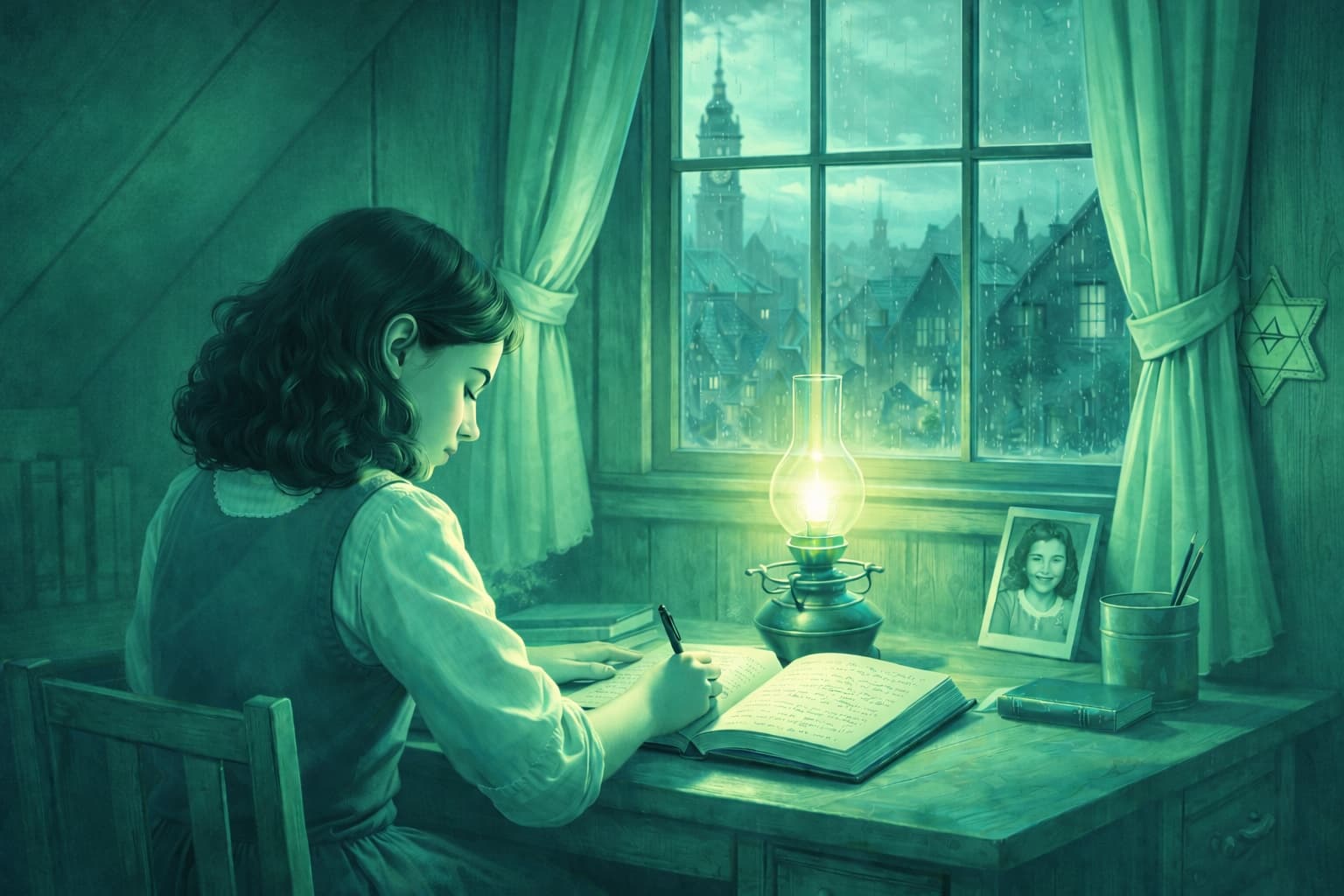
The Diary of a Young Girl - Anne Frank
 Andres Aguilar
A thirteen-year-old girl gets a diary for her birthday. The first thing she does is give it a name: she calls it Kitty. And over the next two years, locked away in a hiding place with seven other people, she's going to tell it everything. Absolutely ev...
A Girl, a Diary, a Name: Kitty
A thirteen-year-old girl gets a diary for her birthday. The first thing she does is give it a name: she calls it Kitty. And over the next two years, locked away in a hiding place with seven other people, she's going to tell it everything. Absolutely everything. Her fears, her fights, her first romantic feelings, her dreams of becoming a writer. She never imagined that diary would become one of the most important testimonies of the twentieth century. She also never imagined she wouldn't live to see it published.
The Diary of a Young Girl is not a history book. It's the voice of a teenager trying to hold herself together while the world falls apart outside. And that's exactly what makes it so powerful.
An Ordinary Family in Extraordinary Times
Anne Frank was born in Frankfurt, Germany, in 1929. Her family was Jewish, middle-class, pretty normal. Her father, Otto Frank, had been an officer in the German army during World War I. Her mother, Edith, was a homemaker. Anne had an older sister, Margot, three years older than her. For a while, they were a regular family living a regular life. But in 1933, when Anne was four years old, Hitler came to power. And suddenly, being Jewish in Germany stopped being ordinary and became dangerous.
Otto Frank saw what was coming. He didn't wait for things to get worse. In 1933, as soon as Hitler took office, he was already planning to get his family out of Germany. They moved to Amsterdam, in the Netherlands. Otto set up a business selling pectin, an ingredient used to make jam. The family settled in, the girls started school, they learned Dutch. For a while, it seemed like they'd made it out. Anne grew up like any Dutch girl: she had friends, went to the movies, loved to ice skate. She was vivacious, outgoing, loved being the center of attention. Her teachers described her as a chatterbox and a handful, but brilliant.
The Nazi Occupation Reaches Amsterdam
But Hitler didn't stay in Germany. In May 1940, the Nazis invaded the Netherlands. Within days, the country fell. And all the antisemitic laws the Franks had left behind in Germany caught up with them in Amsterdam. First came the minor restrictions: they couldn't go to certain places, they had to wear a yellow star on their clothes to identify themselves as Jewish. Then came the more serious ones: they couldn't run businesses, Jewish children had to attend separate schools, there was a curfew. Life kept getting harder, narrower, more dangerous.
By 1942, the Nazis were deporting Jews from the Netherlands to concentration camps in the East. Families disappeared overnight. Everyone knew that once you got on those trains, you didn't come back. Otto Frank had been preparing for this. For months, he had been setting up a secret hiding place in the building where his offices were located: an annex at the back, hidden behind a hinged bookcase. Nobody walking into the offices could have imagined there were entire rooms hidden back there.
The Escape and the Hiding Place
On July 6, 1942, a summons arrived. A letter from the German government ordering Margot to report for deportation. Margot was sixteen years old. That same night, the whole family packed their bags and left. They couldn't take much — only what fit in their bags, nothing that might look suspicious. The next day, in the middle of summer, Anne walked out of her house wearing several layers of clothing, one on top of another, because she couldn't carry a big suitcase through the street without drawing attention. She left behind her home, her room, her entire life. She was thirteen years old.
The hiding place was small. Very small for eight people. Besides the Franks, there was another family: Mr. van Pels, who had worked with Otto, his wife, and their son Peter, who was fifteen. Later they were joined by Fritz Pfeffer, a dentist and family friend. Eight people living in rooms that barely added up to about 540 square feet. The windows had permanently closed blackout curtains. They couldn't make noise during the day because the offices were operating downstairs with employees who knew nothing about the hiding place. They couldn't flush the toilet, couldn't walk around in shoes, had to whisper. Two years. Every single day. Never going outside.
The Diary: A Teenage Voice in the Middle of Horror
Anne describes all of this in her diary. And that's the genius of this book: Anne doesn't write like a victim. She doesn't wallow in self-pity or lean into the drama. She writes like a teenager, because that's what she was. She complains about her mother, like any thirteen-year-old girl. She says her mother doesn't understand her, that she's always comparing her to Margot, that Margot is the perfect one and she's the problem child. She fights with Mrs. van Pels over little things. She mentions that Pfeffer snores and it drives her crazy. She describes how everyone has habits that get on her nerves when you're crammed into such a tiny space.
But she also writes about beautiful things. She falls for Peter van Pels. At first she thought he was a shy, boring kid. But after months of living together, they start talking more, spending time together up in the attic. Anne writes about the first kiss, about the long conversations, about how meaningful it is to have someone to share what she's feeling. It's a strange and beautiful experience reading this: you're reading about a girl falling in love, with all the excitement and intensity of a first romance, but you know the context. You know they're in hiding, you know what's waiting for them. And yet she lets herself feel all of it. She lets herself be happy in the middle of the horror.
Dreams, Hope, and Inner Growth
Anne also writes about her dreams. She wants to be a writer or journalist after the war. She follows the news about the Allied landing, about the advances against the Nazis, and it fills her with hope. She thinks about everything she's going to do when they leave the hiding place. She'll go back to school, she'll have friends again, she'll be able to walk down the street without fear. She rewrites parts of her diary thinking about publishing it someday. She has ambition, talent, the drive to build something.
What's most striking about the diary is how Anne grows. At the start she's a pretty typical thirteen-year-old girl: moody, dramatic, wrapped up in superficial concerns. But over those two years in the annex, she matures in a remarkable way. She starts reflecting on deeper things: the war, human nature, why there's so much hatred in the world. There's a passage where she writes that, despite everything, she still believes that people are basically good at heart. She writes this as a girl in hiding because she's Jewish, knowing that outside there are people who want to kill her for how she was born — and she still finds a way to hold on to her faith in humanity. It's heartbreaking and beautiful at the same time.
She also writes about her body, about menstruation, about the changes of adolescence. That was a very uncommon topic in the 1940s, but Anne writes about it anyway, because she's writing to Kitty, her diary, her confidante. She has no one else to talk to about these things. Her mother isn't someone she's close to, Margot is more reserved. The diary becomes her best friend, the only place where she can be completely honest.
Daily Tension and the Silent Heroes
Life in the secret annex wasn't just monotony and confinement. There was also constant tension. The Allies were bombing Amsterdam regularly, trying to destroy Nazi installations. Anne writes about nights when the walls shook, when they heard explosions, when nobody knew if the next bomb would fall on them. Every strange sound could be the Gestapo. Every time someone knocked in the offices downstairs, everyone in the annex froze, holding their breath, waiting.
The people helping them were quiet heroes. Miep Gies and other employees of Otto Frank risked their lives every day bringing them food, books, news from the outside world. If they were caught helping hidden Jews, the Nazis would deport them too. But they did it anyway. For more than two years, they kept up that lie. When Anne writes about them in her diary, she does so with enormous gratitude.
Confinement, Introspection, and Maturity
There's something particularly moving about how Anne deals with boredom. She can't go outside, can't go to school, can't see anyone from the outside world. But she finds ways to keep herself busy. She reads constantly. She studies shorthand and various subjects on her own. She writes short stories, starts a novel. She gives herself a haircut and it turns out badly, then writes about it. She laughs at herself. In the middle of everything, she finds moments of lightness.
Anne is also very hard on herself in the diary. She constantly analyzes herself, questions herself, asks whether she's being a good person, whether she's being fair to others. She acknowledges when she's been unkind to her mother. She recognizes her own contradictions. This shows a remarkable level of self-awareness and emotional maturity. But it also shows what the confinement was doing to her: there was no escape from her own thoughts. She couldn't go outside to clear her head, to get distracted. Everything happened inside her mind and those four walls.
The relationship between Anne and her father was special. Otto was the backbone of the family, the one who kept calm, the one who resolved conflicts between the annex's residents. Anne adored him and describes him as the only one who truly understood her. But even with him there's tension sometimes, especially when Otto disapproves of the closeness between Anne and Peter. Otto thought they were too young, that they were mistaking forced proximity for real love. Anne gets angry, feels betrayed. It's a completely normal dynamic between a father and his teenage daughter — except it's happening in the most abnormal situation imaginable.
The Arrest
In the summer of 1944, things seemed to be improving. The Allies had landed in Normandy and were advancing through Europe. Liberation seemed close. Anne and the others listened to the radio every night, tracking the progress of the Allied troops. Hope was growing. They just had to hold on a little longer.
On August 4, 1944, at ten-thirty in the morning, the Gestapo arrived. Someone had tipped them off. It was never determined with certainty who. The German police, along with Dutch collaborators, burst into the offices. They knew exactly where to look. They went straight to the bookcase hiding the entrance to the annex. They moved it. They went up.
They arrested everyone: all eight residents of the annex and two of the helpers who were there at the time. They were loaded into trucks. They were taken to prison. And from there they were deported. First to Westerbork, a transit camp in the Netherlands. Then, on a packed train, they were sent to Auschwitz, in Poland.
The Concentration Camps
Anne Frank arrived at Auschwitz in September 1944. She was fifteen years old. She was immediately separated from her father. Men were sent to one side, women to the other. Anne never saw Otto again. She stayed with her mother and Margot. All three survived the initial selection, where the Nazis decided who could work and who went straight to the gas chambers. But surviving the selection only meant a slower death.
The conditions at Auschwitz were inhumane: overcrowding, starvation, disease, forced labor. Edith, Anne's mother, died of starvation and exhaustion in January 1945. By that point, Anne and Margot were no longer there. In October 1944, they had been transferred to Bergen-Belsen, another concentration camp in Germany.
Bergen-Belsen was hell. There were no gas chambers, but there didn't need to be. People died of disease, especially typhus. There were no basic sanitary conditions. Bodies piled up everywhere. Anne and Margot fell sick with typhus. In February or March of 1945, both of them died — first Margot, then Anne. Anne was fifteen years old. She died weeks before the British liberated Bergen-Belsen. Weeks. If she had held on just a little longer, she would have walked out alive.
The Diary Reaches the World
Otto Frank was the only one of the eight annex residents to survive. He was liberated from Auschwitz by the Soviet army in January 1945. It took him months to get back to Amsterdam. When he arrived, he began looking for his daughters. Weeks later he confirmed the truth: Margot and Anne had died at Bergen-Belsen.
Miep Gies had saved Anne's diary. When the Gestapo arrested everyone, the Germans had thrown everything on the annex floor while searching for valuables. Miep went up afterward and found the diary among the papers. She kept it without reading it, waiting to give it back to Anne when she returned. When she learned of Anne's death, she handed it to Otto.
Otto read his daughter's diary. It broke him. Not just because of the grief of losing her, but because he discovered he hadn't really known her. He read her deepest thoughts, her fears, her dreams, her talent as a writer. Anne had written in the diary that she hoped it would be published someday, that her story could help people understand what had happened. Otto decided to honor that wish.
In 1947, the diary was published for the first time in Dutch. Then came translations into German, English, and French. Today it's been translated into more than seventy languages and is one of the most widely read books in the world. Millions of people have come to know Anne Frank through her words.
The Impact of a Voice
The impact of the diary is hard to measure. It put a face, a voice, a personality on the Holocaust. It's easy to tune out when people talk about six million Jewish people killed — that number is too large to process emotionally. But Anne Frank is a person. She's a girl with dreams, fears, and a diary. And when you understand what happened to her, you start to understand what happened to millions.
The diary also forced many people to confront reality. It was right after the war, and many people in Europe wanted to forget, to move on. The diary held them face-to-face with what had happened. It was impossible to read it without feeling something.
The house where the Franks hid, at Prinsengracht 263, is now a museum: the Anne Frank House. You can visit the secret annex, see the rooms where they lived, read excerpts from the diary on the walls. It's a deeply rattling experience. You see how cramped the space was, the marks on the wall where Otto measured his daughters' heights, the bookcase that hid the entrance. And you understand in a different way what they lived through.
A Chosen Faith
Anne wrote in her diary that, despite everything that was happening, she still believed that people were good at heart. That line gets repeated constantly, and it's beautiful — but it's also heartbreaking. Because Anne died in a concentration camp. The people she believed were good killed her. Her faith in humanity was betrayed in the most brutal way imaginable.
But maybe the point isn't whether Anne was right or wrong. The point is that she chose to believe it. In the middle of all of it, she chose hope over cynicism. She chose to keep being human, to keep feeling, to keep dreaming. And she left that message for us — a message in a bottle thrown from the worst moment in human history.
The diary also raises uncomfortable questions that are still relevant today. About hatred, about indifference, about what we do when we see injustice. The people who betrayed the Franks did it for money. There are people who cause harm for their own self-interest. There are people who look the other way while others suffer. This doesn't only belong to the past.
A Legacy That Survived
Anne Frank never knew her diary would become what it is. She died thinking her life hadn't mattered, that everything had ended before it began. But she was wrong. Her voice survived. Her story survived. And it still matters today, eighty years later.
Otto Frank devoted the rest of his life to keeping Anne's memory alive. He answered letters from readers, gave interviews, worked on human rights causes. He died in 1980, at ninety-one years old. Until the end, he carried both the weight of being a survivor and the pain of having lost his entire family. But he also carried the pride of having shared his daughter's gift with the world.
Reading The Diary of a Young Girl is not easy. Because you know how it ends. Every time Anne writes about her plans for after the war, every time she gets excited about something, you know it's not going to happen. It's like watching a tragedy in slow motion. But it's also a testimony to resilience — to how the human spirit can hold itself together even when everything is falling apart.
Final Reflection
The diary reminds us that history isn't just dates, battles, and treaties. It's people. It's lives. It's dreams that were cut short. Anne Frank wanted to be a writer. She achieved it — but at the highest possible price. Her legacy is a constant reminder of what was lost in the Holocaust: not just lives, but potential. How many scientists, artists, teachers, doctors, parents, and friends could those six million people have been?
The book ends abruptly. Anne's last diary entry is from August 1, 1944 — three days before the arrest. She writes about the contradiction of being herself: cheerful and outgoing on the outside, but reflective and deep on the inside. She ends wondering whether she'll ever be able to show the world her true self. The answer, paradoxically, is yes. Through her diary, millions of people have come to know her exactly as she was. The version of Anne that she wanted the world to see.
If this summary grabbed you, we strongly encourage you to read the full book. The Diary of a Young Girl is an experience that deserves to be lived in its entirety — with all of Anne's reflections, everyday details, and her one-of-a-kind voice. This article is just a window into a much richer and more moving text. The best way to honor her memory is to read her words directly.
Related episodes

In this article we are going to see what it is about. Who was Chris Voss and why his story matters.

Hesse wrote this book with a razor blade on the table and the date of his own suicide marked on the calendar. What came out wasn't a farewell note but one of the strangest and most widely read novels of the twentieth century. Why does Steppenwolf keep ...

One night in crisis, a Cambridge student asked himself such a strange question that it changed his life: who is the one observing the one who suffers? What he found in answering that question became one of the bestselling spirituality books of the cent...