
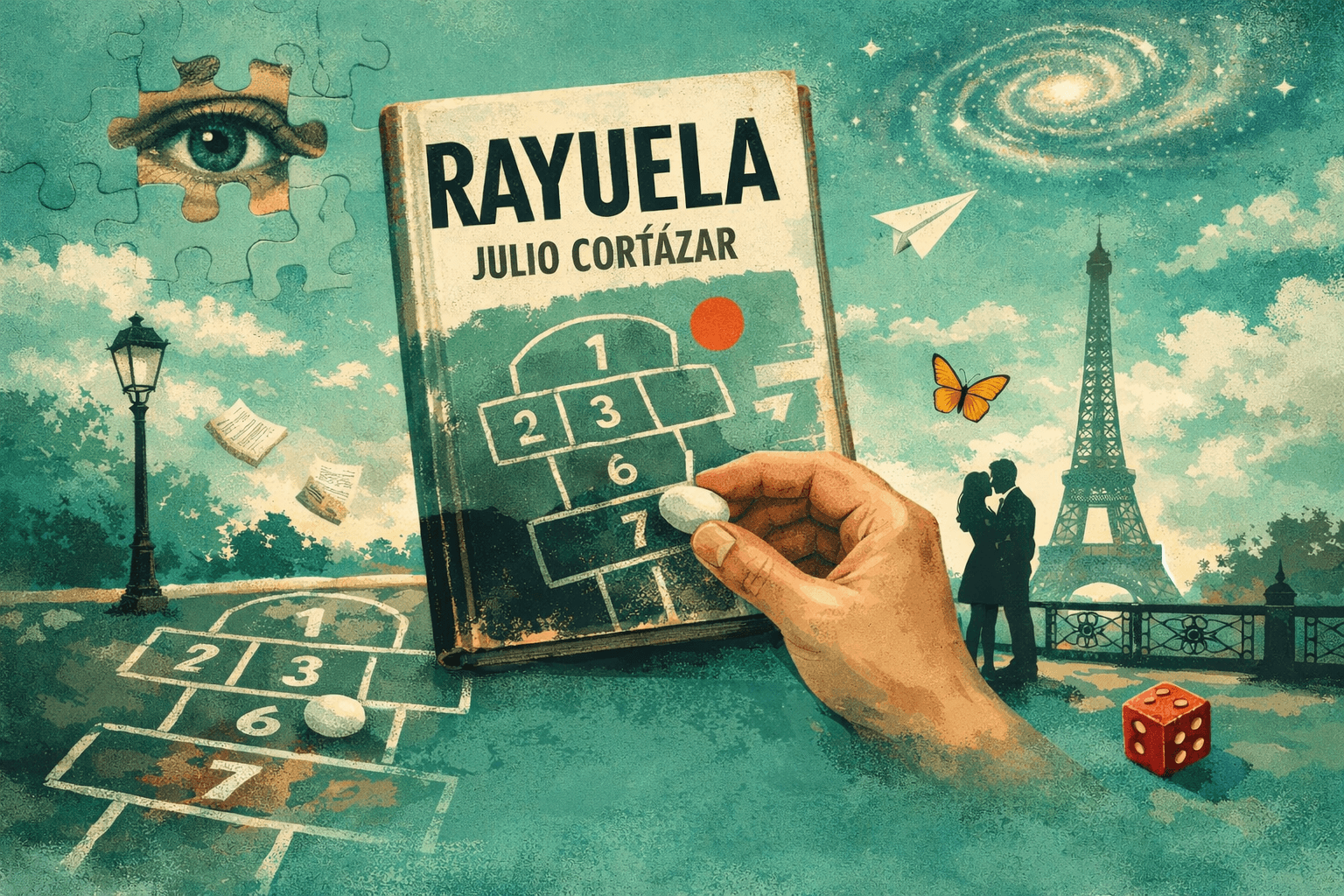
Hopscotch - Julio Cortázar
 Andres Aguilar
In 1963, Julio Cortázar wrote a novel that isn't read — it's played. Hopscotch opens with a board of instructions offering different reading paths, and none of them is the right one. More than sixty years later it remains the most experimental and fasc...
Imagine picking up a book and reading in the very first pages: "You can read this book in two different ways — or three, or really however many you can think of." That's not a suggestion. It's an invitation to actively participate in building the story. That's exactly what Julio Cortázar did in 1963 with Hopscotch, a novel that didn't just tell a story but revolutionized the very act of storytelling. Today I want to talk about a book that changed literature in the Spanish-speaking world, drove millions of readers crazy, and more than sixty years later still delivers a one-of-a-kind experience every time someone opens it.
Cortázar in Paris: the context of a literary revolution
First, you need to know who Cortázar was when he wrote this. By 1963, Julio was an Argentine writer living in Paris — a voluntary exile since the fifties. He had already published extraordinary short stories: "House Taken Over," "Blow-Up," tales that played with the fantastical in a way nobody else could. But Hopscotch was something else entirely. It was his attempt to write the anti-novel, to break with everything a traditional novel was supposed to be.
The table of instructions: multiple ways to read
The book opens with a "Table of Instructions" — a kind of user's manual. Cortázar tells you: you can read this book in two ways. The first is the classic approach: chapters one through fifty-six, ignoring the rest. That gives you a more or less conventional story. The second is following the sequence he proposes — jumping from chapter to chapter according to a specific order that takes in all one hundred fifty-five chapters. Then there's a third option, which Cortázar doesn't spell out but many readers discover on their own: read in whatever order you feel like.
The story of Horacio and la Maga
The central story — if we can call it that — revolves around Horacio Oliveira, an Argentine living in Paris. He's with la Maga, a Uruguayan woman who is something of a free spirit, a little lost, a little mystical — everything Horacio is not. He's an intellectual, always thinking, analyzing, trying to understand the world through reason. She's intuitive, emotional, living in the moment without overthinking it. Much of the book plays out in the tension between these two.
The Serpent Club
Horacio is part of the Serpent Club, a group of expat friends who get together to listen to jazz, drink wine, and talk about art, philosophy, and literature. There's Gregorovius, a Romanian intellectual; Étienne, a painter; Babs, an American woman; Ronald and Babs as a couple. They gather at Ronald's apartment to listen to records and talk until dawn about everything and nothing. Those conversations you have in your twenties when you think you're going to solve the mysteries of the universe over cheap wine.
Part one: the other side (Paris)
The first section of the book, "From the Other Side," takes place in Paris. Here we watch Horacio and la Maga's relationship slowly fall apart. They have a child together, Rocamadour, who dies. That event marks a turning point. La Maga disappears and Horacio searches for her through Paris — except it's like he's not really looking, as if he's after something bigger than her. He's searching for what he calls the "kibbutz of desire," a kind of enlightenment or authenticity that all his thinking keeps him from reaching.
Existentialist Paris
Cortázar paints Paris in a particular way. Not the tourist Paris of the Eiffel Tower. This is the Paris of bridges over the Seine, cheap apartments, late-night streets, jazz in dark bars. An existentialist, bohemian Paris where expats are searching for something they left behind or perhaps never had.
Part two: this side (Buenos Aires)
Then comes the second section, "From This Side," where Horacio returns to Buenos Aires. The tone shifts completely. Argentina feels more concrete, more suffocating than Paris. Horacio reconnects with Talita and Traveler, a couple who are his friends. He works at a circus first and then at a mental asylum. Madness becomes a central theme. Horacio starts seeing in Talita a kind of double of la Maga, though she's nothing like her.
The bridge between worlds
There's a famous scene where Horacio and Traveler build a bridge between their apartments using planks, to pass things to each other without going down to the street. It's a perfect metaphor for what the whole book does: constructing shaky bridges between worlds, between people, between ideas. Everything in Hopscotch is an unstable bridge.
The ambiguous ending
In the asylum, Horacio ends up something like voluntarily confined. There's a confusion — a possible suicide attempt or an attack on someone — it's never made clear. The book ends with Horacio looking out a window, Traveler down in the courtyard below, everything left unresolved. You don't know if Horacio jumps or not, if he's crazy or the only sane one. Cortázar gives you no certainties.
The expendable chapters: breaking the narrative
But here's the key: that's only one possible reading. If you read the book in the order Cortázar proposes, everything changes. The chapters get intercut with texts from the "Expendable Chapters" — newspaper clippings, reflections on literature, quotes from other authors, philosophical tangents. These chapters break the narrative, pulling you out of the story just as you're most absorbed in it.
The role of the active reader
Why does Cortázar do this? Because he wants you to be an active reader, not a passive one. He wants you thinking while you read, questioning, building your own interpretation. The expendable chapters include writings by Morelli, an old writer who appears briefly in the story but whose notes on literature surface throughout the book. Morelli is a kind of Cortázar alter ego — the character who theorizes about what Cortázar is actually doing.
Morelli and the theory of the anti-novel
Morelli says things like: the traditional novel is dead, we need new ways of telling stories, the reader must be a co-conspirator, not a passive consumer. He talks about the anti-novel, about breaking with causality, with psychologically consistent characters, with plots that resolve. All of which is exactly what Hopscotch does.
The philosophical search: overcoming the Great Habit
And here's what's fascinating: Cortázar isn't just experimenting for the sake of it. There's a deep philosophical search running through the book. Horacio is trying to break free from what he calls "the Great Habit" — that automatic, unquestioned way of living. He wants to reach another reality, a more authentic one, but he can't figure out how. He thinks too much, and thinking is exactly what keeps him from getting there.
Reason vs. intuition
La Maga, by contrast, seems to have natural access to that state. She doesn't think — she just is. She says things that sound dumb but follow their own poetic logic. Horacio admires and resents her at the same time. He sees her as pure intuition without intellect, but he also recognizes she has something he lost or maybe never had.
Experimentation with language
Cortázar plays constantly with language. He invents words, mixes the River Plate dialect of Spanish with French borrowings, and has his characters speak in "Gibberish" — an invented language that sounds like something but means nothing specific. There's a famous chapter, chapter sixty-eight, where la Maga and Horacio have an intimate scene described entirely in Gibberish. You understand everything without understanding a single word.
Jazz as literary metaphor
Then there's the theme of jazz. Jazz is essential to Hopscotch. It's not just background music — it's a metaphor for what Cortázar is trying to do with literature. Jazz is improvisation, breaking the rules, finding harmony in chaos. The characters listen to Charlie Parker, Louis Armstrong, Jelly Roll Morton. They argue about recordings and performances. Jazz gives them a language for talking about the ineffable.
A book of references and layers
There are constant references to other books, other authors. Cortázar cites or alludes to Antonin Artaud, the Surrealists, Zen philosophy, existentialist literature. The book is full of layers — references that connect to each other. You can read it knowing none of that and it still works, but every reference you catch opens up another dimension of the text.
The search for the center
One of the concepts Horacio pursues is what he calls the "center." It's not a physical place — it's more like a state of consciousness where everything integrates, where the division between subject and object, between self and world, dissolves. It's an almost mystical idea, but Cortázar presents it without religious vocabulary. It's a spiritual search for people who don't believe in the spiritual in any traditional sense.
The title and the childhood game
The book's title comes from the children's game of hopscotch — where you hop on one foot trying to reach heaven. It's a perfect metaphor: life as a game, as a series of leaps between squares, trying to reach something that lies just beyond. And like the game, Horacio's life has arbitrary rules, squares you can't land on, a constant need to keep your balance.
Death as a recurring theme
Cortázar also writes a great deal about death. Not only the literal death of Rocamadour, but death as part of life itself. Horacio has a morbid fascination with death — he sees it as a possible exit, or maybe an answer. But it's not a glorification of suicide. It's more complicated than that. It's as if death were another way of reaching that center he's searching for.
The doubles: Horacio and Traveler
The relationship between Horacio and Traveler is important. Traveler is called that — but he's never traveled, never left Argentina. He's a kind of double of Horacio who took the other road: staying, having a more or less conventional life. And yet they're close friends who understand each other, bound by something deep. When Horacio returns to Buenos Aires, Traveler is his connection to the normal world — but also his mirror.
Talita: between two worlds
Talita gets caught in the middle. Horacio projects la Maga onto her, seeing what he wants to see. This creates enormous tension because Talita is her own person — she's nobody's ghost. But Horacio can't help it. He's trapped inside his own head, inside his fantasies, inside his search.
Symbols: the circus and the asylum
The circus where they work is another symbol. The circus is theater, fiction, the creation of illusions. Horacio is constantly trying to tell real from constructed — yet he works literally in a place where everything is artifice. Then the asylum is even more on the nose: a place where sanity and madness are socially defined, where being crazy might mean being saner than the sane.
Fragmented reality
The expendable chapters also include absurd news clippings, anecdotes, fragments of conversations. Cortázar is saying: reality is this too, not just the main plot. Life isn't an ordered narrative — it's fragmentary, chaotic, jumping from one thing to another. The book tries to capture that.
Absurd humor and deep reflection
There are moments of genuine absurdist humor in Hopscotch. It's not a solemn book all the way through. There are ridiculous situations, nonsensical conversations, moments of pure comedy. Cortázar had a particular sense of humor — somewhere between intellectual and childlike. His characters laugh at themselves, at their own pretensions, at their deep searches that sometimes become deeply ridiculous.
Cronopios and famas
The concept of cronopios and famas — which Cortázar develops in another book — is present here too. Cronopios are creative, chaotic, living in the moment. Famas are orderly, predictable, rule-followers. Horacio wants to be a cronopio, but his intellectualism makes him something more complicated. La Maga is pure cronopio.
Characters as literary constructions
One of the things Cortázar does is break with the idea of the realistic character. His characters say things real people would never say, do arbitrary things, lack fully coherent psychologies. This is intentional. Cortázar wants you to see the characters as literary constructions, not real people. He wants you to stay aware that you're reading fiction.
Buenos Aires as oppressive backdrop
The book has a particular vision of Buenos Aires. Not the picturesque Buenos Aires of tango and cafés. This is a rougher, hotter, more suffocating Buenos Aires. There's something stifling about Cortázar's Buenos Aires — as if Horacio can't breathe there. Paris was cold but full of possibility. Buenos Aires is familiar but claustrophobic.
Typographical experimentation
Cortázar also plays with typography and the layout of text on the page. Some chapters are a single enormous paragraph; others are tiny fragments. There are interlaced texts, footnotes that aren't really footnotes. All of this is part of the experiment of making the literary artifice visible.
The search for language
Horacio's search is also a search for language. He feels that everyday language is worn out, that words aren't enough to say what he really wants to say. Hence the Gibberish, the invented words, the conversations that seem to go nowhere but are actually circling something that can't be named.
A perfect ending in its ambiguity
The ambiguous ending is perfect for what the book proposes. If Cortázar had clearly told you whether Horacio commits suicide or not, he would have been betraying everything he set out to do. He's leaving the decision up to you. Every reader finishes Hopscotch in a different place — not only because they can read it in different orders, but because each person completes the book with their own interpretation.
The impact in 1963: a literary earthquake
When Hopscotch came out in 1963, it hit like a thunderbolt. Young Latin Americans adopted it as their book. It was modern, rebellious, different. It broke with traditional literature and academic forms. It was a book that made you feel smart, part of something new.
The Latin American Boom
The Latin American Boom was just getting started, and Hopscotch was one of its founding works. Alongside One Hundred Years of Solitude by García Márquez and The Time of the Hero by Vargas Llosa, these books put Latin American literature on the world map. But Hopscotch was distinctive because it didn't tell the story of Latin America in any epic way. It was more introspective, more experimental, more existentialist.
The influence on generations of writers
The book influenced generations of writers. The idea that you can play with structure, that the reader can be an active participant, that a novel doesn't have to be linear — all of that became possible after Hopscotch. Cortázar didn't invent it all from scratch — there were precursors — but he brought it to a mass Spanish-language audience.
The critics and the pushback
It also generated pushback. A lot of people found it pretentious, too intellectual, too concerned with being experimental. Some readers think Cortázar is more interested in showing off how clever he is than in telling a story. That Horacio is an insufferable character, full of himself, who treats la Maga badly. All of that is a fair reading too.
Multiple levels of reading
What's interesting is that Hopscotch works on multiple levels at once. You can read it as a complicated love story between Horacio and la Maga. You can read it as an existential search. You can read it as a formal experiment. You can read it as a portrait of Latin American bohemian life in Paris. All those readings are there.
A permanent legacy
The legacy of Hopscotch is enormous — not only in literature but in how we think about reading itself. The idea that a text can have multiple entry points, that there's no single correct way to read it — that seems obvious now, but it wasn't before Cortázar. He opened doors for all kinds of narrative experimentation that came after.
A book for every generation
And it's still being read today. Each generation finds something different in it. For some it's a book about spiritual searching. For others it's about the impossibility of escaping yourself. For others it's about Argentina and exile. The book is rich and ambiguous enough to sustain all those readings.
Cortázar on his own work
Cortázar said he wrote Hopscotch as a way of exorcising his own demons, his own searches. That Horacio is and isn't him. That la Maga was inspired by a real woman but became something larger than the actual person. That the Serpent Club has elements of real expat groups but is also invented. All fiction works this way: a mixture of experience and fabrication.
A book that demands participation
What's clear is that Hopscotch is not a book to read passively. It demands participation, demands that you think, demands that you decide how you're going to move through it. Some chapters are difficult, dense, full of references you won't catch all of. But that's part of the experience. You're not reading to understand everything — you're reading to feel something, to think, to get a little lost.
Conclusion: a one-of-a-kind experience
And that, in a nutshell, is Hopscotch. A book that proposes a game, that breaks the rules of the traditional novel, that tells the story of a person searching for something he can't name and that probably doesn't exist. A book that makes you a co-author of the narration, that forces you to choose your own path. A novel that is many novels depending on how you read it and who you are when you read it.
One important note: what you read here is a summary, a way to get acquainted with the book's central ideas. But if something we talked about resonated with you, sparked your curiosity, or you simply want to experience it for yourself — read the whole book. Reading Hopscotch is not the same as reading about Hopscotch. It's an experience you have to live yourself, jumping between chapters, getting lost in the digressions, finding your own connections. So if it caught your interest, do yourself a favor and read it.
Related episodes

In this article we are going to see what it is about. Who was Chris Voss and why his story matters.

Hesse wrote this book with a razor blade on the table and the date of his own suicide marked on the calendar. What came out wasn't a farewell note but one of the strangest and most widely read novels of the twentieth century. Why does Steppenwolf keep ...

One night in crisis, a Cambridge student asked himself such a strange question that it changed his life: who is the one observing the one who suffers? What he found in answering that question became one of the bestselling spirituality books of the cent...