
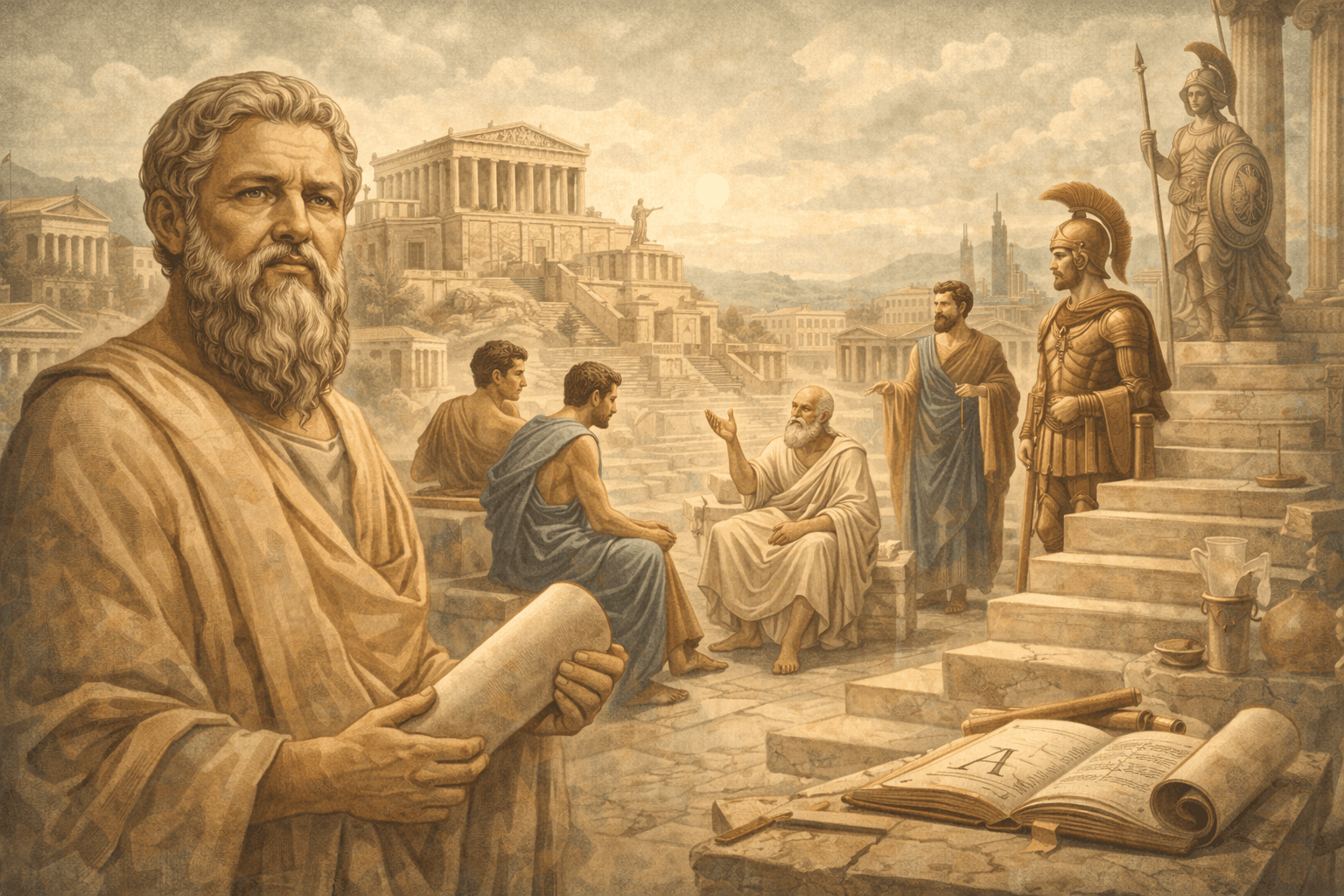
The Republic - Plato
 Andres Aguilar
The Republic explores what justice is, how a just society should be organized, and the role of knowledge and education. Through a series of dialogues, Plato puts forward the myth of the cave, the ideal city, and the figure of the philosopher-king.
Introduction: A Provocative Classic
The Republic explores what justice is, how a just society should be organized, and the role of knowledge and education. Through a series of dialogues, Plato puts forward the myth of the cave, the ideal city, and the figure of the philosopher-king.
A book written 2,400 years ago argues that democracy is the second-worst system of government possible, that poets should be banished from the city, that children should be raised by the state without ever knowing their parents, and that only philosophers should rule. Sounds like a dystopia, right? Well, we're talking about Plato's The Republic — one of the most influential texts in Western history. A book that inspired utopias, justified dictatorships, and founded political philosophy as a discipline. Today we're diving into this classic that everyone name-drops but almost nobody has read in full, to understand what it actually says and why it still matters.
The Context: Plato and the Death of Socrates
Plato lived in Athens between 427 and 347 BCE. He came from an aristocratic family — meaning his family enjoyed significant wealth and privilege. His real name was Aristocles, but people called him Plato, which roughly means "broad-shouldered," because he was supposedly a powerfully built guy. He was an athlete in his youth, wrote poetry, and was on track for a political career. But when he met Socrates, everything changed. Socrates was this street philosopher who spent his days asking people uncomfortable questions and challenging everything they took for granted. And Plato became his most devoted student.
In 399 BCE, the Athenians put Socrates on trial for corrupting the youth and not believing in the city's gods. They sentenced him to death. He was forced to drink hemlock, a poison. Plato was 28 years old when his teacher died, and he was devastated. But also furious. Furious at the Athenian democracy that had killed the wisest man in the city. That experience shaped his entire philosophy. The Republic is, in part, an attempt to understand how a society can be so wrong as to execute its best citizens.
Socrates never wrote anything, so everything we know about him comes from other writers — mostly Plato.
The Structure of the Book: Socratic Dialogues
The book is written as a dialogue, which was Plato's signature format. The main character is Socrates, who debates with various interlocutors about justice and how an ideal city should be organized. It's important to understand that the Socrates in Plato's dialogues is a literary character, not necessarily the historical Socrates. Plato uses his teacher as a mouthpiece for his own ideas throughout the book.
The Opening Question: What Is Justice?
The conversation kicks off with a deceptively simple question: what is justice? Several characters take a stab at it. One says justice means telling the truth and paying back what you owe. Socrates dismantles that with an example: if a friend lends you a weapon and later goes crazy, is it just to give it back? Obviously not. So that definition doesn't hold up.
Thrasymachus and the Law of the Stronger
Then a character named Thrasymachus shows up — a Sophist. The Sophists were teachers who got paid to teach rhetoric and argumentation. Thrasymachus has a cynical take. He says justice is whatever serves the interests of the stronger. That laws are made by the powerful for their own benefit, and being just simply means obeying whoever's in charge. It's basically might makes right, dressed up in nicer language.
Socrates debates Thrasymachus for hours. He peppers him with questions, ties him up in contradictions, until Thrasymachus ends up silent and frustrated. But the question still doesn't have a satisfying answer.
The Ring of Gyges: A Thought Experiment
Then another character, Glaucon, proposes a thought experiment. He tells the story of the Ring of Gyges — a magic ring that makes you invisible. The question is: if you had a ring like that and could do whatever you wanted without consequences, would you still be just? Or would you take advantage — steal, kill, do whatever you felt like?
Glaucon argues that almost nobody would be just if they could get away with anything. That people are only just because they're afraid of punishment or care about their reputation. But deep down, all of us would rather be unjust if we could. It's a pessimistic view of human nature that still hits home today. Think about corruption — how people behave when they think nobody's watching.
The Ideal City: Three Classes and Their Virtues
Socrates responds with an elaborate argument that takes up the rest of the book. He says that to understand what justice is in an individual, you first have to understand what justice looks like in a city. It's easier to see the bigger picture. So he proposes building, in theory, an ideal city from scratch. And here's where the most famous and influential part of the book begins.
The Tripartite Division of Society
Plato's ideal city is divided into three classes. At the base are the producers: farmers, craftsmen, merchants — the people who make what the city needs to function. Above them are the guardians, the soldiers and protectors of the city. And at the top are the rulers, whom Plato calls the philosopher-guardians. Each class has a specific function and an associated virtue. Producers need temperance, guardians need courage, and rulers need wisdom.
Justice in the city, according to Plato, means each class doing its own job and not meddling with the others. Cobblers make shoes, soldiers defend the city, philosophers govern. Problems arise when the roles get confused — when soldiers want to rule or merchants want to call the shots. That creates conflict and tears the city apart.
The Analogy with the Human Soul
Now comes the analogy with the individual. Plato says the human soul also has three parts. The rational part, which seeks truth and wisdom. The spirited part, which seeks honor and recognition. And the appetitive part, which seeks physical pleasures like food, sex, and wealth. These three parts correspond to the three classes of the city.
A just person is one where reason rules, the spirited part supports it, and the appetites are kept in check. It's like an internal monarchy where reason is the king. An unjust person is one where the appetites take over, or where there's conflict between the parts. Think of the guy who knows he should exercise and eat right, but inhales three burgers and spends the day on the couch. His reason lost control.
With this framework, Plato argues that being just is better than being unjust — even if nobody's going to punish you. Because justice is internal harmony, having your soul in proper order. Whereas injustice is internal conflict — being a slave to your impulses. So even if you had the Ring of Gyges and could do whatever you wanted, it would still be better to be just, because you'd live better with yourself.
It's an interesting argument, but not everyone buys it. Because it requires accepting Plato's entire psychology of the soul's parts. And it also requires valuing internal harmony over external pleasures. Some people would rather live with inner conflict but be rich and powerful than live in peace but poor.
The Radical Proposals: Communism for the Guardians
But here's where things get really controversial: the description of how the guardians and rulers should be educated and how they should live. Plato proposes something radical. He says these groups shouldn't have private property or family. Everything should be held in common. Children would be raised by the state, never knowing their biological parents. Women and men would receive the same education and could fill the same roles. And marriages would be arranged by the state to produce the best possible children.
When you read this today, it sounds like a totalitarian nightmare. But Plato had his reasons. He thought private property and family create particular loyalties that conflict with the common good. If you're a judge and your son is charged with a crime, are you going to be fair or are you going to favor your kid? If you have a nice house and your neighbor has a crummy one, are you going to care about the whole city's well-being or just your own house?
Plato wanted to eliminate those conflicts of interest. If the rulers have no property or family, they have no reason to be corrupt or biased. Their only concern is the city's good. It's a logic you can follow, but the price is steep. You're sacrificing everything that makes human life meaningful in the name of political efficiency.
Censorship and the Expulsion of the Poets
The Strict Educational System
And here comes another key element: education. Plato spends an enormous amount of space describing how the guardians should be educated. First in music and gymnastics — which for the Greeks meant cultural and physical education. But with strict censorship. Children should only read stories that promote the right values. No poets telling myths where gods behave badly, where heroes have flaws, where cowardice or injustice is portrayed in a flattering way.
The Theory of Three Levels of Reality
This leads to one of the most famous and controversial parts of the book: the expulsion of the poets. Plato argues that poets are dangerous because they imitate reality imperfectly and appeal to the emotions rather than to reason. He explains that there are three levels of reality. First are the Forms or Ideas — perfect, eternal concepts. For example, the Form of a Bed, the perfect essence of what a bed is. Second, there are the physical beds that carpenters make, which are imperfect copies of the Form. And third, there are paintings or poems about beds, which are copies of copies — twice removed from the truth.
Poets, according to Plato, operate at that third level. They don't know the truth — they only imitate appearances. And worse, their work appeals to the emotional part of the soul, not the rational part. When you watch a tragedy and cry, you're strengthening the irrational part of your soul. You're practicing being emotional instead of rational. That's why poets should be expelled from the ideal city, or at least strictly censored.
This is ironic, because Plato himself was a brilliant writer. His dialogues are top-tier literary works. But he believed philosophy was different because it sought truth through reason, not emotion through imitation.
The Philosopher-King: Education and Governance
Then Plato describes a selection process for the rulers. Not just anyone can be a philosopher-ruler. It requires decades of rigorous education. First gymnastics and music in childhood. Then mathematics and the sciences in adolescence. And finally, the best students spend years studying philosophy, learning about the Forms and the truth. Only after all of this — when you're around fifty years old — are you ready to govern.
And here comes the most famous line in the book: "Until philosophers are kings, or the kings and princes of this world have the spirit and power of philosophy, cities will never have rest from their evils, nor I think will the human race." This is the idea of the philosopher-king — someone who combines knowledge of the truth with political power.
It sounds great in theory, but in practice it's a mess. Who decides who a true philosopher actually is? And what happens when the philosopher-king makes a mistake or gets corrupted? There's no check on that. It's a system that depends entirely on the virtue of the rulers, with no institutions to limit their power.
The Degeneration of Governments
The book then does something fascinating: it describes four types of degenerate government, showing how each one springs from the previous one and is worse.
From Aristocracy to Tyranny
It starts with timocracy — the rule of the honorable, those who crave military glory. Better than what follows, but worse than rule by philosophers. From timocracy springs oligarchy, the rule of the wealthy. There the city splits between rich and poor, and there's constant conflict.
From oligarchy springs democracy, when the poor revolt and seize power. And here Plato gets critical. He describes democracy as a system where everyone does whatever they want, where there's no respect for authority or excellence. He says that in a democracy, teachers are afraid of their students, children disobey their parents, and even animals are insolent. It's freedom taken to the extreme, where there's no order or hierarchy.
And finally, from democracy springs tyranny — the worst government possible. The tyrant is someone who rises to power promising to protect the people from the oligarchs, but once in charge becomes paranoid and cruel. He kills his enemies, eliminates anyone who poses a threat, and rules through fear. The tyrant is the most miserable of all men because he lives in constant fear and his desires are never satisfied.
This degenerative sequence is Plato's way of showing that Athenian democracy — the one that killed Socrates — isn't a good system. That it inevitably leads to tyranny. It's a critique that many find elitist and unfair. But Plato had historical reasons. Athens had swung between democracy and tyranny multiple times. And from his aristocratic perspective, democracy was the rule of the ignorant.
The Myth of Er: The Eschatological Finale
The book closes with the Myth of Er, a story about the afterlife. Er is a soldier who dies in battle but then comes back to life and tells what he saw. He describes how souls are judged, how the just go to heaven and the unjust go to a kind of hell, and after a thousand years all of them are reincarnated, choosing new lives. The point of the myth is to reinforce that justice is valuable even after death — that there are eternal rewards and punishments.
It's interesting that Plato, after all the rational argumentation, ends with a myth. Many people take this as evidence that even he knew his rational arguments weren't entirely convincing, so he throws in a religious element to drive the point home.
Historical Influence: From the Neoplatonists to Totalitarianism
The Republic is a book that has been interpreted in countless ways. Some read it as a serious utopia — a genuine blueprint for how society should be organized. Others read it as satire, an exaggerated critique of the political ideas of its time. Others still read it as a philosophical exercise, more interested in theory than practice.
The Legacy Through the Centuries
What's undeniable is its influence. It inspired countless philosophers and politicians. The Neoplatonists of late antiquity studied it with almost religious devotion. Medieval Christians, especially Augustine, adapted many Platonic ideas into Christianity. The idea of a perfect world of Forms became the Christian heaven. The tripartition of the soul influenced Western psychology for centuries.
In the Renaissance, Plato was rediscovered with excitement. Italian humanists preferred him to Aristotle. And his ideas about the ideal city influenced utopian thinkers like Thomas More and Campanella. Later he shaped German idealist philosophers like Hegel. And in the twentieth century, Karl Popper wrote a fierce attack called The Open Society and Its Enemies, where he argued that Plato was the intellectual godfather of totalitarianism.
Popper's Critique and the Dangers of Platonism
Popper had a point. Many of the worst political ideas of the twentieth century have Platonic echoes. The idea of an enlightened elite that knows what's best for everyone and should wield absolute power. The idea that individual freedom must be sacrificed for the collective good. The idea of social engineering — that you can design the perfect society from the top down. The Nazis, the Soviet Communists — these regimes all had Platonic elements.
But it's also unfair to blame Plato for what others did 2,300 years later. He was writing in a specific context, responding to specific problems. And not everything in The Republic is totalitarian. The idea that rulers should be wise and educated is reasonable. The idea that justice matters and should guide politics is valuable. The emphasis on education as the foundation of a good society is on point.
What is problematic is the excessive confidence in the ability of a few wise men to design everyone else's lives. It's the lack of epistemic humility. Plato thought philosophers could know the absolute truth about how people should live. But history shows that nobody has that knowledge. The most successful societies are the ones that allow for experimentation, diversity, error, and correction.
Contemporary Relevance
The Platonic Appeal and Its Limits
There's also something genuinely attractive in the Platonic vision. The idea that there should be objective standards of justice and truth. That not everything is relative or just a matter of opinion. That excellence matters and should be recognized. In an era where everything gets reduced to opinions and feelings, where truth is treated as a social construct, there's something bracing about Plato's absolutism.
Eternal Questions Without Easy Answers
The book also raises questions that are still relevant. Who should govern? The most educated? The most popular? The wealthiest? Those chosen by vote? Every system has problems. Democracy can elect demagogues. Aristocracy can become oppressive. Meritocracy can favor the privileged who have access to education. There are no easy answers.
And the question of justice still doesn't have a satisfying answer. Is justice whatever serves the interests of the stronger, as Thrasymachus said? Is it each person getting what they deserve? Is it equality of opportunity or equality of outcomes? Plato offered his answer, but the debate continues.
Why Read The Republic Today
One thing that fascinates me about The Republic is how a book this old is still being discussed. We don't read it as a historical curiosity — we read it because the questions it raises are timeless. As long as there are human societies, we'll be asking ourselves how to organize them, what justice is, who should govern. And we'll keep coming back to Plato — not necessarily because he has the right answers, but because he asked the right questions.
The Literary Style: Philosophy as Drama
The book's dialogue format is also brilliant. Instead of being a dry treatise, it's a dramatic conversation. There's personality, there's conflict, there are moments where Socrates is sarcastic or where the interlocutors get frustrated. It's philosophy, but it's also literature. And that makes it more accessible and memorable than if it were just an abstract argument.
Accessibility and Challenges of the Text
Obviously, it's not an easy read. Depending on the edition, it's around 300 pages, with dense arguments and long digressions. Some parts drag, especially the sections on mathematics and the theory of Forms. But some parts are genuinely exciting — like the debates with Thrasymachus or the descriptions of the different types of government.
If you've never read ancient philosophy, The Republic is a good place to start. You don't need any background knowledge. Plato explains everything as he goes. And even if you disagree with his conclusions, the exercise of following his arguments — watching how he builds his case step by step — is educational. It trains you to think more rigorously and systematically.
Conclusion
Alright, that's a wrap on Plato's The Republic. It's one of those foundational books that everyone should read at least once — not to treat it like a bible, but to understand where many of the ideas that still shape how we think about politics, justice, and society actually come from.
Related episodes

In this article we are going to see what it is about. Who was Chris Voss and why his story matters.

Hesse wrote this book with a razor blade on the table and the date of his own suicide marked on the calendar. What came out wasn't a farewell note but one of the strangest and most widely read novels of the twentieth century. Why does Steppenwolf keep ...

One night in crisis, a Cambridge student asked himself such a strange question that it changed his life: who is the one observing the one who suffers? What he found in answering that question became one of the bestselling spirituality books of the cent...