
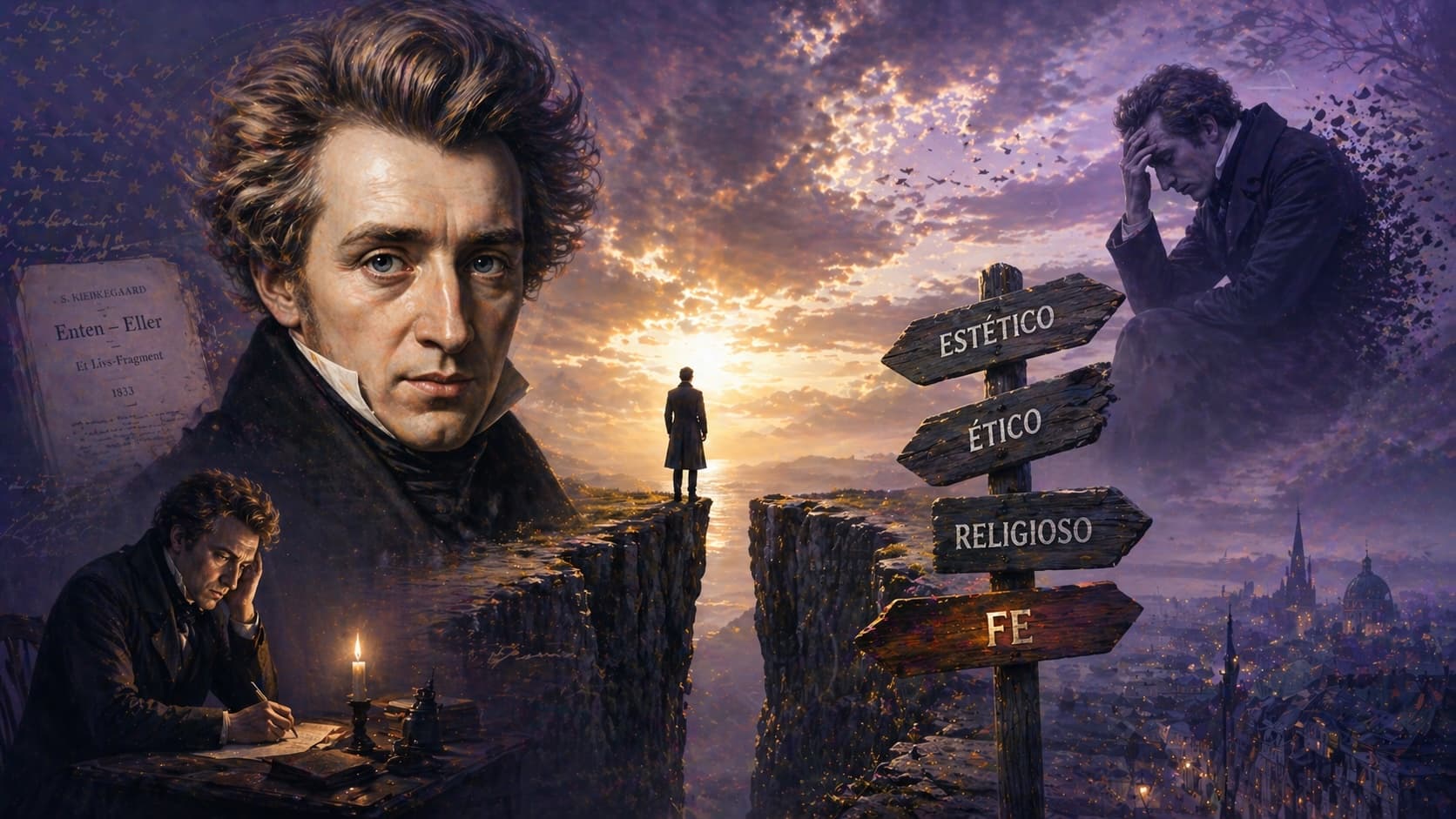
Kierkegaard: The Leap of Faith and the Anguish of Choosing
 Andres Aguilar
In 1841, a young Dane returned the ring to the woman he loved without giving her any explanation she could understand — and spent the rest of his life writing about that decision. Kierkegaard didn't build a philosophical system: he built a question tha...
On August 11, 1841, in Copenhagen, a young man made one of the most painful decisions of his life and turned it into the engine of his entire philosophy. Søren Kierkegaard was twenty-eight years old and had been engaged for a year to Regine Olsen, a sixteen-year-old girl he was deeply in love with. He broke off the engagement. He returned the ring. Without any explanation she could understand. And he spent the rest of his life writing, in part, about that decision: why he made it, what it meant, what it reveals about the nature of human choice.
Regine married another man. Kierkegaard never got over it. When he died at forty-two, he left instructions that everything he owned be given to her. And Regine, already an old woman, read his complete works and said that only then did she understand what he had been trying to tell her that August afternoon. That he had loved her deeply, but that he had felt his love for God and his philosophical mission were incompatible with conventional human love. That he chose solitude and suffering because he believed them necessary for what he had to do.
It's a sad love story, and also — if we think about it carefully — a story about the anguish of choosing. About what happens when you have to make an important decision knowing that any path means losing something irreplaceable. About the radical loneliness of being the only one who can choose for yourself.
The Man Behind the Philosopher
Søren Aabye Kierkegaard was born in Copenhagen in 1813, the seventh and last child of a wool merchant who had become wealthy and who was, by all accounts, a man marked by a sense of religious guilt so profound it bordered on pathology. His father, Michael Pedersen Kierkegaard, was convinced he had gravely sinned in his youth and that God would punish him by making all his children die before him. Indeed, six of his seven children died young. Søren was the only one who outlived his father — but just barely.
That dark childhood, shaped by the father's intense religiosity and by the atmosphere of guilt and redemption that filled the house, molds everything Kierkegaard would go on to write. Faith, anguish, sin, the individual's relationship with God — none of these are academic abstractions for him. They are the questions that haunted him from the time he could think.
He went to university to study theology but took ten years to finish. In between, he read everything, frequented cafés and theaters, earned a reputation as an eccentric and brilliant character in the small Copenhagen of his day, and began writing the first philosophical texts that would eventually make him famous. Many of them he published under pseudonyms, different ones for each book: Johannes the Seducer, Constantin Constantius, the Silent One. As if different voices within him needed to express themselves separately before he could integrate them.
The Critique of Hegel: Subjectivity vs. System
To understand Kierkegaard you have to understand who he was fighting against. And the main target of his criticism was Georg Wilhelm Friedrich Hegel, the most influential German philosopher of the nineteenth century — someone we touched on in the Heraclitus episode, since Hegel took ideas about flux and opposites and built them into a huge, ambitious philosophical system.
Hegel constructed what is known as an idealist system: a philosophy that claimed to explain all of reality — nature, history, the human spirit, God — within a coherent and exhaustive conceptual framework. It was a work of colossal intellectual ambition. And it had colossal success: in the first half of the nineteenth century, virtually all German philosophy and much of European philosophy revolved around Hegel like planets around a sun.
Kierkegaard hated that. Not Hegel's thinking in its entirety, because he was too intelligent to completely hate something so sophisticated. But he hated the pretension that a philosophical system could capture and explain human existence from the outside, as if the philosopher could stand at a privileged point above reality and describe how the whole thing works.
For Kierkegaard, that was an illusion. And it was a dangerous illusion because it distracted from the only thing that truly matters: the concrete, singular, irreducible existence of each individual. Hegel thought in terms of universal historical processes, of movements of humanity as a whole. And Kierkegaard replied: yes, all of that may be very interesting, but I am me — specifically me, with this particular history and this concrete decision I have to make right now — and no philosophical system tells me how to make it.
> I am me — specifically me, with this particular history and this concrete decision I have to make right now — and no philosophical system tells me how to make it.
That tension between the universal system and individual existence is the heart of all of Kierkegaard's philosophy. And it's the reason we consider him the father of existentialism: he was the first to say that individual, subjective, irreducible existence had to be the starting point of philosophy, not a problem to be solved within a larger system.
The Three Stages of Existence
One of Kierkegaard's most original contributions is his description of what he calls the three "stages" or modes of existence. These aren't stages that everyone necessarily passes through in order — they're more like three distinct ways of life, three ways of relating to existence and to choice.
The first is the aesthetic stage. It doesn't have to do with art specifically, though it can include it. The aesthetic life is the life oriented toward pleasure, experience, and sensation. The person living aesthetically seeks what is interesting, beautiful, exciting. They flee boredom and routine with the same energy they use to chase new experiences. It's the character who appears in one of Kierkegaard's most famous books, Either/Or, as "the Seducer" — someone who seduces women not so much out of carnal desire as for the intellectual pleasure of the conquest, of crafting the perfect strategy.
The problem with the aesthetic life, according to Kierkegaard, is that it is fundamentally unstable. Novelty becomes routine. Pleasure runs out. Boredom inevitably returns. And at the bottom of the aesthetic life lies a despair that gets covered up with more stimulation, more experiences, more flight from the present moment. The aesthetic person is never fully anywhere because they're always looking for the next interesting place.
The second stage is the ethical. Here life is organized around duty, moral norms, and commitments to others. The ethical person marries, fulfills their obligations, is a responsible citizen. Kierkegaard doesn't present this as something bad — on the contrary, it's a more stable and deeper existence than the aesthetic — but it has its limits too. Ethical norms are general and abstract, and the concrete life of each person always has situations that the norms can't fully cover. There are moments when ethical rules conflict with each other, or when following them blindly would lead to something that feels profoundly wrong.
The third stage is the religious. And here Kierkegaard gets truly interesting — and also harder to follow without context. The religious stage isn't simply going to church or following the commandments. It's a direct, personal, and irreducible relationship between the individual and God that transcends both pleasure and duty.
Abraham and the Leap of Faith
To illustrate the religious stage, Kierkegaard devotes an entire book to analyzing an episode from Genesis, the first book of the Bible. The story of Abraham and the sacrifice of Isaac.
If you don't remember it: God asks Abraham to sacrifice his son Isaac — the son of his old age, the fruit of a miracle, the continuation of his lineage. Abraham agrees. He takes his son, climbs the mountain, raises the knife. And at the last moment, God sends an angel who stops the sacrifice and provides a ram in its place. It was a test. Abraham passed it.
Kierkegaard's question is: how do we understand what Abraham did? From an ethical standpoint, what he was about to do was a crime. Killing an innocent child. If we apply common moral standards, Abraham is a would-be murderer. Yet tradition presents him as the father of faith, as the supreme example of trust in God.
How do you resolve that contradiction? Kierkegaard says you don't resolve it — you transcend it. What Abraham does is not an ethical decision because it cannot be justified by any ethical argument. It's a leap into a stage where the individual relationship with the absolute — with God — surpasses the general norms of common morality.
He calls this "the teleological suspension of the ethical." Which means, in more accessible terms: there are moments when your relationship with what you consider sacred or absolute takes you beyond what ordinary moral norms can comprehend or justify. It's not a license to do whatever you want. It's a description of the internal logic of authentic faith as Kierkegaard understood it.
And the "leap of faith" is exactly that: the moment when you take a step you cannot justify with rational arguments, that has no guarantee of success, that involves trusting in something beyond reason's reach. It's not a leap into irrationality in the sense of stupidity. It's a leap toward what reason cannot reach on its own.
Anxiety: The Dizziness of Freedom
There's another concept of Kierkegaard's that I find enormously valuable, and that connects to everything above: anxiety. Not fear, which is always fear of something concrete. Anxiety is different. Anxiety has no specific object. It is, says Kierkegaard, "the dizziness of freedom."
The image he uses is powerful. When you stand at the edge of a cliff, you feel vertigo. That vertigo is not only fear of falling — it's also the awareness that you could jump. That no one stops you. That the possibility exists. Anxiety is that vertigo applied to freedom in general: the awareness that you must choose, that you could have chosen differently, that no choice is guaranteed, and that you are responsible for what you do with that freedom.
Anxiety is therefore not a pathology to be cured but a condition of human existence. It appears precisely because we are free. If we had no freedom, if we were entirely determined by our nature or our past or our biology, there would be no anxiety. Anxiety is the price of freedom, the signal that we can actually choose.
> Anxiety is not a pathology to be cured but a condition of human existence. Anxiety is the price of freedom, the signal that we can actually choose.
This connects directly to what Sartre would later call "the condemnation to be free." Sartre read Kierkegaard, argued with him, took elements of his thinking and pushed them in an atheistic direction. But the central intuition — that freedom is constitutive of human existence and that this freedom generates an anxiety that cannot be eliminated, only traversed — comes from Kierkegaard.
The Singular Individual vs. The Crowd
Another important dimension of Kierkegaard's thought is his deep distrust of anything that dissolves individuality into an anonymous mass.
He lived through the emergence of mass media in Denmark, the rise of newspapers that shaped public opinion, the growth of mass movements across Europe. And it generated deep distrust in him. Not because he was necessarily conservative or anti-populist, but because he saw in the crowd the danger of anonymous irresponsibility.
When people identify with a movement, a social class, a nation, or any collective category, they lose something essential: the individual responsibility for their own choices. "Everyone thinks this way" or "that's the spirit of the times" are ways of escaping the most fundamental individual question: what do you think — specifically you, with this concrete life you're living?
For Kierkegaard, truth is not a set of objective propositions one can learn and repeat. Truth is something that is lived, embodied, experienced subjectively. His most famous statement on this is: "Subjectivity is truth." Which doesn't mean everything is relative and everyone has their own truth. It means that the truths that matter for human existence — how to live, what to believe, what to commit to — only gain meaning through individual appropriation, through the act of making them your own.
The Sickness Unto Death: Despair
There is a book by Kierkegaard called The Sickness Unto Death that is dedicated to analyzing a condition he considers humanity's fundamental problem: despair. Not in the colloquial sense of being very distressed, but in a deeper philosophical sense.
For Kierkegaard, despair is not being oneself. Or more precisely: not wanting to be oneself. It's the condition of someone who flees the task of building themselves as a singular and concrete individual, who escapes into the comfort of being "like everyone else" or of defining themselves by their social roles without questioning them.
Most people, he said, live in a despair they don't even recognize as such. They are too busy following conventions, fulfilling expectations, being what is expected of them, to ask whether that is who they really are or want to be. It's a form of flight from authentic existence.
The only way out of that despair, according to Kierkegaard, is precisely what is most difficult: to choose to be yourself. To accept your own singularity with all its anxiety and uncertainty. To commit to a life project that is genuinely your own and not an imitation of what others expect.
And this connects directly back to anxiety. Despair and anxiety are, for Kierkegaard, two sides of the same condition: being a being that must choose who it is, without guarantees, without an instruction manual. Whoever feels no anxiety is probably someone who isn't really living, who has been anesthetized by the comfort of following the most well-worn path.
The Influence: Existentialism, Theology, Psychology
Kierkegaard died in 1855 at forty-two, probably from a spinal condition that had plagued him his whole life. He died in a hospital after having exhausted all his financial resources publishing his own books at his own expense. He was famous in Denmark but practically unknown elsewhere in Europe. His texts took decades to be translated.
One biographical detail stands out in retrospect: he spent the last months of his life embroiled in a fierce and very public controversy with the official Lutheran Church of Denmark, which he accused of having become a dead institution offering a domesticated and comfortable version of Christianity that had nothing to do with the radical, challenging faith he read in the New Testament. It was a controversy that cost him friendships and reputation. He sustained it to the end, consistent with his conviction that authentic truth always unsettles institutions that prefer peace and quiet.
At the start of the twentieth century he was rediscovered and translated, and his influence expanded remarkably. The existentialism of Heidegger, Sartre, and Camus — which we've explored in earlier episodes — would be unimaginable without him. It was Kierkegaard who placed individual existence at the center of philosophy, who pointed out that the problem of how to live is irreducible to any theoretical system.
In theology, he had enormous influence on what is called dialectical theology or crisis theology, especially through Karl Barth. And there's an interesting connection to psychology: Rollo May, one of the founders of humanistic psychology in the United States, took Kierkegaard's concept of anxiety directly and integrated it into clinical practice. Existential therapy, which today has many practitioners around the world, draws directly from Kierkegaard.
To Close
Kierkegaard is a difficult philosopher, but also an honest one in a way that is rare. He doesn't offer you a system that explains everything. He doesn't give you a method for eliminating anxiety. He doesn't promise that if you follow his steps you'll be fine. He tells you, instead, that the anguish of choosing is inseparable from being human, that the most important decisions are those that cannot be fully justified with rational arguments, and that genuine existence requires embracing that uncertainty — without escaping into the crowd, into constant entertainment, or into the mechanical fulfillment of norms.
The leap of faith is not only a religious concept. It's a description of something we all do when we make the decisions that truly matter: choosing a partner, changing our lives, committing to something with no guarantee of success. In those moments, reason takes you so far and then you have to take one more step. A step that no one can take for you.
And what's most honest about Kierkegaard is that he doesn't pretend that step is easy or that it eliminates the anxiety. The anxiety doesn't disappear. It stays because the freedom stays. But the difference between someone who moves through it and someone who runs from it is the difference between living authentically and living on borrowed terms, in the molds others prepared.
> The difference between someone who moves through anxiety and someone who runs from it is the difference between living authentically and living on borrowed terms, in the molds others prepared.
That was what Kierkegaard understood he had done that August afternoon in 1841 when he returned the ring to Regine. A leap toward what he believed was his mission, knowing it meant losing something he loved. It wasn't a decision that could be fully justified. But it was his. And for him, that was the most important thing.
Related episodes

Why did you choose this way? Because he thought that philosophy was neither poetry nor opinion.

Close your eyes and look for your self. That permanent center that is you. Look carefully. A friendly, chubby Scotsman did that same exercise nearly three hundred years ago — and didn't find it. What he found instead was one of the most unsettling idea...

The most powerful man in the world wrote a private journal every night that he never intended to publish: he challenged himself not to be an idiot, reminded himself he was going to die, and braced for setbacks before they arrived. Two thousand years la...