
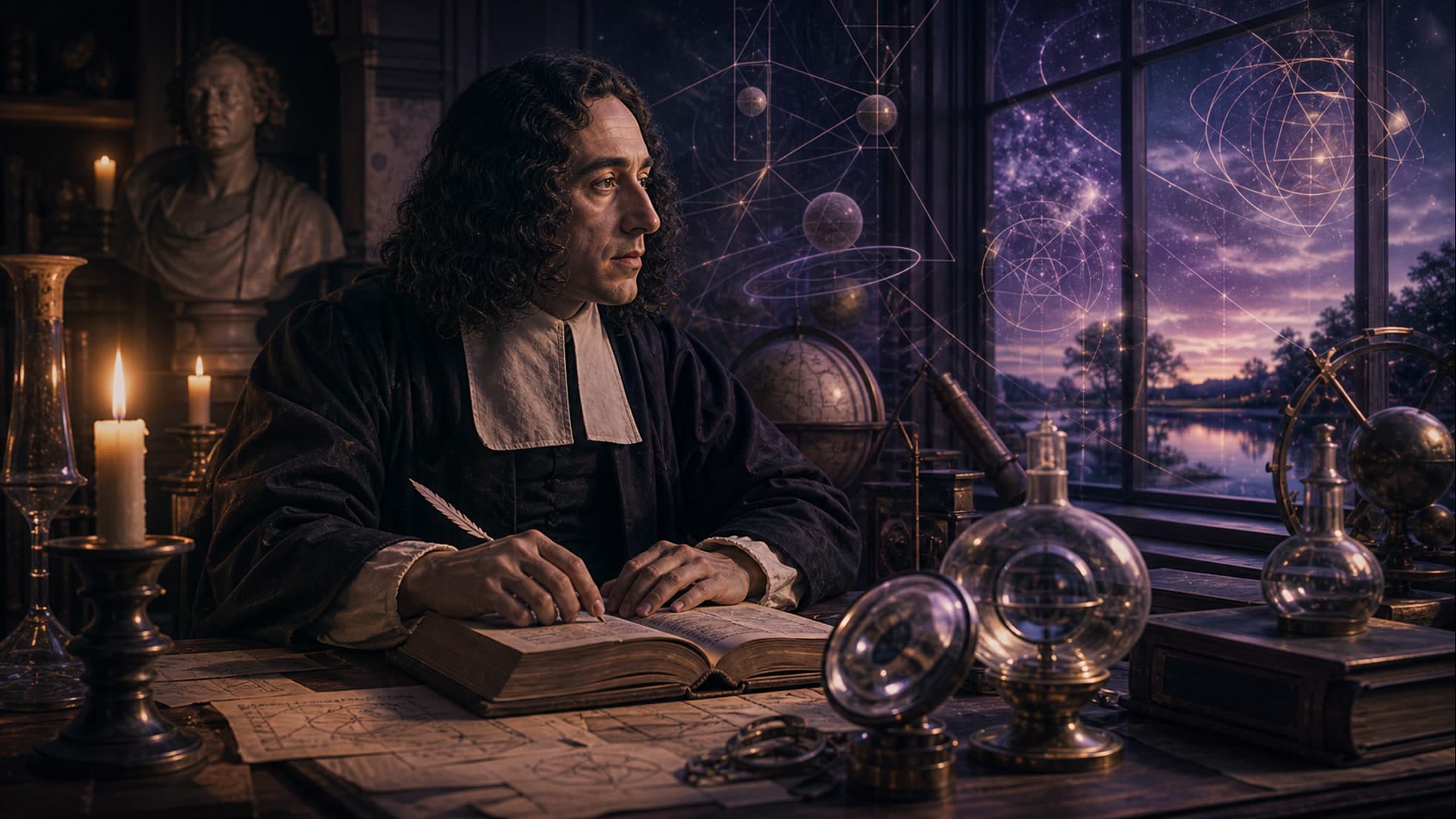
Spinoza: do you have free will or is everything already determined?
 Andres Aguilar
Why did you choose this way? Because he thought that philosophy was neither poetry nor opinion.
There is a question that is at the heart of how we understand life: when you decided to get up today, when you chose the clothes you wore, when you decided to listen to this text, were you choosing freely? Or did you simply fulfill a sequence of causes, a chain that started billions of years ago with the Big Bang and that at this moment brought you here, exactly where you are, without you ever having had the real option of doing anything else?
Most of us go through life convinced that we are free. That every decision we make is ours. That we are the authors of our lives. And at the same time, every day we see evidence to the contrary. We make the same wrong decision in different relationships, we repeat the same patterns as our parents, we react automatically to certain stimuli, we are swept away by emotions that we do not decide to feel. How much freedom is there really in all that?
Almost four centuries ago, in a small room in The Hague, Holland, a Dutch philosopher of Sephardic origin dedicated his entire life to answering that question. And the answer he arrived at is one of the most radical in the history of thought. His name was Baruch Spinoza, and he said something that almost no one in his time accepted: free will, as we imagine it, does not exist. Everything is determined. And, paradoxically, in that radical determinism he found true freedom.
The excommunicated Jew
Baruch Spinoza was born in Amsterdam in 1632. His family was Sephardic Jews who had fled Portugal to escape the Inquisition. Amsterdam, at that time, was one of the strangest and freest cities in Europe. It was a huge port, full of merchants, ships, money, and above all, religious tolerance. At a time when most of the continent was burning people for thinking differently, Holland let Jews live their lives, Protestants argued with Catholics, free thinkers wrote whatever they wanted, as long as they didn't make the powers that be too uncomfortable.
In that tolerant Amsterdam Spinoza grew up. He studied in a Jewish school, where he learned Torah, Talmud, Hebrew, the great rabbinic thinkers. He was a brilliant student. His teachers thought he was going to be a great rabbi, a glory to the community. But something broke along the way.
Spinoza began to read other things. He read Descartes, who was revolutionizing philosophy at the time. He read Maimonides, the great medieval Jewish philosopher. He read classic texts. And he started asking questions that the community didn't want to hear. He began to doubt the divine authorship of the Torah. He began to question whether God had the personal characteristics that religion attributed to him. He began to maintain that the soul was not immortal, not in the traditional sense at least.
The Jewish community of Amsterdam found all this very bad. They were in a delicate situation. They had been trying for years to gain the trust of local Christian authorities, demonstrating that they were trustworthy citizens. Having a brilliant young man among them who questioned God was a bomb that could explode against them. They offered Spinoza money, they offered him silence, they asked him to keep his mouth shut. Spinoza did not accept.
In 1656, when he was twenty-three years old, the community excommunicated him. The excommunication, in Hebrew cherem, was brutal. The text of the cherem that survives speaks of the harshest curses. It is forbidden for any Jew to speak with him, to help him, to read what he wrote, to be under the same roof. Spinoza was literally expelled from his own world. And not only that: shortly after a fanatic tried to kill him in the street, he stabbed him which he narrowly avoided. Spinoza kept the jacket with the knife hole throughout his life, as a reminder of how far intolerance could go.
And then he did something remarkable. He changed his name. From Baruch (which in Hebrew means "blessed") he became Benedictus, the Latin version of the same name. He moved to a smaller city. He made his living polishing optical lenses. It was manual, precise, silent work. While I polished lenses, I wrote. While he was writing, he didn't mess with anyone. He lived the rest of his short forty-four years almost like a monk, in extreme austerity, eating little, spending almost nothing, dedicated to thinking.
A geometry of God
Spinoza's main work is called Ethics. It is one of the strangest books ever written. The reason is the form. Spinoza decided to write philosophy as if it were geometry. Definitions, axioms, propositions, demonstrations, theorems. The book starts with definitions of "substance", "attribute", "mode", and builds step by step, with the rigor of a mathematics manual, towards conclusions that are anything but mathematical.
Why did you choose this way? Because he thought that philosophy was neither poetry nor opinion. It was the search for necessary truths. And the necessary truths are demonstrated, not felt. If Spinoza was right, his philosophy was going to be as unassailable as a theorem of Euclid. You couldn't discuss it, you could only show where the error was in a demonstration.
The central conclusion of Ethics, the one that generated the most scandal and the most fascination, is that there is only one substance in the universe. Just one. And that substance, says Spinoza, is God. But be careful, not the God of the Bible, that bearded and capricious character who creates the world in six days, who gets angry, who forgives, who punishes. Spinoza's God is something else. It's the entire universe. It's nature. It's all that exists.
For Spinoza, God and nature are the same thing. Deus sive Natura, writes in Latin: "God or, what is the same, Nature." This means that God is not outside the universe creating it. God is the universe. Every star, every plant, every person, every thought, everything is part of a single reality that is God. There is no creator separate from creation. There is only one thing, infinite, which has infinite attributes, and of which we know two: thought and extension, the mental and the physical.
This idea earned Spinoza being called an atheist and a pantheist, two accusations that in his time were practically synonymous with "dangerous." For the Jews he was an atheist because he denied the personal God of the Torah. For Christians he was an atheist for the same reasons. For some free thinkers, he was the most radical pantheist in history: someone who dissolved God in nature until he disappeared as a separate entity. The controversy continued for centuries.
Total determinism
If everything is God, and God is nature, and nature functions according to necessary laws, then something inevitably follows. Everything that happens had to happen exactly as it happened. It couldn't have been any other way. Every event in the universe, from the movement of a planet to a decision you make today, necessarily follows from the causes that preceded it.
For Spinoza, this is not an opinion. It is a logical conclusion from its premises. If God is nature and nature operates out of necessity, then there is no real chance, no miracles, no spontaneous decisions that break the causal flow of the universe. Everything that happens is an inevitable consequence of something previous, which in turn is an inevitable consequence of something even more previous, going back to infinity.
And here comes the direct blow to the human ego: you, your life, your decisions, your emotions, your thoughts, are also part of that chain. You think you decide freely. But in reality, says Spinoza, what you call freedom is ignorance. It is not knowing the causes that led you to do what you did. If you could see clearly enough all the causes that pushed you to make the decision you made, you would realize that it was the only possible decision for someone like you in that situation.
If a stone thrown into the air were conscious, it would believe that it moved of its own will. That is the illusion of men who believe they are free: they ignore the causes that determine them.
That image of the stone is one of the most powerful in all of philosophy. Imagine a stone falling from a building. The stone falls because gravity attracts it, because someone threw it, because the laws of physics move it. The stone does not choose to fall. Fall. But if the stone could think, if it had a consciousness as it fell, what would it think? You'd probably think, "I decided to fall. I'm falling freely. I chose this moment." I would have a sense of freedom, a subjective experience of choice. But that feeling would be an illusion. The stone is only fulfilling what physics imposes on it.
Spinoza says: we are that stone. We have the feeling of choosing, but that feeling comes from not understanding the causes that move us. Genetics, education, emotions, previous experiences, brain reflexes, all of that is pushing us all the time. And we, meanwhile, say: "I decided." It's like an actor who believes he is the director of the play while someone writes the script from the outside.
The conatus: the secret engine of everything that exists
One of the central ideas of Ethics, and perhaps one of the least known outside of academic philosophy, is that of conatus. Spinoza defines it more or less like this: each thing, to the extent that it exists, strives to persevere in its being. Every plant, every animal, every person, every atom, is pushing to continue existing, to maintain itself, to grow in its own way. That push is the conatus.
In human beings, conatus manifests itself as desire. Desire, for Spinoza, is not a whim. It is the fundamental force that keeps us alive, that makes us want the things we want, that defines our essence. You don't want something because it is good. It is good for you because you want it. This completely reverses traditional moral logic. There is no objective good outside that we have to aspire to. There are desires, and anything that increases our power to act, our ability to continue to exist and prosper, is good for us. Anything that diminishes that power is bad.
From this idea comes a fairly elegant theory of emotions. Joy, says Spinoza, is the feeling that accompanies the increase in our power to act. Sadness is the feeling that accompanies the diminution of that power. When something does you good, you feel joy, because something in your life is allowing you to grow, be more alive, be more of yourself. When something hurts you, you feel sadness, because something is shrinking you, weakening you, taking away your vitality. Complex passions, such as love, hate, envy, jealousy, are combinations of these basic emotions with ideas about the causes that produce them.
This theory is remarkably modern. Contemporary psychology, especially the affirmative psychology of people like Antonio Damasio, found in Spinoza a surprising precursor. Damasio wrote an entire book on the connections between Spinozism and the neurobiology of emotions. For Spinoza, the mind and body were not separate things as they were for Descartes. They were two aspects of the same reality. What happens in your body and what happens in your mind are two sides of the same coin, two different descriptions of the same event.
The freedom that does exist
Here comes the most surprising twist. If everything is determined, if we do not have free will, then what? Are we condemned to be puppets? Is Spinoza's philosophy depressing? For Spinoza, no. On the contrary.
Spinoza says that there is a form of freedom, but it is not the one we think. It is not the freedom to choose anything at any time. That freedom does not exist, it is an illusion. Real freedom is understanding the causes that determine you. It's knowing why you do what you do. It is realizing what passions dominate you, what fears paralyze you, what desires control you. The more you understand your own functioning, the freer you are. Not because you can escape the causes, but because you can act from understanding instead of acting from ignorance.
This idea is very similar to what psychoanalysis later said. Freud said that the unconscious controls us, and that therapeutic work consists of making the unconscious conscious to have a little more margin over our lives. Spinoza, two centuries earlier, said something similar. Freedom is not the absence of causes. It is understanding of causes. And the tool for that understanding is reason.
Spinoza also has a theory of emotions that connects directly to this. Distinguish between passions and actions. Passions are emotions that we suffer passively, that dominate us, that drag us. When you are jealous, when you are angry, when you are obsessed with something, those are passions. They have you, not you them. Actions, on the other hand, are emotional states that arise from our own nature, that we understand, that are aligned with our reason.
The path to freedom and happiness, for Spinoza, is to transform passions into actions. It is understanding why we feel what we feel so that those emotions stop controlling us and begin to be at the service of a better life. This sounds a bit abstract, but think about something concrete. When you are angry with someone and you understand exactly what made you that way, what things in your personal history were activated, what old memory is being played in that situation, anger changes character. It is no longer a storm that drags you down. It's something you can look at, understand, eventually let go of.
The friendship of a rebellious genius
Spinoza, despite his excommunication and his radical ideas, was a person very loved by those who knew him. His letters show a kind, patient guy, willing to explain his ideas calmly even to interlocutors who did not understand them. He had close friends, he lived with families who took him in, he took care of his owners when they were sick. He was not the bitter hermit one might imagine from his story.
An anecdote that illustrates the character well: in 1673, Prince Charles Ludwig of the Palatinate offered him a professorship at the University of Heidelberg. It was a prestigious, well-paid position at one of the best universities in Europe. Spinoza rejected it. His reason: he feared that the professorship would limit his freedom of thought. If he accepted, he was going to have to teach within the limits that the university set for him, and he preferred to continue polishing lenses in The Hague, earning little, but thinking whatever he wanted. There are few cases in the history of philosophy of a more consistent rejection of one's own ideas.
Spinoza died in 1677, aged forty-four. The cause is believed to have been a lung disease, possibly aggravated by the glass dust he breathed while polishing lenses. He had few possessions. His friends published the Ethics after his death, in a volume titled Opera Posthuma, without signing it, to avoid persecutions. The book was quickly banned almost everywhere. But the manuscripts circulated. The ideas percolated. And over time, Spinoza became one of the most influential thinkers of the modern era.
The intellectual love of God
There is a concept in Spinoza that is worth mentioning because it is one of the most beautiful and least understood. He calls it amor intellectualis Dei, the intellectual love of God. It does not refer to the love that God feels, nor to the love that you feel towards a personal God. It refers to a specific state of mind that appears when you deeply understand how the universe works.
Spinoza says that when you manage to see your own life, your emotions, your joys and your sufferings, as part of the necessary order of nature, you stop fighting with them. You accept. And in that lucid, not resigned acceptance, arises a calm joy that he calls the intellectual love of God. It is a happiness that does not depend on the ups and downs of life. It is the happiness of those who understand.
This sounds mystical, and in fact many people read Spinoza as a rationalist mystic, a strange mixture that only works for him. Beatitude, he says in the last part of the Ethics, is not the reward of virtue, but virtue itself. It's not something you earn by being good. It's what it feels like when you understand.
The current echo
Today, Spinoza's determinism is more relevant than ever, but in a way that he could not imagine. Modern neuroscience, experiments on decision-making, studies on how the brain decides before consciousness finds out, all of this calls into question free will in terms very similar to those proposed by Spinoza. Benjamin Libet's famous experiments in the 1980s showed that the brain begins to prepare a motor decision before the subject reports having decided. Consciousness is late to the party. Neuroscientists continue to debate what exactly that means, but the general direction points toward the idea that the feeling of choosing is constructed after the fact.
And on the other hand, Spinoza's philosophy reappears in deep environmentalism, in Western Buddhism, in certain currents of systemic thinking. The idea that we are part of a whole, that we are not separate from nature, that the boundary between the self and the rest of the universe is more porous than we think, is very Spinozian. Albert Einstein, when asked if he believed in God, said: "I believe in the God of Spinoza, who reveals himself in the ordered harmony of what exists, and not in a God who cares about the destinies and actions of human beings."
The most profound thing that Spinoza left behind is not an answer about free will, but an invitation to live differently. If you understand that you are determined, that your emotions have causes, that your life is part of something enormous that exceeds you, then you can stop fighting against the universe. You can accept what happens. You can stop believing that you are special, that your choices are sacred, that the world revolves around your will. And in that lucid surrender, paradoxically, there is a peace that the illusion of free will never gives.
A falling stone thinks it decides to fall. You think you decided to listen to this text. Maybe Spinoza was right. Maybe everything was written from the beginning. But understanding that movement, seeing the causes that bring you here, that is something. That, according to Spinoza, is the closest we are going to get to freedom.
Related episodes
Close your eyes and look for your self. That permanent center that is you. Look carefully. A friendly, chubby Scotsman did that same exercise nearly three hundred years ago — and didn't find it. What he found instead was one of the most unsettling idea...
The most powerful man in the world wrote a private journal every night that he never intended to publish: he challenged himself not to be an idiot, reminded himself he was going to die, and braced for setbacks before they arrived. Two thousand years la...
A man whose master broke his leg responded without screaming and without losing his composure. Not because he was unfeeling, but because he had found something no master can take from anyone: control over one's own inner response. Epictetus went from s...