
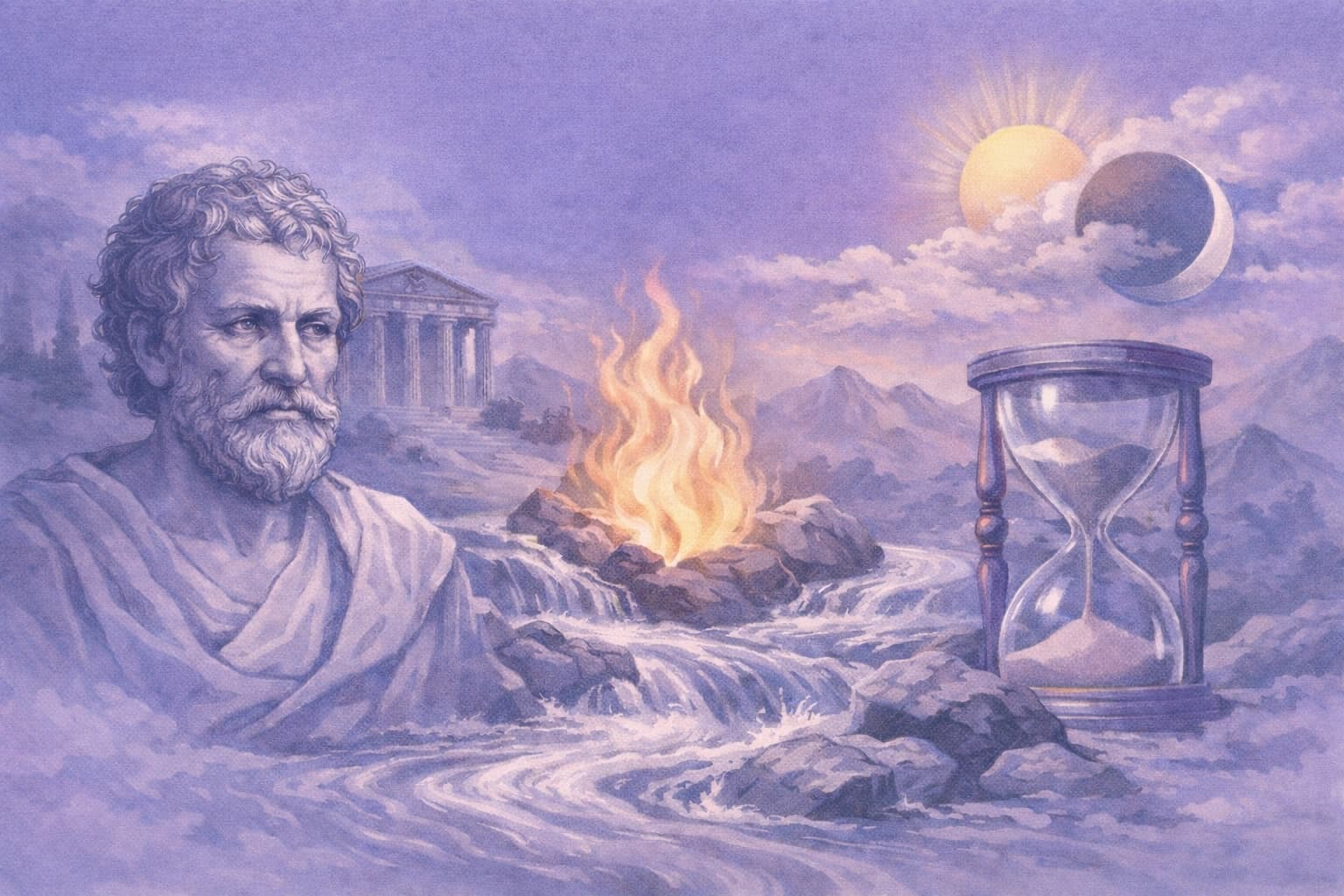
Heraclitus: Everything Flows, Nothing Stays
 Andres Aguilar
Twenty-five hundred years ago, a Greek philosopher who died buried in manure left behind an idea we still haven't managed to refute: nothing is static, everything changes, and clinging to what will inevitably change is the surest path to suffering. Her...
At some point in the fifth century BCE, a sick man decided to cure himself using a rather peculiar method. Convinced that his body was retaining too much moisture — a medical theory of the era that doesn't hold up to any modern analysis — he buried himself completely in a pile of cow manure and waited for the sun's heat to dry him out. He died that way, buried in excrement, somewhere in his sixties, one of the most brilliant and most misunderstood intellects of all antiquity.
The man was Heraclitus of Ephesus. And if that death seems consistent with someone who was known in life as "the Obscure" for deliberately writing in a style so cryptic that nobody understood him well, then you already have a first image of who this guy was.
But beyond the anecdote — which may be apocryphal, meaning invented or exaggerated by tradition — Heraclitus was the philosopher who forever changed how we think about change. The one who said you can't step into the same river twice. The one who claimed the world isn't a thing but a process. The one who saw conflict and contradiction not as problems to be solved but as the very structure of reality. And if that sounds abstract right now, don't worry: by the time we're done here it'll make a lot of sense and you'll recognize his ideas in places you never expected to find them.
The Context: Ephesus and the First Philosophers
To understand Heraclitus, you have to place him in his context. Ephesus was an important Greek city on the coast of what is now western Turkey. A cosmopolitan, wealthy city, with commercial connections to Persia, Egypt, and the entire Mediterranean world. A place where ideas circulated alongside merchandise.
Heraclitus lived roughly between 535 and 475 BCE — around the same time that Buddha was teaching in India and Confucius in China. Some historians call this period the "Axial Age," that strange era when, in different parts of the globe with no apparent connection to each other, thinkers appeared for the first time asking fundamental questions about human nature and the universe.
In Greece, the philosophers who came before Heraclitus — people like Thales, whom we discussed in an earlier episode, or Anaximander — had primarily asked one question: what is the world made of? What is the fundamental matter of reality? Thales said water. Others proposed air, earth, or fire. It was a legitimate question and the starting point for what would eventually become natural science.
Heraclitus did something different. Instead of asking what the world is made of, he asked how the world works. And his answer was radical: the world is not a static substance but a process in permanent motion. It's not a thing — it's an event that is continually occurring.
The River and the Paradox of Change
The most famous image from Heraclitus — the one everybody quotes even if they don't know it's his — is the river. "You cannot step into the same river twice," he is said to have said. Though to be precise, what he seems to have actually written is something more subtle: both you and the river are different the second time. Not only does the river change. You change too.
Think about it for a moment, because it seems obvious but is actually quite disturbing. The river you see today doesn't have the same water molecules as yesterday. The riverbed has shifted slightly. The water temperature is different. The light falls at another angle. It's recognizable as the same river in a practical sense, but in a deeper sense it's a different river. And you, looking at it, are not exactly the same as you were yesterday either. Your cells are renewing. Your neurons forged new connections while you slept. Your thoughts and emotions today are not identical to yesterday's.
So what is it that makes the river "the same river"? And what makes you "the same person"? Heraclitus doesn't answer that question directly, but he poses it with a clarity that's uncomfortable. And that discomfort is precisely what philosophy is about when it's done right.
His central idea — panta rhei, which in Greek means "everything flows" — is not just an observation about rivers. It's an assertion about the nature of all of reality. Everything is in motion. Nothing is static. What we call "things" are actually processes unfolding in time, and our tendency to see them as fixed objects is a convenient illusion that helps us function in the world but distorts reality.
> What we call "things" are actually processes unfolding in time, and our tendency to see them as fixed objects is a convenient illusion that helps us function in the world but distorts reality.
Fire and the Logos
If everything flows, if everything is constantly changing, is there anything that remains? Is there any principle of order in the middle of all this movement? Yes, said Heraclitus — but it's not a substance, it's a law. And he called it the logos.
The word logos in Greek has several meanings: word, reason, speech, proportion. Heraclitus used it to designate the rational principle that governs change in the universe. It's not that everything changes randomly and chaotically. Change has a structure, a logic, a repeating pattern. The logos is that invisible pattern that orders the perpetual flux of things.
To illustrate it, Heraclitus used fire as his central image — and some interpreters read him as saying fire was the primordial element, though scholars debate this. But fire is brilliant as a metaphor, even if you haven't thought about it that way: fire is never the same. It's constantly changing, consuming new material, transforming it into light and heat and ash. But at the same time it has a recognizable form, a pattern of behavior that makes it identifiable. Fire is change with structure. The universe, for Heraclitus, is something like that.
He also said something apparently paradoxical: fire becomes water, water becomes earth, earth becomes fire. Everything transforms into everything else. Nothing is created or destroyed — it's perpetually transformed. And if this reminds you of something you learned in high school chemistry class, that's not a coincidence: the law of conservation of matter has an ancestral intuition in this Greek philosopher from 2,500 years ago.
The Unity of Opposites: The Hardest and Most Powerful Idea
Now we get to what I think is Heraclitus's most original and most difficult-to-grasp contribution: the idea that opposites are actually the same, or more precisely, that opposites need each other and are different aspects of one and the same reality.
Let's look at some examples of what he said. He said that the road up and the road down are the same road. That illness makes health desirable. That hunger makes food pleasurable. That fatigue makes rest sweet. That without evil we would not recognize good.
This might sound like wordplay, but there's something deeper. The idea is that opposites are not separate things that exist independently and contradict each other. They are poles of the same tension, and that tension is what generates reality as we know it.
He used the image of the bow and the lyre. An archer's bow and a musician's lyre look like completely different objects, but they have the same essential structure: a tension between two extremes that, precisely because they oppose each other, produces something. In the bow, the tension launches the arrow. In the lyre, the tension produces music. Harmony, said Heraclitus, is not the absence of tension but the result of tensions well balanced.
> Harmony, said Heraclitus, is not the absence of tension but the result of tensions well balanced.
This idea had an enormous influence on later philosophy, particularly on Hegel — the nineteenth-century German philosopher who built his entire philosophy around the movement of opposites: thesis, antithesis, and synthesis. And from Hegel, that idea passed to Marx, who used it to understand history as a movement of conflicts and resolutions. So the next time someone talks about dialectics — that's the technical term for that movement of opposites — remember there's a thread running from Marx to Hegel and from Hegel all the way back to Heraclitus standing by a river in Ephesus 2,500 years ago.
The Contempt for the Crowd and a Difficult Character
Now let's talk about the man himself, because Heraclitus as a person was, to be honest, pretty insufferable. And that too is part of his story and how his ideas came down to us.
He came from an aristocratic family in Ephesus and had the disdain characteristic of someone who believes he's smarter than everyone — and who was right to believe it. He despised the poets, including Homer, who was basically the Shakespeare of Greece and a cultural untouchable. He criticized Pythagoras — the triangle guy — for accumulating knowledge without understanding anything. He thought most people lived asleep, following conventions without questioning anything.
He deliberately wrote in an obscure, cryptic style — in fragments that look more like riddles than arguments. Some think it was because he wanted only those who truly made the effort to understand him. Others think he simply didn't care much about being understood by ordinary people and wrote for that posterity he knew would eventually value him.
There's an anecdote, probably also apocryphal, that when the Ephesians asked him to give them laws, he refused and went to play knucklebones with the children in the temple of Artemis, saying he found that more interesting than doing politics with adults who understood nothing. I don't know if this actually happened, but it's very consistent with the character.
He was also reportedly called "the Weeping Philosopher," in contrast to Democritus, "the Laughing Philosopher," because Heraclitus supposedly wept constantly over human stupidity while Democritus laughed at it. Two different responses to the same diagnosis.
The Influence: From the Stoics to Hegel, via Nietzsche
Heraclitus died and his texts fragmented. Literally: what came down to us are fragments of a larger work that was lost. We have around 125 fragments, some only a few words long, others a few lines. They look like pieces of a puzzle with three-quarters of the pieces missing.
But those fragments were enough to influence virtually all subsequent Western philosophy.
The Stoics — whom we'll discuss in another episode when we get to Epictetus — took the Heraclitean concept of logos directly and made it a pillar of their philosophy. For them, the logos was the divine reason that ordered the universe, and living in conformity with the logos was the key to the good life. Without Heraclitus, there would be no Stoicism as we know it.
Plato argued with Heraclitus — or rather with his followers — because he felt that if everything changes constantly and nothing remains, then genuine knowledge is impossible. How can you know something that keeps changing? Plato's answer was to posit a world of immutable and eternal forms existing above the world of change. In a sense, all of Plato's philosophy is a response to Heraclitus.
Then there's Hegel, who in the nineteenth century explicitly said there is no philosopher of antiquity who interests him more than Heraclitus, and that the fundamental principles of his own philosophy were all already in him. The dialectical movement Hegel described as the engine of history — the tension between opposites that resolves into a synthesis which then generates a new tension — is essentially Heraclitean.
And Nietzsche, who also came up in this series when we talked about the death of God, loved Heraclitus deeply. He saw him as the only pre-Socratic philosopher — meaning one who came before Socrates — who deserved genuine respect, because he'd had the courage to look at reality without softening it: conflict as engine, change as the only constant, the illusion of permanent being as a comforting error.
The Paradox of Knowledge: How to Know What Changes?
There's a question that Heraclitus's thinking inevitably generates, one that later philosophers couldn't ignore: if everything changes constantly, how is knowledge possible?
Knowledge seems to require a certain stability. To know something about a river you need to be able to come back and recognize it as the same river. To learn chemistry you need to trust that hydrogen will behave tomorrow the same way it does today. How does that hold up if the flux is constant?
Plato asked himself this question and answered it by positing a world of eternal, immutable "forms" or "ideas" existing beyond the sensory world. The particular horse you see changes and dies, but the "form" of the horse — the essence of what it is to be a horse — is eternal. True knowledge is knowledge of those forms, not of the changing things of the sensory world.
It's an elegant solution, but one that pays a very high philosophical price: it doubles the world. Now we have the world we perceive, which changes, and the world of forms, which doesn't. How are they related to each other? Where are those forms? Who created them?
Aristotle, Plato's great dissident pupil, rejected that duplication and sought the forms within things themselves. But in both cases — Plato and Aristotle — they're responding to Heraclitus. They're trying to save knowledge from the avalanche of permanent flux he had identified.
In other words: the epistemological question — the question of how we know — that dominates much of Western philosophy has its starting point in Heraclitus. Not bad for someone who wrote in cryptic fragments and ended up buried in manure.
Heraclitus Today: Why He Still Matters
And today? What does Heraclitus tell us in the twenty-first century?
More than you might think. We live in a culture with a very complicated relationship with change. On one hand, we celebrate innovation, movement, disruption as values in themselves. On the other hand, we still have a deep resistance to changing who we are, to recognizing that the certainties we have today may be different tomorrow, that the identities we've built with such effort are also processes in motion and not fixed states.
Heraclitus's insistence on permanent change has something liberating about it: if everything changes, if you yourself are a process and not a fixed thing, then you can also change. The mistakes of the past don't define you forever because you aren't the same person as before. But it also has something unsettling: if everything flows, if nothing stays the same, where are the anchor points? What can we hold onto?
Heraclitus's answer would be that the anchor point is not a static thing but the logos: understanding the pattern underlying the change. You can't stop the flow, but you can understand how it flows. And that understanding is the deepest form of wisdom available to humans.
> You can't stop the flow, but you can understand how it flows. And that understanding is the deepest form of wisdom available to humans.
There's also something very Heraclitean in modern physics, though physicists don't usually cite him. Quantum mechanics — the physics that describes the behavior of subatomic particles — shows that at the fundamental level, reality is not made of static objects but of processes, interactions, probabilities in motion. Physicists talk about "fields" rather than "particles," about events rather than things. The universe at a deep level looks much more like what Heraclitus described than like the billiard-ball metaphor we used to use.
The Obscure and His Legacy
There's something I find beautiful and a little melancholy about the story of Heraclitus. He was a man who understood something profound about reality — that change is the only constant, that opposites need each other, that there's an order in the permanent flux of things — and who nonetheless died misunderstood, buried in manure, with his texts fragmenting and getting lost over time.
And yet his ideas survived. Not complete, not in the form he would have wanted, but fragmented and dispersed, transmitted through other thinkers who debated with him or admired him. It's almost ironic: the philosopher of flow and change left a body of work that also flowed and changed, that fragmented and transformed, that reaches us incomplete but recognizable.
There's a fragment of his that stays with me: "The same thing are the living and the dead, the waking and the sleeping, the young and the old. For these, shifting around, are those, and those shifting around are these." It's dense, cryptic, typically Heraclitean. But if you think about it, it says something about how all the categories we use to organize the world are useful conventions laid over a continuous flux that doesn't have the clean borders we'd like to believe.
And this doesn't just apply to abstract ideas. It shows up in the most everyday things. Jerry Seinfeld has a great bit where he says everything we own is basically just trash in different stages. First it's on the shelf, then in a drawer, then in a box, then in the garage... and eventually it ends up in the trash.
It's funny. But it's also deeply Heraclitean.
The river flows. Your stuff flows too. You flow too. And for Heraclitus, that wasn't a catastrophe — it was simply the nature of things. Learning to live with that truth, without clinging too tightly to what will inevitably change, was for him the most honest way to relate to reality.
To Close
Heraclitus is difficult. His texts are difficult, his character was difficult, and the idea he proposes — that reality is fundamentally dynamic and contradictory — is difficult to accept because it asks us to give up a certain comfort.
But there's something in that difficulty that's worth it. Because if there's one thing Heraclitus teaches us, it's that resistance to change isn't just futile — it's a way of not seeing reality as it is. The river keeps flowing regardless of whether you want it to stay still. The question is whether you learn to move with it or stay standing on the bank watching water that's already gone.
In our episode on Thales, we talked about how the first Greek philosophers asked what the universe is made of. Heraclitus takes it a step further and asks how it works. And his answer — that it works through conflict, change, and the tension of opposites — turned out to be one of the most fertile intuitions in all of Western intellectual history.
Related episodes

Why did you choose this way? Because he thought that philosophy was neither poetry nor opinion.
Close your eyes and look for your self. That permanent center that is you. Look carefully. A friendly, chubby Scotsman did that same exercise nearly three hundred years ago — and didn't find it. What he found instead was one of the most unsettling idea...

The most powerful man in the world wrote a private journal every night that he never intended to publish: he challenged himself not to be an idiot, reminded himself he was going to die, and braced for setbacks before they arrived. Two thousand years la...