
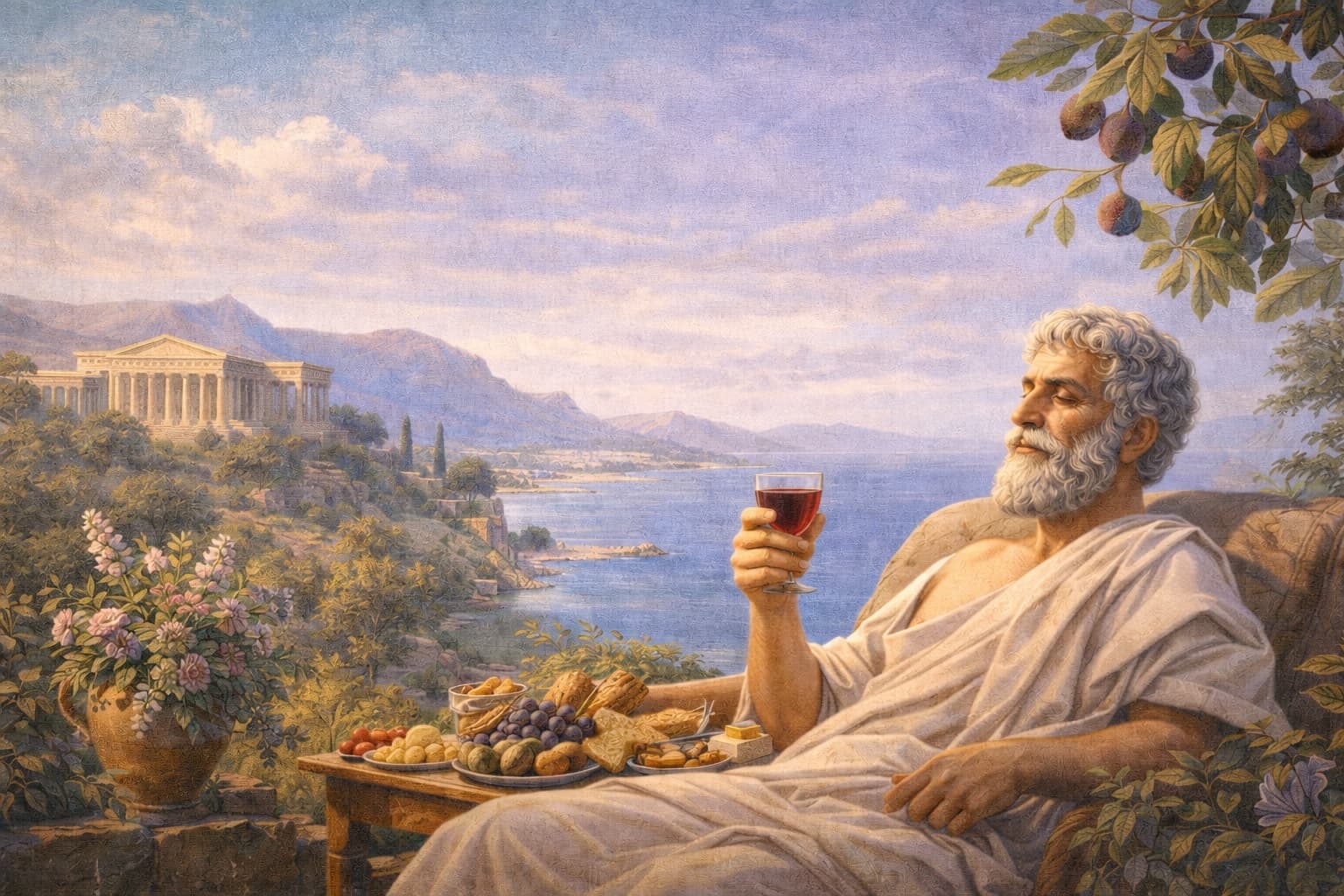
Epicurus: Why Moderate Pleasure Is the Key to Tranquility
 Andres Aguilar
For centuries, Epicurus was blamed for a philosophy of excess and indulgence he never actually taught. The real Epicurus lived in a modest house eating bread and water, and his idea of pleasure was almost the opposite of what we've been told: not more,...
Something was misrepresented to us about Epicurus. For centuries — and when I say centuries I'm not exaggerating — this Greek philosopher was presented as the spiritual father of orgies, extravagant banquets, and a life of excess. "Epicurean" became synonymous with someone who wallows in carnal pleasures, eats until they burst, and pursues luxury and constant sensation. There are restaurants named after him to sell five-course menus with wine pairings. Luxury hotels calling themselves "Epicure" or "Epicurean" to suggest refinement and abundance.
The problem is that Epicurus lived in a modest house in Athens with a garden, ate barley bread and water, and was known for living a life of almost monastic simplicity. A guy who would have looked at a Roman banquet with the same discomfort you and I feel looking at a fast-food ad at two in the morning when we're on a diet.
So how did this happen? How did the philosopher of moderate pleasure become the icon of excess? That's what we're going to explore today. And I'll give you a heads-up: the answer has to do with politics, the Church, and something humans are very good at — twisting other people's ideas to suit our own purposes.
Who Was This Guy
Epicurus was born in 341 BCE on Samos, a Greek island off the coast of what is now Turkey. His family was of Athenian origin but lived in a colony, so from childhood he had that feeling of being between two worlds. At eighteen he moved to Athens to do his military service — mandatory for citizens — and there he began frequenting the philosophical schools that were everywhere in the city.
Athens at that time was the intellectual center of the known world. Plato had already died, but his Academy continued operating with his disciples. Aristotle's followers debated at the Lyceum. And there were a ton of smaller philosophical currents competing for attention and students, as if the city were a giant marketplace of ideas where everyone was offering their system and trying to convince you theirs was the right one.
Epicurus studied with several teachers, absorbed diverse influences, and eventually concluded that they were all wrong about something fundamental. At thirty-five he settled permanently in Athens and founded his own school. He called it, with all the originality in the world, "The Garden." Not because it had some special poetic significance, but because it was literally a house with a garden that he bought on the outskirts of the city.
And here's the first interesting thing: The Garden was radically different from the other philosophical schools of the era. Plato's Academy and Aristotle's Lyceum were institutions for free Greek citizens — mostly men, from comfortable backgrounds. The Garden admitted women, slaves, and foreigners. For the fourth century BCE, that was quite a statement of principles. Not a political revolution with flags and speeches, but something more everyday and perhaps more profound: the idea that any person, regardless of their origin or gender, could seek happiness and deserved the tools to do so.
They lived communally. They shared expenses, meals, conversations. Epicurus had fairly precarious health and spent much of his life dealing with physical ailments, especially kidney and stomach problems — which is almost ironic for someone whose philosophy revolves around pleasure and physical wellbeing. But according to the letters he left, that didn't prevent him from finding genuine moments of joy in small things. One of his best-known lines goes something like this: "Send me a little cheese, so that when I want to have a real feast I can." The feast was cheese. A small piece of goat cheese. That was what generated genuine pleasure for the man supposedly responsible for inventing unbridled hedonism.
The Philosophical System: What He Actually Said
The central idea of Epicurus is that the goal of human life is to achieve happiness. Nothing too original there. Aristotle said something similar, the Stoics did too, almost all Greek philosophy circled around that question. The difference is how Epicurus defined happiness and how he thought you got there — because that's where he parts ways with everyone else and proposes something genuinely different.
For him, happiness was not a state of permanent ecstasy or the result of accumulating pleasures and intense experiences. It was something much closer to what we'd call today wellbeing or balance. And he defined it with two Greek words that are worth understanding because they're the key to his entire system.
The first is ataraxia. From the Greek, it means serenity, tranquility of soul, absence of mental disturbance. It's not euphoria or excitement. It's that state in which anxiety, fear, and constant worry about the future aren't gnawing at you. It's the calm of someone who goes to bed at night without owing anything emotionally to anyone and without ruminating over imaginary catastrophes. Someone who has nothing to prove and expects nothing in particular from anyone.
The second is aponia. This one is simpler: absence of bodily pain. Not torturing yourself with extreme deprivation — Epicurus was not an ascetic, meaning he didn't believe that suffering the body purifies the soul — but also not overeating until you feel sick or doing things that make you physically miserable afterward. The body at rest. Without pain, without self-inflicted discomfort.
And how do you get there? This is where Epicurus's philosophy gets interesting and, for many people, surprising. Because he said the path to wellbeing doesn't run through seeking more pleasures but through understanding which ones actually matter and which are a trap disguised as a promise.
He made a distinction between different types of desires. First there are natural and necessary desires: eating when you're hungry, drinking when you're thirsty, having shelter and a roof over your head. These are easy to satisfy, and satisfying them generates real and lasting wellbeing. Then there are natural but not necessary desires: for example, eating something good rather than just whatever kills the hunger. Those are fine too, said Epicurus, as long as they don't create dependency or anxiety when you can't satisfy them. The problem appears when you start needing that specific pleasure in order to function.
And finally there were what he called empty or vain desires: the ambition for unlimited wealth, the pursuit of fame, power for power's sake, pleasures that consume themselves and always demand more. These, according to Epicurus, are the ones that chain you rather than free you. They're desires that by their very nature are never fully satisfied. There's always another rung above.
The metaphor I like best for understanding this is the stomach. If you eat a reasonable amount of something good, you feel satisfied and that wellbeing lasts. If you eat until you're stuffed, you end up feeling sick and the pleasure became its opposite. And if you spend the day thinking about the next lavish meal you're going to have, you'll never enjoy the moment you're actually in. Excess pleasure doesn't add up — it subtracts. And that applies to food, to money, to recognition, to practically anything you desire with too much intensity.
The Tetrapharmakos: The Recipe for Happiness
One of the most curious things about Epicurus's philosophy is that he summarized it himself in what's known as the tetrapharmakos — literally "the four-part remedy" in Greek. It was a kind of recipe for happiness, formulated as if it were medicine, because Epicurus understood philosophy exactly that way: not as an abstract intellectual exercise but as a concrete treatment for human suffering.
The remedy had four components. First: don't fear the gods. Second: don't fear death. Third: what is good is easy to obtain. Fourth: what is terrible is easy to endure.
Let's take these one at a time, because each is deeper than it looks at first glance.
The thing about the gods was radical for his time. Epicurus was not an atheist in the modern sense. He believed the gods existed, but conceived of them as beings completely disinterested in human affairs, living in a kind of perfect blessedness without meddling in our lives. Therefore, praying to them to intervene in your life, fearing their whims or punishments, was a monumental waste of mental energy. The gods are not going to help or punish you because they simply don't care about you. That might sound harsh, but it also lifts an enormous burden: the belief that the universe has it out for you in particular.
The thing about death is perhaps his most famous and most elegant argument, and I think it deserves time. The Epicurean logic goes like this: while you are alive, death does not exist for you. When death arrives, you no longer exist. So what exactly are you afraid of? There's no moment when you and death will be in the same room at the same time. The fear of death is not a fear of something that's actually going to happen to you — it's an illusion that generates suffering in the present for no objective reason. Now, some people respond: "But I'm afraid of the dying process, of pain, of losing the people I love." And Epicurus acknowledged that. But he distinguished that from fear of death itself, which was what he was attacking.
The third point — that what is good is easy to obtain — connects with what we were saying earlier about types of desires. If what you really need to feel okay is bread, water, conversation with people you love, and sky over your head, those things are within reach of almost anyone. The problem isn't that happiness is inaccessible. The problem is that we convince ourselves we need things that are actually vain desires: the latest-model car, the bigger apartment, the higher position.
And the fourth — that what is terrible is easy to endure — was said by someone who lived with chronic pain. In the last letter he wrote before dying, Epicurus describes undergoing intense physical pain, but says the joy he felt remembering conversations with friends was enough to counterbalance it and maintain his serenity. It's not naive optimism or a denial of suffering. It's a bet on the human capacity to find sources of joy even in difficult circumstances — without those sources needing to be grandiose.
Friendship as the Greatest Good
I want to pause on something that's often overlooked when people talk about Epicurus: friendship was, for him, the greatest good a human being could cultivate. Not family, which in ancient Greece was an institution heavily tied to obligations and duties you didn't choose. Not romantic love, which Epicurus viewed with some caution because it generates intense emotional dependency and potential suffering when things go wrong. Friendship. That voluntary relationship between people who choose each other, without legal or biological obligations, founded on the genuine pleasure of each other's company and conversation.
He said something like: "Of all the things wisdom provides for happiness in life, the greatest by far is the possession of friendship." And this wasn't just rhetoric. He practiced it. The Garden was essentially a community of friends who lived and philosophized together, who helped each other through hard times and shared good moments without needing any ceremony.
There's something very contemporary in this idea that I find remarkable. Today there's an entire branch of psychology that researches the factors contributing to subjective wellbeing — meaning what actually makes people feel good about their lives — and over and over the studies show that the quality of social relationships is the most robust predictor of long-term happiness. Not money beyond a certain basic threshold, not professional success, not social status. Relationships. The depth of bonds. The possibility of having people you can talk to without needing to perform.
Epicurus reached that conclusion 2,300 years ago, without controlled studies or statistical analysis. Just by observing what actually made people feel good.
Why They Misrepresented Him
Back to the question from the beginning: how did Epicurus become the symbol of gluttony and excess?
The first reason is that his philosophical enemies caricatured him from the start. The Stoics — who competed with the Epicureans for students and influence — constantly described them as hedonists who only thought about sensual pleasure. It was a classic rhetorical strategy: saying "those guys just want to have a good time" is much more effective than refuting their philosophy point by point. The caricature sticks better than the argument.
The second reason is deeper and has to do with the rise of Christianity. When Christianity became the dominant religion of the Western world, it needed a philosophical enemy, an embodiment of the thinking that opposed its values of renunciation, sacrifice, and spiritual transcendence. And Epicureanism — with its emphasis on earthly pleasure, its skepticism about the afterlife, and its disinterest in interventionist gods — was the perfect candidate for that role. For centuries, "Epicurean" was almost an insult, synonymous with materialist and atheist in the most pejorative sense imaginable.
The third reason is simply human: it's always easier to remember the caricature than the original idea. "The philosopher who said pleasure was the only thing that mattered" is a simpler and juicier story than "the philosopher who distinguished between types of desires and proposed a life of moderation, friendship, and attention to the present." Popular culture simplifies. That's not a new phenomenon, though social media has enormously accelerated it.
The Connection to the Present
What does any of this have to do with us today? More than it might seem at first glance.
We live in a culture that is, in many ways, the perfect antithesis of Epicureanism. We're surrounded by systems designed with great precision to maximize desire, not satisfaction. Social media, marketing, the entire consumer economy operates on the premise that you're never quite satisfied. There's always something more you want, something better than the model you have, some experience you haven't had yet that will supposedly make you happy once you reach it.
Epicurus would have looked at Instagram and said it's a perfect machine for generating the desires he called vain. Desires for recognition, for favorable comparison with others, for performing a life better than the one you actually have. Everything that, according to him, takes you away from ataraxia — from that tranquility that's the basis of real wellbeing. Infinite scroll as the modern form of the endless search for ever-more-intense pleasures that never quite satisfy.
I'm not saying Epicurus had all the answers. He didn't. Some aspects of his philosophy are debatable. His argument about death, for example, is more clever than convincing for many people, because the fear of ceasing to exist seems to go beyond logic. And his wariness toward romantic love seems to go too far, because that kind of connection can also be a genuine source of joy. But there's a central intuition that remains very valuable: the difference between pleasures that free you and pleasures that chain you.
Think about it this way. Morning coffee with someone you love. A conversation that shifts your perspective. Reading something that makes you think. A walk without hurrying. Eating when you're hungry and stopping when you're satisfied. Those things are within reach of almost anyone, and they generate genuine, lasting wellbeing. The problem isn't that they're boring. The problem is that in a world designed to constantly stimulate you with bigger, faster, more intense things, learning to value them requires an active effort that goes against the current.
The Legacy
Epicurus died in 270 BCE, from kidney stones, at seventy-one years old — a pretty long life for the era. He died surrounded by friends, which was exactly the scenario he would have chosen. His last words, according to tradition, expressed gratitude and a remarkable serenity in the face of what was coming. A man consistent to the end.
His school survived for several centuries. In Rome, the poet Lucretius wrote an extensive and beautiful text called "On the Nature of Things" that is essentially an exposition of Epicureanism in verse. It was enormously influential and then, for centuries, practically vanished from circulation because the Church wasn't exactly fond of it.
During the Renaissance, as classical texts were being recovered, Epicureanism reemerged and influenced modern thinkers. And today, in ways sometimes explicit and sometimes more veiled, his ideas resonate in positive psychology, in minimalism as a cultural movement, in certain currents of Westernized Buddhism, and in what's called "slow living" — that tendency to deliberately live more slowly. Not that all these movements are Epicurean, but they share something: the suspicion that more isn't always better, and that the quality of the attention with which you live matters as much as what you have.
Something I find especially valuable in his intellectual legacy: he was one of the first philosophers of antiquity to write in a deliberately accessible style, without complicated terminology, thinking about a broad audience rather than only other philosophers. He believed philosophy should be useful for everyday life, not an intellectual exercise reserved for an elite with time to think about abstractions. In that too he was quite countercultural relative to the tradition around him.
It should also be mentioned that he wrote an enormous quantity of texts — several hundred scrolls according to the records — but almost all of it is lost. What survives are fragments, a few letters, and summaries of his doctrine written by others. Which is an interesting irony: the most misrepresented philosopher in history is also one whose original texts we have least of. We have to reconstruct him largely from what his enemies wrote about him.
One letter in particular survived intact: the Letter to Menoeceus, which is perhaps the most complete text we have in his own voice. It's brief, written with remarkable clarity, and summarizes the central points of his philosophy. If you ever feel like reading ancient philosophy and don't know where to start, that letter is a great entry point. It doesn't take more than twenty minutes to read and is surprisingly contemporary.
To Close
Epicurus was not what they told you he was. He was not the apostle of excess or the defender of dissolute living. He was a guy who lived with chronic pain in a modest house with a garden, who ate bread and cheese with genuine gratitude, who cultivated deep friendships as his most precious possession, and who had concluded that happiness is not something you achieve by accumulating experiences or material goods — it's something you cultivate by learning to distinguish what you really need from what's just the part of you that always wants more.
It's a philosophy that, 2,300 years later, remains irritatingly relevant. Especially in this historical moment when the entertainment industry, consumer culture, and social media compete for your attention with tools of persuasion that the Greek philosophers couldn't have imagined.
The next time someone tells you you'll be happy when you have more, when you reach a certain level, when you can afford certain things — remember Epicurus and his little piece of cheese. Not as a boring moral lesson or a call to self-sacrifice. But as a genuine, honest question: what do you actually need to feel okay? Because the answer, if you think about it seriously, is probably much simpler and more accessible than the world around you wants you to believe.
Related episodes

Why did you choose this way? Because he thought that philosophy was neither poetry nor opinion.

Close your eyes and look for your self. That permanent center that is you. Look carefully. A friendly, chubby Scotsman did that same exercise nearly three hundred years ago — and didn't find it. What he found instead was one of the most unsettling idea...

The most powerful man in the world wrote a private journal every night that he never intended to publish: he challenged himself not to be an idiot, reminded himself he was going to die, and braced for setbacks before they arrived. Two thousand years la...