
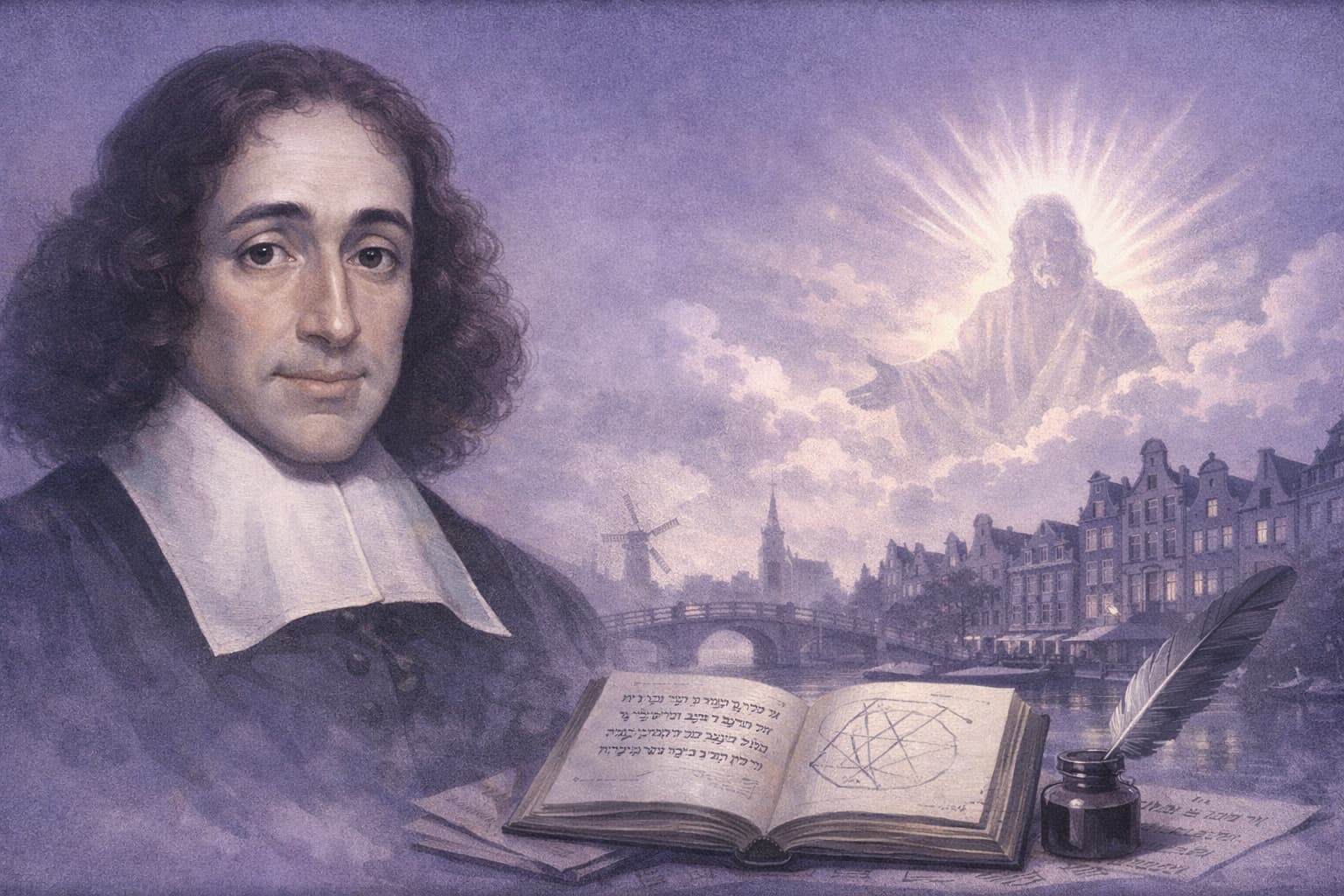
Spinoza: The Philosopher Who Wanted to Free God
 Andres Aguilar
At twenty-three, Spinoza was expelled from his community with the harshest excommunication recorded in modern Jewish history. No one knows exactly what ideas brought him to that point — but what he thought and wrote after that exile permanently changed...
On July 27, 1656, in the Portuguese synagogue of Amsterdam, one of the most violent documents in the history of modern thought was read aloud. It was not a death sentence. It was something, in a certain sense, worse. It was an excommunication — a cherem in Hebrew — expelling a twenty-three-year-old from his community, from his spiritual family, from everything he had ever known.
The text of the excommunication is extraordinarily harsh. It speaks of "abominable heresies," "monstrous actions," practices that must be hated and detested. But it doesn't specify what those heresies or actions were. To this day, historians aren't entirely sure what that young man did to deserve such a severe condemnation.
What we do know is that his name was Baruch Spinoza. And that what he thought was so disruptive, so radically different from everything the religious tradition of his era accepted, that the Jewish community of Amsterdam preferred to expel him before his ideas could spread.
What we also know is that Spinoza didn't change a thing. He kept thinking. He kept writing. And what he wrote is, two and a half centuries later, one of the most ambitious, most coherent, and most unsettling philosophical systems in all of Western history.
Who Was Spinoza?
To understand Spinoza, you have to understand where he came from, because his origins are inseparable from his thought.
The Spinoza family was of Portuguese descent — Sephardic Jews expelled from Portugal in 1492 during the Inquisition. Like so many Iberian Jewish families, they had wandered across Europe looking for a place where they could live with some degree of safety. Amsterdam, in the seventeenth century, was one of the few places in Europe where Jews could live with relative peace and practice their religion freely.
The Sephardic community of Amsterdam was, by that time, fairly prosperous and fairly conservative. They had settled in, they had businesses, they had a synagogue. And they wanted to maintain peace with the Dutch authorities, which meant not causing trouble, not generating scandals, not drawing attention with heterodox ideas.
And then along came this young man — son of a respectable merchant, brilliant, with an exceptional education in both the Jewish tradition and the European philosophy of his time — and he started asking questions nobody wanted to answer.
Questions like: What does it actually mean that God made the world? Does God have a will, emotions, purposes? What is the soul? Does it survive the death of the body? Are moral laws arbitrary divine commands, or do they have a rational basis? Why should we believe the Bible is the word of God?
These questions, in that context, were not academic curiosities. They were explosives.
Spinoza's God: A Conceptual Revolution
The central thing in Spinoza — what makes him so radical and so influential — is his idea of God. And to understand it, we need to start from what everyone in his era believed about God.
The dominant idea, in both Judaism and Christianity, was of a personal God: a being who has a will, who makes decisions, who created the world at a specific moment by a free act of his will, who intervenes in history, who communicates with human beings, who judges, rewards, and punishes.
Spinoza says all of that is anthropomorphism. It's projecting human traits onto something that completely transcends the human. When we say that God "wants," "loves," "gets angry," or "decides," we're using concepts that belong to finite, temporal, limited beings and applying them to something infinite. That doesn't make sense.
So what is God for Spinoza? His answer is radical: God is nature. Or more precisely, God and nature are the same thing — one single infinite substance. In Latin, he uses the expression Deus sive Natura: God, or nature.
This is not atheism, though it looked like it to his contemporaries. Spinoza doesn't say God doesn't exist. He says God is everything that exists. God is not a being among other beings: God is being itself, the totality of what there is.
And that totality operates according to necessary, immutable, eternal laws. There are no accidents in the universe, no exceptions, no miracles in the sense of something that violates natural laws. Everything that happens is the necessary expression of God's nature.
The Geometry of God
Now, the way Spinoza presents all of this is as peculiar as its content. His most important work is called the Ethics, published posthumously in 1677 — the same year he died at forty-four from tuberculosis. And it's written... like a geometry textbook.
Yes, like Euclid. It begins with definitions, follows with axioms, and from there derives propositions through formal proofs. Everything is presented with the rigor of a mathematical demonstration.
There's something deeply beautiful and deeply challenging about that. Beautiful because it says: the truth about God, the soul, freedom, and human happiness is not a matter of faith but of reason. It can be demonstrated with the same clarity as a theorem. Challenging because the reading is, let's be honest, extremely difficult.
Why do it this way? Because Spinoza believed that the prejudices, superstitions, and fears that prevent us from seeing reality as it is can only be cured by reason well applied. Not by sermons, not by good intentions, but by demonstrations that anyone, in principle, can follow and verify.
It's a gesture of enormous confidence in human reason and, at the same time, of enormous humility: I'm not asking you to take my word for it — I'm asking you to follow the argument and see if it holds.
The Problem of Free Will
One of the most provocative consequences of Spinoza's system is what it says about free will. And it's one of the hardest to accept.
If God is nature and everything that happens is the necessary expression of God's nature, then everything that occurs in the universe occurs necessarily. There are no accidents. No alternatives. No "it could have happened differently."
Including what we do. Our decisions are part of that necessary chain of causes and effects. In that sense, free will as we normally understand it — the ability to have acted differently from how we acted — doesn't exist.
This sounds very disturbing, and Spinoza knows it. But his argument is that the disturbance comes from a misunderstanding of what we are. We think we're free when we're actually ignorant of the causes that determine us. When someone says "I freely decided to eat a croissant," what they're really saying is that they don't see the causes that led to that decision. If they could see them all, they wouldn't speak of a "free decision" but a "necessary result."
Spinoza's famous metaphor is that of a stone rolling downhill. If the stone could think, it would believe it was falling freely because it had "decided" to fall. Absurd. But we do exactly the same thing.
Yet Spinoza doesn't conclude that freedom doesn't exist. He has a different — and more interesting, and more demanding — idea of freedom.
True Freedom: Understanding Necessity
For Spinoza, freedom is not the absence of determination. That would be impossible in a universe where everything is determined. Freedom is acting determined by your own nature rather than by external forces that compel you.
A person who acts out of fear, out of unexamined habits, out of passions they don't understand, is being determined mainly by external causes. They're not free even if they think they are. A person who understands their own nature, who grasps the causes of their actions, who acts from reason rather than fear or superstition, is being determined by their own nature. That is the freedom that's possible.
And the path to that freedom runs through knowledge. Knowledge of oneself, of nature, of God. The more you understand why things are as they are, the more you grasp the necessity of what happens, the less power the passions that disturb you have over you.
The passions, for Spinoza, are states of the soul that involve confusion about causes. Fear, anger, envy, anxious desire — all those states are forms of being affected by causes we don't understand well. When fear is clarified, when you really understand what you're facing and why, it stops being blind fear and becomes something manageable. It doesn't disappear, but it no longer controls you.
This idea anticipates by centuries something contemporary psychotherapy recognizes as fundamental: understanding the causes of our emotional states is an essential part of the process of changing them.
Attributes and Modes: How the Infinite Substance Unfolds
One of the more technical parts of Spinoza's philosophy — but also one of the most illuminating — is how he explains the relationship between that infinite God-nature and the concrete things we perceive: this table, this tree, this thought.
Spinoza says that the infinite substance — which is God or nature — has infinite attributes: infinite dimensions or aspects. But human beings, with their limited cognitive capacities, can only perceive two of those infinite attributes: extension and thought.
Extension is the physical world, the world of bodies, of things that occupy space. Thought is the mental world, the world of ideas and minds.
And here comes something crucial: for Spinoza, extension and thought are not two different substances, as they are in Descartes, where body and soul are distinct things and the problem is how they connect. They are two attributes of the same single substance. Body and mind are not two different things that interact — they are the same thing seen from two different perspectives.
This is called psychophysical parallelism, and it's one of Spinoza's most original ideas. The order and connection of ideas is the same as the order and connection of things. There's no causality between mind and body because they're expressions of the same reality.
What does that mean in practice? That every mental state corresponds exactly to a bodily state. When you think, something happens in your body. When something happens in your body, something happens in your mind. Not because one causes the other, but because they're the same thing expressed in two different languages.
Contemporary neuroscience — which describes neural correlates of mental states, which shows that every subjective experience corresponds to a specific configuration of brain activity — is describing something Spinoza anticipated philosophically three centuries earlier. Not that he "predicted" it in a scientific sense, but the conceptual structure is surprisingly compatible.
The Passions and the Soul's Servitude
For Spinoza, human beings spend most of their lives in a state he calls servitude or slavery — being governed by the passions rather than by reason.
The passions aren't bad in themselves. Spinoza distinguishes between active passions, which spring from our own nature and strengthen us, and passive passions, which result from external causes affecting us without our understanding them. Fear, sadness, envy, jealousy, excessive hope based on illusions — all of those are passive passions that fragment us, weaken us, make us dependent on external things.
Liberation from that servitude doesn't come from eliminating emotions but from transforming them. When you understand the causes of an emotion, when you understand why you feel what you feel and why things are as they are, that emotion changes in nature. The fear of death, for example, can be transformed when you genuinely understand what death is within Spinoza's system: not the end of substance but a transformation of modes. An adequate understanding of death doesn't eliminate all emotion related to it, but it does dissolve the irrational terror that makes us live inauthentically.
Spinoza has a line that is, in itself, a program for living: "A free man thinks of nothing less than of death, and his wisdom is a meditation not on death but on life." It's not about denying finitude but about not letting the fear of it determine how we live.
Spinoza's Politics: The First Liberal
Spinoza was not just a cabinet philosopher. He was a man deeply committed to the political consequences of his ideas.
He wrote a Theologico-Political Treatise, published in 1670, which was immediately placed on forbidden book indexes by both religious authorities and some civil authorities. In that book, he does several things that were explosive for the era.
First, he analyzes the Bible as a historical document — the product of human authors who lived in specific contexts, with the prejudices and limitations of their time. That the Bible has moral and spiritual value does not mean it is a book of history or science. This distinction, which seems obvious to us today, was dangerously heterodox in 1670.
Second, and perhaps more relevant, he argues that the State has no authority over the opinions and beliefs of citizens. The State can regulate actions, can demand obedience to laws, but it cannot — without becoming tyrannical — control what people think. Freedom of thought and expression are not privileges the State grants: they are natural rights the State cannot remove without destroying itself.
Spinoza is one of the first modern thinkers to articulate this with such clarity. In a century when the wars of religion had devastated Europe, where both civil and religious power claimed authority over the consciences of citizens, saying that nobody has authority over what you think was an act of enormous philosophical and political courage.
It's not an exaggeration to say that the modern liberal tradition — with its emphasis on freedom of conscience, expression, and thought — has in Spinoza one of its founding fathers.
What Happened Afterward
Spinoza spent the last twenty years of his life in a kind of inner and outer exile. He lived modestly, earned money grinding lenses — which was, paradoxically, relevant to the optics science of the era. He refused a professorship at the University of Heidelberg because he wanted to maintain his intellectual independence.
He had friends and correspondents across Europe. Philosophers, scientists, politicians wrote to him. Leibniz visited him in person. But he always lived at the margins of official society, expelled from his community of origin and never fully accepted by the Christian one.
He died in 1677, at forty-four, probably from the tuberculosis that had accompanied him for years. He never married, had no children, didn't travel much. An apparently small life — and yet philosophically enormous.
The book he worked on most — the Ethics — was published after his death because he knew it would bring severe persecution if published while he was alive. His friends waited until he died to give it to the world.
Einstein and Spinoza
There's a story I can't leave out. Albert Einstein, when asked about his religious beliefs, used to say that he believed in the God of Spinoza. A God that reveals itself in the ordered harmony of what exists — not a God who concerns itself with the fate of individuals.
For Einstein, the idea of a universe that operates according to perfect, eternal, universal mathematical laws — laws that any sufficiently powerful mind can discover — was a form of spirituality that didn't require a personal God. The beauty of the equations was, in some sense, divine.
Spinoza would have recognized that. Human reason, when it works well, when it profoundly understands nature, is participating in the only knowledge of God that counts. Not blind faith, not mystical revelation — but rational comprehension of the necessary order of things.
Why Spinoza Still Matters Today
Why talk about Spinoza in the twenty-first century? Because several of his central problems remain unresolved and remain urgent.
The question of freedom in a determined universe is as relevant as it was in 1660. Modern neuroscience has shown that many of our decisions are processed unconsciously before we become aware of them. Free will, as we naively understand it, has increasingly less ground to stand on. And the Spinozist answer — that freedom is not the absence of determination but comprehension and self-knowledge — may be one of the most honest available.
The question of the separation between reason and faith, between critical analysis of sacred texts and respect for religious tradition, still generates cultural wars. Spinoza established with precision that these are different questions requiring different tools. Analyzing the Bible historically is not denying its spiritual value. Asking what the human author of a sacred text actually wrote, in what context, with what purposes, is not blasphemy — it's intellectual honesty.
And the question of tolerance — whether the State can and should control the beliefs of its citizens — is more urgent than ever in a world where some States are attempting exactly that.
Spinoza also has something important to say about fundamentalisms of all kinds. His critique of literal interpretation of sacred texts, his insistence that morality has rational bases independent of religion, his distrust of any authority that claims truths that can't be reasoned about or debated — these are powerful antidotes to closed thinking of any stripe.
And there's an ecological dimension that might surprise you. If God and nature are the same, if human beings are part of nature and not its owners or masters, then destroying nature has a dimension that goes beyond economic calculation or even harm to future generations. There are contemporary thinkers who find in Spinoza philosophical resources for thinking about a different relationship with the natural world — one that doesn't see it as a resource to be exploited but as something we are part of.
The young man expelled from his community in 1656 renounced nothing. He kept thinking, kept writing, kept asking the questions that made people uncomfortable. He died poor and marginalized. And he left behind a philosophical system that remains, four centuries later, one of the most radically coherent and most necessary to read.
Spinoza didn't try to make God smaller so that God could fit into human categories. He tried to make human categories large enough to be worthy of what exists. That may be the greatest ambition a philosopher can have.
Related episodes
Why did you choose this way? Because he thought that philosophy was neither poetry nor opinion.
Close your eyes and look for your self. That permanent center that is you. Look carefully. A friendly, chubby Scotsman did that same exercise nearly three hundred years ago — and didn't find it. What he found instead was one of the most unsettling idea...
The most powerful man in the world wrote a private journal every night that he never intended to publish: he challenged himself not to be an idiot, reminded himself he was going to die, and braced for setbacks before they arrived. Two thousand years la...