
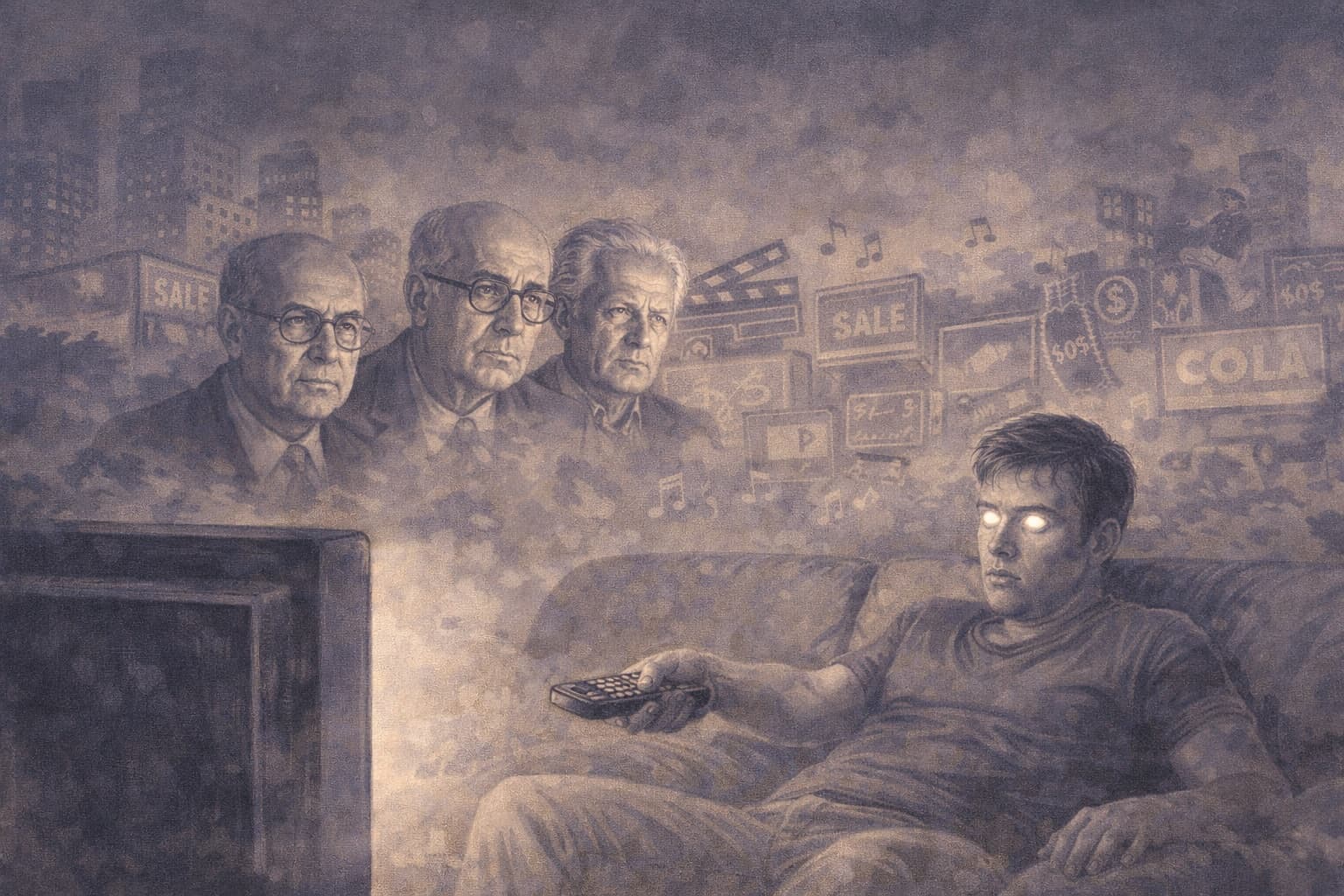
The Frankfurt School: Why the Culture Industry Puts Us to Sleep
 Andres Aguilar
The Frankfurt School arrived at a conclusion that scandalized their contemporaries: the reason that was supposed to liberate us had become our new cage, and mass culture was the most effective mechanism of social control ever invented. They wrote that ...
In 1944, right in the middle of World War II, two German philosophers in exile in Los Angeles wrote one of the most disturbing sentences in all of twentieth-century philosophy. They weren't writing about the Nazi concentration camps, though those were on their minds too. They were writing about Hollywood. About the radio. About cartoons. About commercial jazz.
The sentence went something like this: the Enlightenment — that project to liberate humanity through reason — had become its opposite. The rational knowledge that was supposed to emancipate human beings had transformed into a tool of domination. And the culture industry, that massive system for producing mass entertainment and culture, was one of its most effective mechanisms.
The two philosophers were Max Horkheimer and Theodor Adorno. And the book they were writing — Dialectic of Enlightenment — was published in 1947 and remains one of the most debated, most hated, and most cited texts in contemporary philosophy.
Why would you hate a philosophy book? Because it tells you things you don't want to hear about something you really enjoy. And because it says them with a lucidity that's hard to refute even when it irritates you.
Here's where we're going today.
What Was the Frankfurt School?
Before we get into the ideas, we need to understand where they came from. Because "the Frankfurt School" sounds like something very concrete and unified, and the reality is much richer and more complicated.
It all starts in 1923, in Frankfurt, Germany. A group of intellectuals founds the Institute for Social Research, initially funded by a wealthy businessman named Félix Weil, who was — paradoxically — a Marxist. Rich guy's money for an institution dedicated to critiquing capitalism. Off to a good start.
The Institute wasn't a philosophy school in the traditional sense. It was interdisciplinary from the beginning: philosophy, sociology, psychology, economics, cultural theory. They had one obsession: understanding why capitalism was still standing when, according to Marx, it should have collapsed. Why weren't workers rebelling? Why was fascism gaining ground? What cultural and psychological mechanisms kept people in line?
When Hitler came to power in 1933, the Institute — whose members were mostly Jewish and Marxist, i.e., exactly the target of Nazi persecution — had to close and go into exile. First to Geneva, then to New York, and eventually some of its most important members ended up in Los Angeles.
There, in sunny California, surrounded by Hollywood glamour, American pop music, and the abundance of mass consumption, Horkheimer and Adorno wrote Dialectic of Enlightenment. And what they saw around them scandalized them.
Instrumental Reason: When Intelligence Becomes a Tool
Before getting to the culture industry itself, there's a more fundamental argument in Dialectic of Enlightenment worth understanding. It's the concept of "instrumental reason," and it's one of Horkheimer's most enduring contributions to contemporary thought.
The Enlightenment — that great intellectual movement of the seventeenth and eighteenth centuries that put reason at the center of everything — promised to liberate humanity. Reason was going to displace superstition, dogma, and fear. Rational knowledge of the world was going to allow humanity to control nature, reduce suffering, build more just societies.
What happened? Horkheimer and Adorno observed that modern reason had progressively shrunk to a single function: calculating efficient means to given ends. Reason no longer asks about ends, no longer evaluates whether something is worthwhile or good. It only asks: given this objective, what's the most efficient way to reach it?
This is what they call instrumental reason. And the problem is that a purely instrumental reason can't judge its own ends. If someone decides that the objective is to exterminate a group of people, instrumental reason can only ask how to do it efficiently. The horror of Nazism wasn't a failure of German technical reason — it was, terrifyingly, one of its applications. The death camps were organized with a bureaucratic and technical precision that is itself a negation of humanity.
Horkheimer and Adorno aren't saying reason is bad. They're saying that reason reduced to instrumental calculation — separated from any consideration of ends and values — is potentially monstrous. The question "what is worth doing?" is not a technical question but a philosophical and moral one. And when philosophy and morality fall outside the reach of reason, when only what is calculable and efficient counts, something fundamental is lost.
The Los Angeles Shock
You have to put yourself in these two European intellectuals' shoes to understand the impact. They'd come from Weimar Germany, with its extraordinary cultural ferment. They'd watched that culture get crushed by Nazism. They'd barely escaped. And now they were in the most powerful country in the world, where mass culture was in full swing.
And what they saw wasn't liberation. It was, paradoxically, another form of control.
The radio always played the same things. Hollywood cinema produced stories with the same formulas, the same endings, the same characters. Comedy programs on the radio always told the same jokes. Popular music repeated the same harmonic structures. And people consumed all of it enthusiastically, demanded more, and seemed genuinely satisfied.
For Europeans steeped in the tradition of serious art — the music of Beethoven and Schoenberg, the literature of Kafka and Brecht — this was disturbing. Not simply because mass entertainment was of lower quality. But because it seemed to serve a specific social function: keeping people satisfied with the status quo, without wanting anything different, without thinking critically, without rebelling.
And that led them to develop one of the most influential and most controversial concepts of the twentieth century: the culture industry.
The Culture Industry: What Is It Exactly?
The term itself is already provocative. "Industry" and "cultural" seem to belong to different worlds. Industry produces things mechanically, in series, with the goal of maximizing profits. Culture, in the European humanist tradition, was exactly the opposite: the singular, the unrepeatable, what transcends mere utility.
Putting the two words together in one phrase is already a philosophical statement: culture has become industry. It's produced mechanically, in series, with the goal of maximizing profits.
But Adorno and Horkheimer's critique goes much further than lamenting poor artistic quality. Their argument is deeper and more unsettling.
The central problem with the culture industry isn't that it produces bad things. The problem is that it produces a false sense of satisfaction that leaves the consumer not wanting anything more. Each cultural product promises something it doesn't quite deliver, creates a desire it doesn't fully satisfy, and so you need the next product, and the next one, and the one after that. It's a machine for generating needs that its own products can't satisfy.
Sound familiar? Netflix finishes one episode and automatically starts the next. Instagram shows you one story, then another and another. TikTok has the world's most sophisticated algorithm for keeping your attention scrolling indefinitely. Not because those platforms are evil, but because their business model is based on exactly what Adorno and Horkheimer described: creating a desire that's never fully satisfied so you keep consuming.
Adorno and Horkheimer wrote this in 1944 thinking about radio and cinema. It's terrifying how well it describes what's happening today with digital platforms.
Standardization and Pseudo-Individuality
Another central axis of the critique is standardization. The culture industry produces the illusion of variety and originality while actually offering the same thing over and over with superficial variations.
How many superhero movies follow exactly the same narrative structure? How many pop songs have the same chord progression, the same tempo, the same type of lyrics? How many streaming series have the same dramatic arc, the same rhythm of reveals and plot twists?
Adorno was especially hard on commercial jazz and popular music of his era. He said they had a mechanical structure: intro, chorus, bridge, chorus again. Always the same, with superficial variations that create the illusion of novelty without anything changing in any fundamental way.
This generates what they call "pseudo-individuality." Cultural products give you the feeling that you're choosing, that you're expressing your personality with your tastes, when in reality you're consuming slightly differentiated versions of the same product. The leather jacket that "defines you" comes from the same factory as everybody else's who also defines themselves with it. The "alternative" band you love was selected, produced, and distributed by the same corporate mechanisms as the most mainstream music out there.
Adorno and Horkheimer aren't saying this is a conspiracy. There's nobody in a dark room deciding how to put the masses to sleep. It's simply the logic of the market applied to culture: produce what sells, reduce artistic risk, standardize formats, maximize reach.
The Political Function of Entertainment
And here we get to the political heart of the critique. The culture industry isn't politically neutral. It serves a specific function in reproducing the social order.
By keeping people entertained, superficially satisfied, without the time or energy for critical thinking, the culture industry functions as a tool of social control. Not violent control — not the brute force of totalitarianism. Soft control, friendly control, that disguises itself as freedom and fun.
Adorno has a line that hits like a punch: the culture industry offers entertainment, but the entertainment it offers is entertainment of the kind one must have: the kind that reconciles people to necessity. Put another way: the entertainment the culture industry offers doesn't liberate us — it reconciles us with our situation, helps us tolerate what might otherwise seem intolerable.
After a week of alienating work in a job you didn't quite choose and that doesn't quite fulfill you, on the weekend you watch an action movie or spend hours on your phone. And that doesn't ask you anything about your situation. It doesn't invite you to question anything. It gives you a rest that lets you come back Monday to the same cycle.
True art, for Adorno, does the opposite. It interrupts, disturbs, generates discomfort, puts the contradictions of reality on display. Great music, great literature, great theater — it doesn't give you what you expected: it gives you something you didn't know you needed and leaves you different from who you were before. That's what the culture industry can't do by definition, because the market penalizes what isn't immediately understood and what doesn't satisfy existing expectations.
Was Adorno Just a Snob?
The most obvious objection — and the one you hear most often — is that all of this is cultural snobbery. A European intellectual who can't stand that ordinary people enjoy popular things and constructs a theoretical apparatus to explain why that's wrong.
It's a criticism with some truth to it, and one that Adorno partly earned with some of his more extreme formulations. He said things about jazz and popular music that sound deeply prejudiced today.
But if you read carefully, the Frankfurt School's critique isn't "popular culture is inferior." It's something more specific and more unsettling: the logic of capitalist cultural production tends to colonize even the forms that were born as rebellious or alternative and to integrate them into the system. Rock that was born as transgression ended up in beer commercials. Hip-hop that was born as the voice of resistance from marginalized communities ended up being one of the most lucrative genres in the music industry. Punk got canonized by museums.
It's not that those cultural expressions are bad. It's that the system has a remarkable capacity to absorb criticism, defuse it, and turn it into another product. And that should make us think.
Walter Benjamin and Technical Reproduction
Within the same Frankfurt circle, there's a voice that complicates and nuances the more pessimistic view of Adorno. His name is Walter Benjamin, and he's perhaps the most original and hardest-to-categorize thinker of the entire group.
Benjamin wrote in 1935 an essay that became one of the most cited of the twentieth century: "The Work of Art in the Age of Mechanical Reproduction." There he developed the idea of the "aura" of the work of art. The aura is that quality of unique, unrepeatable presence that an original painting or a live theatrical performance has — the sense of being in the presence of something that exists here and now and nowhere else.
When photography and cinema allow images and performances to be reproduced indefinitely, the aura disappears. A photographic reproduction of the Mona Lisa doesn't have the same effect as standing in front of the original at the Louvre.
But here's the twist: Benjamin doesn't say this is necessarily bad. The loss of aura democratizes access to art. And more interestingly, cinema — which is by definition a reproducible art — has political possibilities that auratic art doesn't have. Eisenstein's films, Brecht's theater, can reach millions and can generate political awareness in ways that a museum painting cannot.
Benjamin is more optimistic than Adorno about the political possibilities of mass media. Not naively — he also saw the dangers, as shown in his analysis of the political use of film by Nazism. But he doesn't close the door.
This tension within the Frankfurt School itself is intellectually rich: there's no unified, dogmatic position, but a living debate that acknowledges complexity.
Habermas and the Second Generation
The Frankfurt School didn't end with Adorno and Horkheimer. It had a second generation, whose most influential representative is Jürgen Habermas, still alive and active, born in 1929.
Habermas developed a different theory than his teachers. Less pessimistic, more oriented toward finding possibilities for genuine rationality in human communicative practices. He talks about the "public sphere" as the place where citizens debate and reach agreement on common matters through argument. Democracy, for Habermas, works well when that sphere exists and is protected.
And the culture industry, for him too, is a problem: it tends to colonize and degrade the public sphere, to replace argumentative debate with entertainment, to reduce citizenship to consumption. But there are resources to resist: public deliberation, democratic institutions, critical education.
The diagnosis is similar to Adorno's, but the response is more constructive. Less apocalyptic.
Why Any of This Matters Today
In 2024, the culture industry is incomparably more sophisticated, more pervasive, and more personalized than what Adorno and Horkheimer imagined. Algorithms don't give you the same product as everyone else — they give you exactly what your browsing history predicts you'll want. It's a hyper-personalized standardization, which is almost a contradiction in terms.
And the result is what some call echo chambers: we live in informational and cultural bubbles where we only consume what confirms what we already think, what we already like, what we already like liking. Pseudo-individuality has reached a level of sophistication Adorno couldn't have imagined.
At the same time, Benjamin's argument about the political possibilities of reproducible media also applies today. The same media that can put people to sleep can also wake them up. Videos circulating on social media document human rights violations, organize movements, inform people about what traditional media won't cover. Technology isn't politically neutral, but it doesn't have a fixed direction either.
The question the Frankfurt School leaves us with isn't "is entertainment bad?" but something harder: what kind of attention are you paying to what you consume? Do you ask yourself what it gives you and what it takes from you? When was the last time something you consumed culturally genuinely disturbed you, challenged you, left you different?
It's not a condemnation of pleasure or entertainment. It's an invitation to critical awareness. Which is, at bottom, what philosophy has always been.
A group of intellectuals fleeing Nazism ended up in Los Angeles and wrote, surrounded by palm trees and movie studios, some of the most lucid pages ever written about the mechanisms of cultural control under capitalism. The context was ironic. The result was a thinking tool that becomes more useful, not less, with every passing year.
Related episodes

Why did you choose this way? Because he thought that philosophy was neither poetry nor opinion.

Close your eyes and look for your self. That permanent center that is you. Look carefully. A friendly, chubby Scotsman did that same exercise nearly three hundred years ago — and didn't find it. What he found instead was one of the most unsettling idea...

The most powerful man in the world wrote a private journal every night that he never intended to publish: he challenged himself not to be an idiot, reminded himself he was going to die, and braced for setbacks before they arrived. Two thousand years la...