
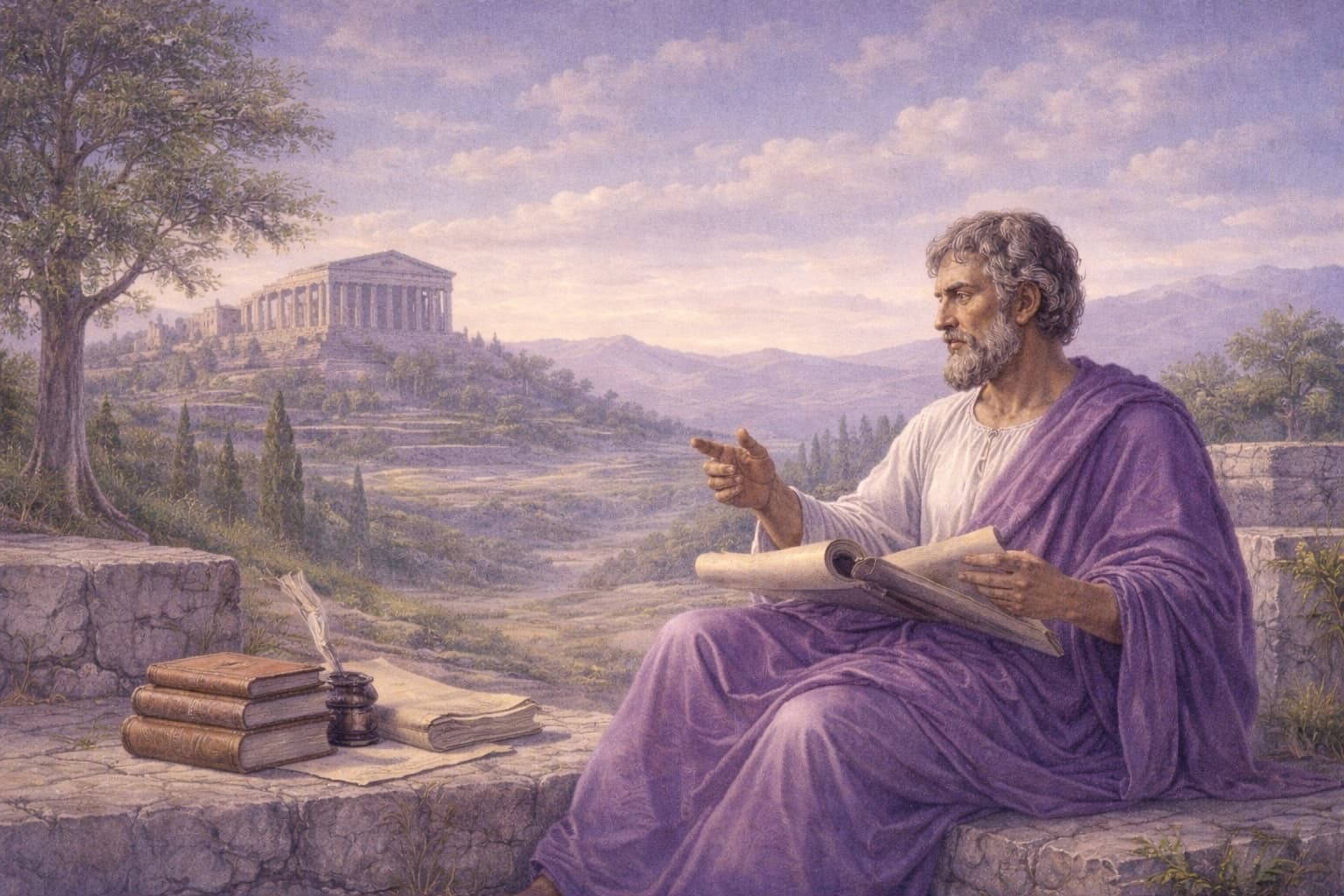
Aristotle and the Pursuit of Happiness Through Virtue
 Andres Aguilar
Aristotle tutored Alexander the Great, dissected octopuses with the same curiosity he brought to justice and friendship, and arrived at a conclusion about happiness that collides head-on with what the twenty-first century sells us: happiness isn't foun...
In 335 BCE, Alexander the Great was conquering the known world. In three years he'd reach India, found cities on three continents, build the largest empire the world had ever seen. And all that time, while Alexander was destroying and creating civilizations, his former tutor was in Athens giving lectures, walking through the gardens of the Lyceum, talking about octopuses.
Yes, octopuses. Aristotle was obsessed with octopuses. And dolphins. And bees. And chicken embryos. This man who wrote about logic, politics, theater, astronomy, physics, economics, and ethics also spent hours studying marine animals with a curiosity we'd recognize today as scientific in the best sense of the word.
Why start with that? Because it says something essential about Aristotle. He wasn't a philosopher with his head in the clouds, disdainful of the concrete world. He was a man deeply in love with reality — with things as they actually are, with life in all its complexity. And from that attitude, when he turns to thinking about happiness, he arrives at answers far richer and far more demanding than anyone expects.
Here we're going to explore one of philosophy's oldest questions. What is happiness? How do you reach it? And Aristotle's answer will surprise you — because it has nothing to do with what marketing, positive psychology, and self-help books want to sell you today.
The Problem with the Happiness Everyone Chases
The dominant model today goes roughly like this: happiness is an emotional state, a feeling of well-being, something you "have" or "don't have" at any given moment. And the way to reach it is by accumulating pleasant experiences and avoiding painful ones. Social media is full of versions of this: "live in the moment," "do what makes you happy," "surround yourself with good energy."
There's nothing inherently wrong with pleasure. Aristotle wasn't a killjoy moralist. But his argument is that confusing happiness with the accumulation of pleasant moments is like confusing health with the absence of headaches. It's a relevant signal, yes — but it's not the same thing.
Why not? Because happiness reduced to pleasure has a structural problem: it's completely dependent on external circumstances, unstable by definition, and leaves human beings in the permanent position of chasing something that always slips away.
Aristotle had a different model. And to understand it, we need to learn a Greek word that, unfortunately, has no perfect English translation.
Eudaimonia: The Word That Changes Everything
The word is eudaimonia. It's usually translated as "happiness," but it actually means something closer to "flourishing," to "living well and doing well," to "fully realizing what one is."
It comes from two roots: eu, meaning good or well, and daimon, which for the Greeks was a kind of inner spirit — the deep character of a person. Eudaimonia is, literally, having a good daimon, being in good accord with what one truly is.
That distinction already tells us something fundamental: for Aristotle, happiness is not a state that happens to you, something that arrives from outside. It's an activity — something you do. It's the result of living in a certain way, of developing certain character traits, of exercising certain capacities. You don't have it; you practice it.
This idea appears at the very beginning of the Nicomachean Ethics, the work where Aristotle develops his moral philosophy. It opens with a statement that seems simple but carries enormous depth: everything human beings do, they do in pursuit of some good. When you cook, you aim to eat well. When you exercise, you aim for health. When you work, you aim for money or recognition. And when you aim for money or recognition, you pursue them because you believe they'll give you something else. There is always a further good, a deeper reason.
Aristotle asks: is there a final good — a good sought not for the sake of something else, but for its own sake? A good that is the ceiling of the entire chain of purposes?
His answer: yes, that good exists, and all of us, deep down, name it the same way: happiness. Eudaimonia. No one pursues happiness in order to get something else. Happiness is the ultimate end.
Function and Excellence: The Argument from the Craftsman
But how do we reach eudaimonia? Here Aristotle makes an elegant philosophical move called "the function argument."
The idea: every thing has a function, a specific purpose that is its own. A knife is for cutting. A doctor's function is to heal. A shoemaker's function is to make good shoes. And in every case, what makes something excellent — good of its kind — is that it performs its function well.
What is the proper function of a human being? It must be something specific to humans, something we don't share identically with plants or other animals. And what distinguishes us, Aristotle says, is the capacity to live according to reason. Human beings are, in his classic definition, "rational animals."
Therefore, the human function is the activity of the soul in accordance with reason. And eudaimonia is performing that function excellently — with virtue.
There's the key word: virtue. In Greek, aretē. Which actually means excellence — the quality of doing something well, of fully performing the function of something. The aretē of a knife is being sharp. The aretē of a horse is being strong, fast, and responsive. And the aretē of a human being is excellence of character — virtue in the moral sense.
The Virtues: Not Too Much, Not Too Little
What exactly is a virtue for Aristotle? Here comes one of the most beautiful and most practical concepts in all his philosophy: the mean.
Aristotle observes that virtues are always a point of balance between two extremes that are vices. Courage, for example, is the virtue that lies between cowardice and recklessness. Cowardice is excess of fear; recklessness is deficiency of fear. Courage is the right point.
Generosity lies between miserliness and prodigality — mindless waste. Honesty lies between deception and a kind of tactless brutality. Well-understood humility lies between arrogance and lack of self-respect.
But be careful, because Aristotle is precise here: the mean is not mediocrity, not doing everything "sort of." It's not a mathematical average. It's the point that is right for that person, in that situation, at that moment. And finding that point requires practice, experience, and something Aristotle calls phronesis — usually translated as prudence or practical wisdom.
Phronesis is, for Aristotle, the most important virtue of all. It's the ability to deliberate well — to see clearly what's right in each concrete situation. It's not a formula, not an algorithm. It's a skill developed through experience, through having lived, having seen how things turn out, having learned from one's own mistakes and others'.
This sets him radically apart from Kant. Kant wanted an ethics based on universal and necessary principles valid for any situation. Aristotle distrusts that. Moral life, for him, is not solved by universal formulas but by particular wisdom — the ability to read each situation and respond appropriately.
Virtues Are Learned: The Ethics of Habit
What I find most valuable in Aristotle — what I think remains most relevant today — is his theory of moral learning. How do we become virtuous?
His answer: by acting virtuously. Which sounds circular but isn't.
Aristotle says we become courageous by being courageous, generous by being generous, just by being just. Virtues are habits — dispositions of character formed through the repetition of acts. At first it might cost you effort, feel forced. But with time, the virtue becomes part of your character, and then acting that way becomes natural, even pleasurable.
The Greek word for habit is ethos — the root of "ethics." Ethics is, literally, the science of character, of the habits that define who we are.
This is strikingly modern. Contemporary neuroscience has shown that habits are encoded in the brain through repetition, that repeated behaviors modify neural connections and are eventually processed differently than new ones. Aristotle had no neuroscience, but he had careful observation of human behavior — and arrived at a very similar conclusion.
We are, in large measure, what we repeatedly do. Not what we think, not what we say, not what we intend. What we do.
The Two Candidates for the Happiest Life
After dismissing wealth, fame, and simple pleasure as the basis of happiness, Aristotle proposes two ways of life that deserve serious consideration as paths to eudaimonia.
The first is the active life — the life of political and civic participation, where moral virtues are exercised in dealing with others, in justice, in governing the community. This is the life of the excellent citizen, the wise statesman, the person who uses their capacities in service of the community.
The second — and here Aristotle surprises — is the contemplative life. The life of the philosopher, mathematician, or scientist who dedicates their time to thinking about the highest things possible. For Aristotle, if there's anything in human beings that resembles the divine, it's the capacity to know and contemplate. And that activity, when excellently exercised under the right conditions, produces the purest and most sustained pleasure that can exist.
This second option has something autobiographical about it. Aristotle was, above all, a man of thought. When he describes the pleasure of contemplation, he's describing something he probably felt very directly. But he also acknowledges it's a difficult ideal to reach — one requiring certain material conditions that aren't available to everyone.
The tension between the active and contemplative lives is never fully resolved in Aristotle. And that tension is productive: it shows that eudaimonia doesn't have a single form — that there are different ways of flourishing depending on each person's nature and circumstances.
The Virtue of Justice: The Good of the Other
Among all the virtues Aristotle analyzes, one occupies a special place: justice. It's the only virtue that, by definition, is oriented toward others. All other virtues — courage, generosity, honesty — can be practiced in solitude or for one's own benefit. Justice always involves another.
For Aristotle, justice is the most complete of all virtues because the just person is concerned not only with their own good but with the good of others. And in that they express most fully what it means to be a political animal — a being who realizes itself in community.
Aristotle distinguishes two forms of justice: distributive justice, which governs how goods and honors are allocated in the community, and corrective or commutative justice, which governs exchanges between individuals and corrects situations of imbalance.
Distributive justice is proportional — it doesn't mean giving everyone the same, but giving each what they're due according to relevant criteria. What those criteria are is a deep political question Aristotle doesn't settle once and for all, recognizing that different political constitutions have different distributive principles. But he establishes that distributive justice always implies proportion, and that injustice is when that proportion is violated.
Friendship as a Condition for Happiness
There's another aspect of Aristotelian ethics I want to highlight — one I think we're paying a high price for ignoring today.
For Aristotle, eudaimonia is impossible without friendship. Not happiness understood as pleasure, but the flourishing life. This is because human beings are, in another of his famous definitions, "political animals" — beings who live in community and who realize themselves only in relation to others.
Aristotle distinguishes three kinds of friendship. Friendships of utility, where we relate to others because they're mutually beneficial. Friendships of pleasure, where we get together because we have a good time. And perfect or virtuous friendship — the kind that exists between people who admire each other for their virtues, who want the good of the other for the other's own sake and not for what they get from them.
Perfect friendship is rare and takes time. It's not built overnight. But it is, for Aristotle, one of the greatest goods a person can have. It's not a complement to the good life — it's a condition of it.
In an era where we have hundreds of social media "friends" and sometimes feel profoundly alone, this sounds like a diagnosis. Aristotle would say we're confusing friendships of utility or pleasure with real friendship — and that this confusion has a cost to our eudaimonia we shouldn't underestimate.
The Problem of External Goods
There's a tension in Aristotelian ethics that Aristotle himself acknowledges, and it makes him more honest than many philosophers. Eudaimonia depends fundamentally on virtues, on character, on what one does. So far so good. But is that enough?
Aristotle says: not entirely. You also need certain external goods — health, minimum resources, friends, a reasonable position in society. Someone living in extreme poverty, seriously ill, who has lost everything, can still be virtuous — but their ability to fully exercise the virtues is limited. Eudaimonia is not independent of external circumstances.
This separates him from the Stoics, who would say that virtue alone is sufficient for happiness regardless of what happens outside. For Aristotle, that's too much to claim. The good life requires a certain floor of material and social conditions.
This has direct political consequences. If citizens' eudaimonia requires certain external conditions, then the State has the responsibility of creating those conditions. Politics, for Aristotle, is not something separate from ethics — it's its continuation at the collective level. The Politics, another of his fundamental books, opens with exactly that idea: the city exists so that citizens can live well, not merely survive.
Aristotle vs. the Modern World
At this point, a question worth asking: why does the Aristotelian vision of happiness feel so strange to us today?
I think it has to do with modern individualism. The dominant idea in our culture is that happiness is a private, personal matter — that everyone has the right to pursue it their own way and nobody has the right to tell you how to live. Happiness is "what you feel" — subjective by definition.
Aristotle would disagree. For him, not every way of living is equally valuable in terms of human flourishing. There are ways of living that better realize human capacities, and ways of living that cut them short. Not because someone from outside declares this, but because human beings have a nature — capacities that demand to be developed — and when we don't develop them, something important is lost.
A life devoted exclusively to immediate pleasure may be pleasurable, says Aristotle, but it is not eudaimonia. A life devoted entirely to accumulating wealth isn't either. A life without deep friendships, that exercises no virtues, that doesn't use reason fully — that is not a flourishing life, even if the person in question says they're happy.
That might sound paternalistic. But Aristotle distinguishes it from political paternalism. He's not saying the State should force you to live a particular way. He's describing what he observes about human nature: that we have capacities, those capacities seek to be realized, and when we do realize them, life is richer, fuller, more satisfying in a deep sense.
A Legacy That Doesn't End
Aristotle's influence is simply incalculable. During the Middle Ages — in the Islamic world first, then the Christian — he was "the philosopher," just that, no last name needed. Thomas Aquinas built an entire philosophical-theological synthesis on Aristotle that remains the official basis of Catholic thought.
In the Renaissance he was both the model to imitate and the target of criticism when natural philosophers began building modern science. In the twentieth century, Aristotelian ethics had a powerful revival through what was called communitarianism and virtue ethics — with thinkers like Alasdair MacIntyre, who in After Virtue argued that modern moral crisis is largely explained by the abandonment of the Aristotelian framework.
And in positive psychology, paradoxically, much recent research moves in an Aristotelian direction without always acknowledging it: people who have purpose, who develop their strengths, who have deep relationships, and who perceive themselves as growing — they are happier in ways that can be robustly measured. It's not just feeling good in the moment. It's something closer to eudaimonia.
To Close: The Question Aristotle Leaves You With
If Aristotle could ask you one question today, I think it would be this: what capacities of yours are you developing? Not what you feel, not what you have, not what you want. What are you doing, with what consistency, and toward what form of excellence are you moving?
It's not an uncomfortable question because it's cruel. It's uncomfortable because it pulls us out of the comfort of measuring life by the pleasant moments we accumulate, and places us before something more demanding and more valuable: the possibility of becoming, with time and practice, better versions of ourselves.
The man who studied octopuses in the gardens of the Lyceum while his former student conquered the world had, perhaps, a form of wisdom that Alexander — with all his power — did not. He knew that true greatness is not measured in conquered territories but in the degree to which one has realized the best of what one can be.
That is eudaimonia. That is what Aristotle has to say to you today, twenty-four hundred years later.
Related episodes

Why did you choose this way? Because he thought that philosophy was neither poetry nor opinion.

Close your eyes and look for your self. That permanent center that is you. Look carefully. A friendly, chubby Scotsman did that same exercise nearly three hundred years ago — and didn't find it. What he found instead was one of the most unsettling idea...

The most powerful man in the world wrote a private journal every night that he never intended to publish: he challenged himself not to be an idiot, reminded himself he was going to die, and braced for setbacks before they arrived. Two thousand years la...