
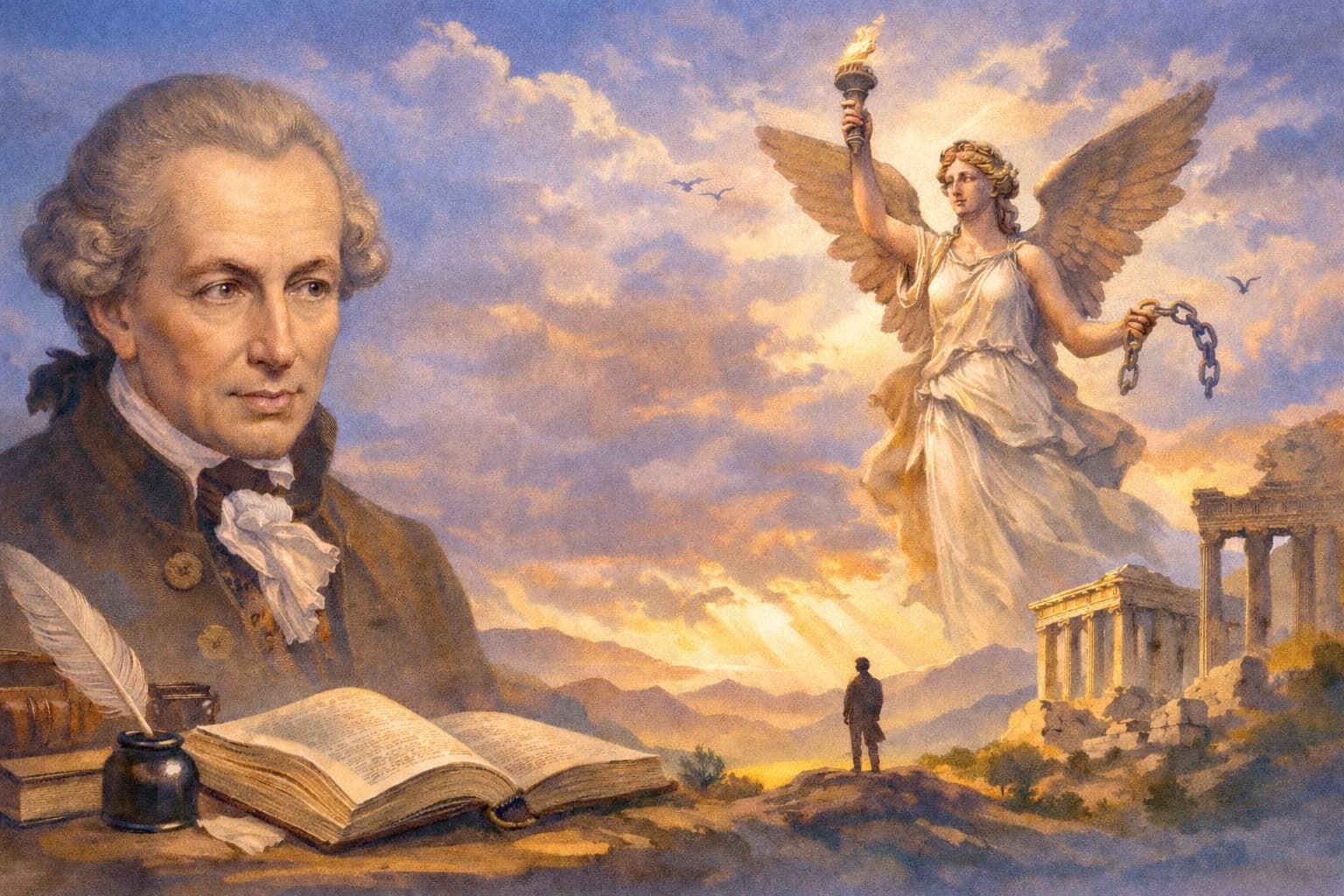
Kant and Freedom: Acting as If You Were the Lawmaker of the Universe
 Andres Aguilar
Kant never left his hometown, kept the most rigid schedule in the history of philosophy, and yet devoted his entire life to thinking about what it truly means to be free. His answer remains the most demanding and the most uncomfortable the discipline h...
There's a story about Immanuel Kant that very few people know, and it says more about the man than any summary of his philosophy ever could. Kant spent his entire life in Königsberg, a city in northern Prussia — now Russian territory. He never strayed more than sixty miles from where he was born. He never saw the ocean. He never left the country. And yet this man who went nowhere permanently changed how humanity understands what it means to be free.
That's already strange enough. But here's the stranger part: Kant was so punctual that the residents of Königsberg reportedly set their clocks by his afternoon walk. Every day, same time, same route. Like a Swiss watch in a wig. And it turns out that this man of obsessive routines — this person who never deviated an inch from his schedule — spent decades of his life thinking about what it means to be truly free. The paradox is delicious, isn't it?
Today we're going to dig into that question. What is freedom for Kant, why his answer is still uncomfortable, and why once you understand it properly you can't look at the world the same way again.
The Core Problem: Are You Free, or Do You Just Think You Are?
Before talking about Kant, we need to understand the problem he was trying to solve. Think about something concrete. You wake up tomorrow and decide to eat a donut instead of sticking to your diet. Were you free in that decision? Your first instinct is to say yes — nobody forced you. But wait a moment. What if that "decision" was the inevitable result of your metabolism, your mood, years of cultural conditioning that associate breakfast with something pleasurable, the advertising you've absorbed your whole life, the chemistry of your brain that morning? Where's the freedom in all that?
This isn't a problem invented by bored philosophers. It's a serious problem with direct consequences for how we understand responsibility, justice, merit, and punishment. If everything you do is the result of prior causes you didn't control, does it make sense to reward or punish you for anything?
In the eighteenth century, when Kant was developing his philosophy, this problem had an especially sharp form. On one hand, modern science — particularly Newton's physics — had demonstrated that the universe operates like a perfect mechanism: every event is the necessary result of prior causes, according to fixed and immutable laws. The universe is a giant machine where everything that happens was, in some sense, already written from the beginning. But at the same time, all of us feel that we're free. We feel that we choose. We feel responsible. We feel there's a real difference between acting well and acting badly. How do you reconcile those two things?
Kant spent years thinking about this. And he arrived at an answer that is, simultaneously, the most demanding and the most powerful in the entire history of Western philosophy.
Kant, the Man Who Arrived Late
Immanuel Kant was born in 1724 in Königsberg, into a very religious artisan family. His mother raised him in the Pietist tradition — a branch of Protestantism that emphasized inner moral life, honesty, and seriousness. Kant studied at his city's university, taught there for decades, and spent most of his adult life working in quiet. One striking fact: Kant published his most important work, the Critique of Pure Reason, when he was fifty-seven years old. Today we'd say he was late to the game. But that work, and the ones that followed, changed the history of Western thought so radically that Kant himself said he had produced a "Copernican revolution" in philosophy.
The comparison was deliberate. Just as Copernicus had put the Sun at the center of the solar system, Kant put the human being — human reason — at the center of knowledge. We're not passive spectators of a world that arrives from outside: we give shape and meaning to what we experience through the structures of our own minds.
But today we're not talking about epistemology. We're talking about ethics, freedom, how we ought to act. That's found in the Groundwork of the Metaphysics of Morals (1785) and the Critique of Practical Reason (1788). That's where Kant develops his moral theory, and where one of the most provocative and most misunderstood ideas in the history of philosophy appears.
The Categorical Imperative: The Formula That Changes Your Life
Kant wanted to find the fundamental principle of morality — not particular rules like "don't steal" or "help others." Religions and traditions already had those. He wanted the deepest principle: the one that would justify all those rules, or challenge them when necessary.
His starting point is a powerful intuition: if there is anything we can call "good" without any conditions, without any "it depends," that thing is a good will. Not intelligence, not talent, not wealth, not happiness. Only good will. Because all those other goods can be used for evil. A very intelligent person can use their intelligence to deceive. Wealth can corrupt. But a will that genuinely wants to do good — that can never be bad.
So: how do I know when my will is acting well? What's the criterion?
Here comes the key idea. Kant says: you act well when you can will that the maxim of your action become a universal law. This is called the categorical imperative.
"Imperative" means a command — there are things you ought to do. "Categorical" means unconditional, without exceptions. Not "if you want X, do Y." Simply: do this.
The formula: "Act only according to that maxim by which you can at the same time will that it should become a universal law."
A "maxim" is the principle guiding your action. If you lie to avoid a problem, the implicit maxim is: "When it's convenient, I lie." The categorical imperative asks: can I will that everyone always lie when it's convenient? The answer is no — because if everyone always lied when it suited them, the very concept of truth would collapse. Universal lying destroys itself. That's why you shouldn't lie — not because God says so, not because consequences are bad, but because the maxim fails the universalizability test.
The Other Formulations: The End in Itself
The second formulation of the categorical imperative is perhaps the most powerful intuitively:
Act so that you treat humanity, whether in your own person or in that of another, always as an end and never as a means only.
Persons have a value that cannot be reduced to their usefulness. A person is not a tool. Using someone without their knowledge or consent — even for a greater good — violates this principle. Lying to someone "for their own good" violates it. Manipulating someone emotionally to do what you want, even with the best intentions, violates it. In all these cases you're treating that person as an instrument rather than recognizing their inherent worth as a rational being.
This formulation has enormous political depth. At bottom, it's the philosophical foundation of human rights: there are things you simply cannot do to people regardless of consequences, because doing so denies their essential dignity.
And Here Comes the Freedom Part
Now we reach the heart of it. How does all this connect to freedom?
Kant distinguishes between two dimensions of being human. On one hand, we're natural beings, part of the physical world, subject to causal laws — so yes, our actions have causes. But on the other hand, we're rational beings, and as rational beings we can do something natural phenomena cannot: give ourselves laws through reason.
When you act according to the categorical imperative, you're not obeying a law that comes from outside — from God, the State, society, or your instincts. You're following the law that your own reason gives itself. And that is what Kant calls autonomy — from the Greek: autos (oneself) and nomos (law). Giving yourself your own law.
True freedom, for Kant, is not doing whatever you feel like. It's not the absence of restrictions. It's not "I do what I want." That's simply following your inclinations and desires — which are just as causally determined as anything else in the universe. True freedom is autonomy: acting according to reason, giving yourself your own moral law.
When you consider whether an action is morally correct, act as if you were the legislator of the universe. Ask: if I were the creator of the moral laws governing all rational beings, would I approve of this? Would it be coherent for everyone to act this way? If yes, proceed. If that rule destroys itself when universalized, don't act that way.
Why This Is Harder Than It Sounds
Kant sets a very high standard, and that has generated enormous debate. The classic problem: the "murderer at the door." Someone comes looking to kill your friend hiding inside your house. He asks if your friend is there. Do you lie?
The strict Kantian answer is: no. You cannot lie, because the maxim of lying cannot be universalized. Kant says this explicitly, and the scandal has lasted to this day. Most people feel viscerally that this is wrong — that in this case, you have to lie.
Critics say this reveals a fundamental problem: Kant's ethics are too rigid, ignoring consequences and context. Defenders say Kant is establishing the logical structure of morality, and that once you start making exceptions based on consequences, you lose the solidity of the principle and can always justify anything with "but in this case the consequences are good." There's truth on both sides, which is why the debate remains so productive.
Dignity as a Political Concept
The concept of human dignity at the foundation of the Universal Declaration of Human Rights (1948) has a direct philosophical debt to Kant. The idea that certain rights cannot be violated regardless of consequences, that people cannot be used as instruments of the State, that torture is wrong even if it might "be useful" — all of that has Kantian roots.
When the Nuremberg Trials, after World War II, sought a foundation for judging Nazi criminals beyond the laws of the German state itself, they were implicitly appealing to a Kantian idea: there is a universal moral law that transcends the positive laws of any state, and that law prohibits treating human beings as mere means.
The Third Formulation: The Kingdom of Ends
A third formulation: act as if you were a legislating member of a kingdom of ends — an imagined community where all rational beings are always treated as ends in themselves, and where the moral laws governing coexistence are ones any rational member could give their reasoned consent to.
When you evaluate whether a social practice, a law, or an institution is just, the Kantian question is: could it be approved by all rational beings if they placed themselves in the position of impartial legislators? Or is someone being treated merely as a means for others' benefit?
John Rawls, the most influential political philosopher of the twentieth century, built his theory of justice on a deeply Kantian foundation. His famous "veil of ignorance" — choose principles of justice without knowing what place you'll occupy in society — is a reworking of Kantian thought. If you don't know whether you'll be rich or poor, male or female, what laws would you choose? Probably the most egalitarian ones. And that, for Rawls as for Kant, is not utopian but a rational requirement.
Duty for Duty's Sake: The Hardest Part to Accept
Kant says an action has genuine moral worth only when done from duty — not from inclination, sympathy, or affection. If you help someone because you enjoy it or because it makes you feel good, Kant doesn't say that's bad. But he says it has no properly moral value. Moral worth appears when you help because it's your duty, even when you don't feel like it.
That sounds cold. The German poet Schiller satirized it: "I like to serve my friends, but I do so with pleasure; hence I am often troubled that I am not virtuous." The irony was perfect.
Kant's response: the foundation of moral action cannot be emotion because emotions are contingent and variable. Today I feel like helping — tomorrow I don't. A morality that rests on emotions is a morality of moods. Duty, by contrast, is constant. It doesn't depend on how I feel. And that's what makes it reliable as the foundation of moral life and social coexistence.
The Man Who Went Nowhere and Arrived Everywhere
When the French Revolution broke out in 1789, Kant was sixty-five. It's said that when he heard the news from Paris, he broke his walking routine for the first time and returned home early, so excited was he. For Kant, that French citizens were giving themselves their own laws — exercising collective political autonomy — was the historical realization closest to what he had been thinking about in the abstract for decades.
Autonomy. Giving yourself your own law. In individual morality as in politics, that was the key.
Why Does This Matter to Us?
When you're about to make a decision, when you're evaluating whether something is right or wrong — what criterion do you use? Consequences? What's socially acceptable? What's convenient? What you were told is right?
Kant says there's a deeper, more universal, more honest criterion. Ask yourself whether you could will that everyone act the way you're thinking of acting. Ask whether you're treating the people involved as ends in themselves or as tools for your purposes.
It's not a comfortable question. Many times the answer forces us to change course. But Kant would say that in that discomfort lies real freedom: not the freedom to do what we want, but the freedom to act according to a law our reason can validate universally.
The man who set the clocks of Königsberg by his punctuality was, in his way, exercising that freedom — not because his routines were intrinsically moral, but because he had thought deeply about what it meant to live well and acted accordingly. With conviction, with consistency, with the seriousness of someone who knows that the rules he gives himself matter.
If something in this piece bothered you or opened up a question — that's exactly what philosophy is supposed to do.
Related episodes

Why did you choose this way? Because he thought that philosophy was neither poetry nor opinion.
Close your eyes and look for your self. That permanent center that is you. Look carefully. A friendly, chubby Scotsman did that same exercise nearly three hundred years ago — and didn't find it. What he found instead was one of the most unsettling idea...

The most powerful man in the world wrote a private journal every night that he never intended to publish: he challenged himself not to be an idiot, reminded himself he was going to die, and braced for setbacks before they arrived. Two thousand years la...