
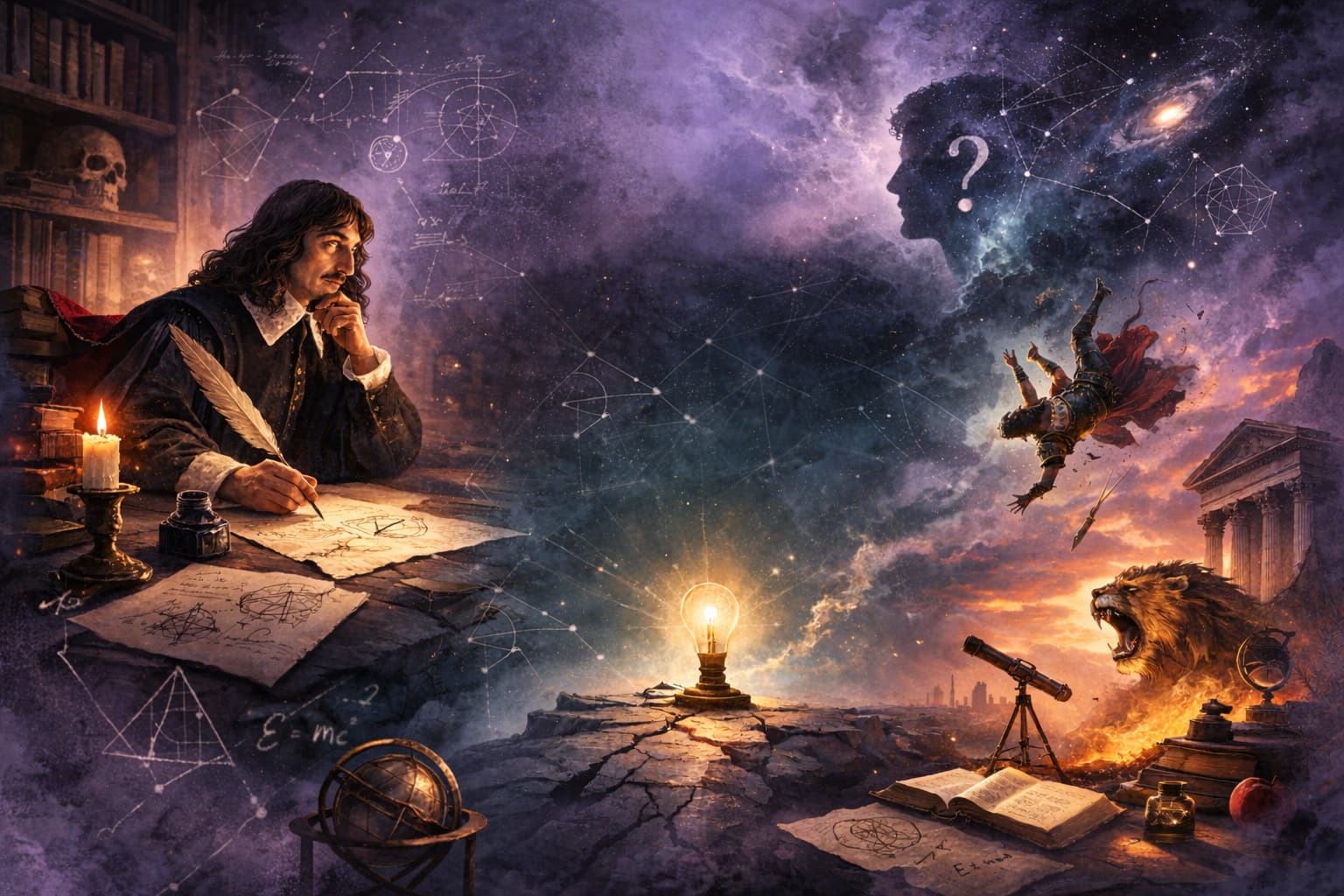
Descartes: The Doubt That Founded Modern Science
 Andres Aguilar
René Descartes decided to doubt absolutely everything he thought he knew — his senses, his memories, the existence of the external world. What he found at the end of that radical process of doubt wasn't nothing. It was the one point of certainty no one...
There's a question we've all asked ourselves at some point — usually late at night when we can't sleep: what if everything I'm living through is an illusion? What if the world I perceive isn't real? What if I'm dreaming right now and don't even realize it?
Most of us think about that for five minutes, feel a little weird, and move on with our lives. But there was a guy in the seventeenth century who decided to take that question completely seriously. So seriously that he shut himself in a heated room one winter and refused to get out of bed until he'd settled the matter. That's not a metaphor. He literally did it. And what he found in there — in that room with a stove — changed the history of human thought forever.
Here we'll walk through René Descartes, the philosopher who decided to doubt absolutely everything and, paradoxically, ended up becoming the foundation on which modern science was built.
The Guy Who Never Wanted to Be Wrong Again
To understand Descartes, you first have to understand the world he lived in. We're in the early seventeenth century. Europe is a place where the Church has enormous influence over what you're allowed to think and what you're not. Galileo has just shown that the Earth revolves around the Sun, and the Inquisition is looking at him with very bad intentions. Knowledge is in a strange moment: on one hand, science is starting to take off with experiments and observations; on the other, nobody is very clear about what all of that rests on.
René Descartes was born in 1596 in La Haye en Touraine, a town in western France (today the city of Descartes, in his honor). His mother dies when he's a little over a year old, and his father, a lawyer with a certain standing, sends him to study at the Jesuit college in La Flèche, one of the best educational institutions in Europe at the time. There they teach him everything: Latin, Greek, ancient philosophy, mathematics, physics. He was a brilliant student — one of those who finish before everyone else and end up staring at the ceiling thinking about something else. The teachers adored him and let him stay in bed until late because they realized Descartes thought better lying down. That's not a joke. Throughout his life he was a lover of the morning lie-in, and he said his best ideas came in that state between sleep and waking, when the mind is relaxed and the noise of the day hasn't started yet.
When he finishes school, Descartes realizes something that bothers him deeply: everything they taught him could be wrong. Not one part, not a few details. Everything. The philosophy, physics, and medicine of the era were full of contradictions. The learned men argued among themselves without agreeing on anything. Aristotle said one thing, the moderns said another, the Church said a third. And he, young and brilliant, stood in the middle of that mess without knowing what to believe.
That haunts him. And that's where the great question of his life starts to take shape: is there any truth you cannot doubt? Is there any solid starting point from which to build all knowledge from scratch?
The Soldier-Philosopher and the Dream That Changed Everything
Before locking himself away to think, Descartes does something unexpected: he joins the army. He enlists as a volunteer during the Thirty Years' War — that brutal conflict that devastated Europe and which we'll cover in a History episode. He does it, he says himself, not out of patriotism or for the money, but to see the world and understand how real people work. It was like doing fieldwork before the concept existed.
In November 1619, while stationed in Ulm, Germany, waiting for a campaign to begin, Descartes has a night he'll never forget. In a state of enormous mental exaltation, he has three dreams in a row, each stranger than the last: in the first, a storm drags him and he can't walk. In the second, thunder wakes him in terror and he sees sparks of fire in the room. In the third, he finds a book of poetry and someone asks him a question whose answer is in that same book.
Descartes interprets those dreams as a sign. They're showing him that his mission in life is to find a universal science, a single method for arriving at true knowledge. That night, at twenty-three, in a room with a stove in Bavaria, he decides to dedicate the rest of his life to that project. And he does.
There's something fascinating about this: one of the most rationalist thinkers in history — someone who distrusts the senses and the deception of appearances — launches his philosophical project from three dreams. The irony is perfect.
Methodical Doubt: Doubting Everything as a Tool
Years later, already settled in the Netherlands, Descartes sits down to write what will be his most famous work: the Meditations on First Philosophy, published in 1641. And he starts with a radical proposal.
He says: I'm going to doubt everything. Not because I'm a skeptic who believes we can't know anything. On the contrary. I'm going to doubt everything precisely in order to find what cannot be doubted. I'm going to apply doubt like a scalpel, to cut away everything uncertain and see if anything solid remains underneath.
First he doubts the senses. And he's right to do it. The senses deceive us all the time. You put a straw in a glass of water and it looks broken. The sun looks small even though it's enormous. Someone with a high fever feels cold when they're burning up. Phantom limb pain makes someone feel pain in a limb they no longer have. Can we trust what we see, hear, smell? Descartes says no — at least not without further argument.
But he doesn't stop there. Then he doubts reality itself. He says: how do I know I'm not dreaming right now? When I'm inside a dream, the dream feels completely real. There's no sign that says "this is a dream." I only realize it when I wake up. So how can I be sure that what I'm living through now isn't also a dream I haven't woken up from yet?
That question is already pretty disturbing. But Descartes goes even further. He says: suppose there's an evil genius — an all-powerful, deceiving being who devotes all his energy to making me believe false things. Who makes me believe I have a body when I don't, that the world exists when it doesn't, that two plus two is four when it really isn't. If that evil genius existed, would there be anything I could be sure of?
The evil genius is the philosophical ancestor of The Matrix, of Elon Musk's simulation idea, of all those modern notions about whether we live in a manufactured reality. Descartes invented it four centuries ago.
Cogito Ergo Sum: The Starting Point of Modern Knowledge
And here comes the climactic moment. After doubting everything, Descartes finds one single thing he cannot doubt: that he is doubting.
Think about it slowly, because it's very elegant. The evil genius can deceive me about the world, about my body, about mathematics. But to deceive me, there has to be something being deceived. For me to think I'm being deceived, I have to be thinking. And if I'm thinking, I exist. At least in that moment, at least as a thinking thing.
There the most famous phrase in the history of philosophy is born: I think, therefore I am. In Latin, cogito ergo sum, which is how it appears in his best-known texts. Though the original phrase was in his own language, French: je pense, donc je suis.
What's interesting is that this phrase isn't a logical argument in the technical sense. It's a direct intuition, immediate evidence. I don't need to reason to know that I exist in the moment I'm thinking. I see it directly. And that makes it unassailable. You can doubt the conclusion of a line of reasoning by finding an error in the premises. But you can't doubt that you're doubting without confirming that you're doubting. It's a perfect trap, and Descartes built it carefully.
This is revolutionary for a very simple reason: Descartes is saying that the starting point of knowledge is not God, not tradition, not the authority of the sages of the past. It's the individual who thinks. Subjectivity. The self that realizes it exists. Nobody had said that so clearly before, with those consequences.
Body and Mind: A Divorce That Still Hurts
Once he has that starting point, Descartes makes a distinction that will have enormous consequences. He proposes that there are two completely different kinds of substance. On one hand, thinking substance: the mind, the self, consciousness. It doesn't occupy space, has no weight, can't be measured. On the other, extended substance: everything that has body, dimensions, extension in space. Physical objects, animals, and the human body too.
This distinction is called Cartesian dualism, and it's one of the most influential and also most problematic ideas in the entire history of thought. According to Descartes, the body is a machine. Animals are biological machines that work by physical mechanisms, without a soul, without consciousness. And the human body is also a machine — only inhabited by a mind.
The problem is that Descartes can't explain very well how those two substances so different from each other relate. How does a mind without a body move a body without a mind? He proposes that the pineal gland, a small structure in the brain, is the point of contact between the two. Animal spirits — very subtle fluids circulating through the nerves — would transmit the mind's orders to the body and the body's sensations to the mind. Today we know it doesn't work that way. But the problem he points to, the mind-body problem, remains unresolved. Four centuries later, neuroscientists and philosophers of mind still debate how brain activity produces subjective experience. Descartes didn't solve it, but he was the first to pose it with this clarity.
The Mathematician Who Gave Science Its Tools
Something that often gets lost when people talk about Descartes only as a philosopher: he was also an extraordinary mathematician. He invented analytic geometry. What they taught you in high school about the x and y axes, Cartesian coordinates for representing points and functions on a plane — he invented that. His surname in Latin is Cartesius; that's where "Cartesian" comes from.
Analytic geometry is a bridge between algebra and geometry. Before Descartes, they were two separate worlds. After him, you can describe a geometric curve with an algebraic equation and vice versa. The consequences are enormous: without analytic geometry there's no differential and integral calculus, without calculus there's no classical physics, without classical physics there's no modern engineering. When someone says Descartes founded modern science, they're not exaggerating. He didn't only do it from philosophy, by establishing a method. He also did it from mathematics, giving science one of its most powerful tools.
He also proposed a mechanistic physics of the universe: everything is explained by collisions, motion, extension in space. No mysteries, no hidden purposes, no magic. Just matter and motion. The details of his physics turned out to be quite wrong, and Newton with his universal gravitation surpassed it completely. But the underlying idea — that the universe works like a machine that can be explained with mathematics — won. That's the program of classical physics, and it's still the heart of modern science.
The Man Who Lived in Fear of the Church
In 1633, Descartes is about to publish a treatise defending that the Earth revolves around the Sun. That same year he learns that Galileo was condemned by the Inquisition for saying exactly that. Descartes puts the manuscript in a drawer and doesn't publish it. He writes to a friend: "If the Earth moves and that's false according to Rome, then all my ideas are false too, and I'd rather publish nothing than cause trouble." A mix of prudence and self-censorship that says a lot about the era.
That says a lot about him: Descartes wasn't a martyr and didn't pretend to be one. He was a prudent man who wanted to think and publish without something happening to him. That's why he chose to live in the Netherlands, the most tolerant country in Europe at the time. He lived incognito, changed addresses often so nobody knew exactly where he was, and when someone came to visit he received them with suspicion.
Descartes's relationship with faith is complex. He wasn't an atheist and didn't pretend to be one, and several of his philosophical arguments depend on the existence of God. But at the same time, founding knowledge on individual reason — without depending on the authority of the Church or tradition — is deeply subversive for the time. He's saying that each person can, with reason alone, arrive at the truth. That's what later will be called the Enlightenment, and it will shake Europe in the following century. With a certain posthumous irony, his works still ended up on the index of forbidden books after his death. The Church waited until he was dead to react.
The Queen Who Killed Him
Descartes died at fifty-three, in Sweden, of pneumonia. And the story of how he got there has something of classical tragedy.
Queen Christina of Sweden was an extraordinary woman for her time: polyglot, intellectual, collector of art and books, ruling a country that had just emerged victorious from the Thirty Years' War. In 1649 she sent Descartes an invitation to come to Stockholm to be her personal philosophy tutor. Descartes didn't want to go. He loved the Netherlands, the mild climate, his lazy mornings in bed. Sweden, his friends told him, was cold and the queen had extravagant habits. But the invitation was so insistent and so honorable that he finally accepted.
He arrived in Stockholm in the fall of 1649. And then hell began. Queen Christina wanted her philosophy lessons at five in the morning. Five in the morning, in the Swedish winter, in a palace where the cold was brutal. Descartes, who had spent his whole life protecting himself from the cold and getting up late, had to start waking up early and walking through frozen corridors to teach a queen who, on top of everything, wasn't a very docile student either.
Four months after arriving, in February 1650, he contracted pneumonia and died. Some historians point to signs of arsenic poisoning in some medicine administered during the illness, though the evidence isn't conclusive. What is certain is that a man who had spent decades taking care of his health, sleeping well, living in mild climates, died a victim of the Swedish winter and the schedule of an early-rising queen. There's something almost comically unfair about that.
The Legacy: Everything That Started There
When you think about Descartes's legacy, the list is impressive and sometimes contradictory.
On one hand, the Cartesian method — that idea of systematically doubting everything to find solid truths — became the basis of the modern scientific attitude. Science doesn't accept claims on faith or authority. It demands proof, demands that results be repeatable, demands that theories withstand scrutiny. That's Cartesianism in action, even if scientists don't call it that.
On the other hand, mind-body dualism remains an unresolved problem, and many modern philosophers consider it a fundamental error. By separating mind and body so sharply, Descartes created what the philosopher Gilbert Ryle called in the twentieth century "the ghost in the machine": an immaterial entity living in a material body that nobody can explain very well how it works. Neuroscience and philosophy of mind still struggle with that ghost.
And when Descartes says that the starting point of knowledge is the thinking self, he's putting the individual at the center of everything. That has enormous consequences: the subject, individual consciousness, subjective experience become the axis from which the world is organized. All later philosophy, from Locke to Kant, from Hegel to twentieth-century phenomenology, is in some sense a response to that movement Descartes inaugurated. Nobody who came after could ignore him, even if they wanted to contradict him.
On a more everyday level: every time someone says "I need to see it to believe it," every time we ask a doctor to base a diagnosis on evidence and not tradition, every time we question a belief because it has no solid foundations, we're being, in a certain sense, Cartesian.
Why Does This Matter Today?
We live in an era of information overload. Fake news, conspiracy theories, algorithms that reinforce what we already believe. In that context, the Cartesian question "what can I really trust?" isn't an intellectual parlor game for seventeenth-century gentlemen. It's a survival tool.
The evil genius is back at the center of cultural discussion thanks to films like The Matrix and debates about whether we live in a computer simulation. Nobody has a definitive answer. Descartes didn't either. But he was the first to ask the question with that precision and that radicality, and that's already enough to secure him a place in history.
And there's something more — something more personal. Descartes was a guy who was afraid. Afraid of the Church, afraid of the cold, afraid of being wrong. He lived in hiding, published cautiously, and fled any direct confrontation. And still he threw himself headlong into the hardest questions he could ask himself. Not because he was a hero. But because curiosity was stronger than fear. That's also a lesson worth taking away.
A man with a stove, a comfortable bed, and a mind that couldn't stop asking questions. With that, it was enough to change the history of thought.
Related episodes
Why did you choose this way? Because he thought that philosophy was neither poetry nor opinion.
Close your eyes and look for your self. That permanent center that is you. Look carefully. A friendly, chubby Scotsman did that same exercise nearly three hundred years ago — and didn't find it. What he found instead was one of the most unsettling idea...
The most powerful man in the world wrote a private journal every night that he never intended to publish: he challenged himself not to be an idiot, reminded himself he was going to die, and braced for setbacks before they arrived. Two thousand years la...