
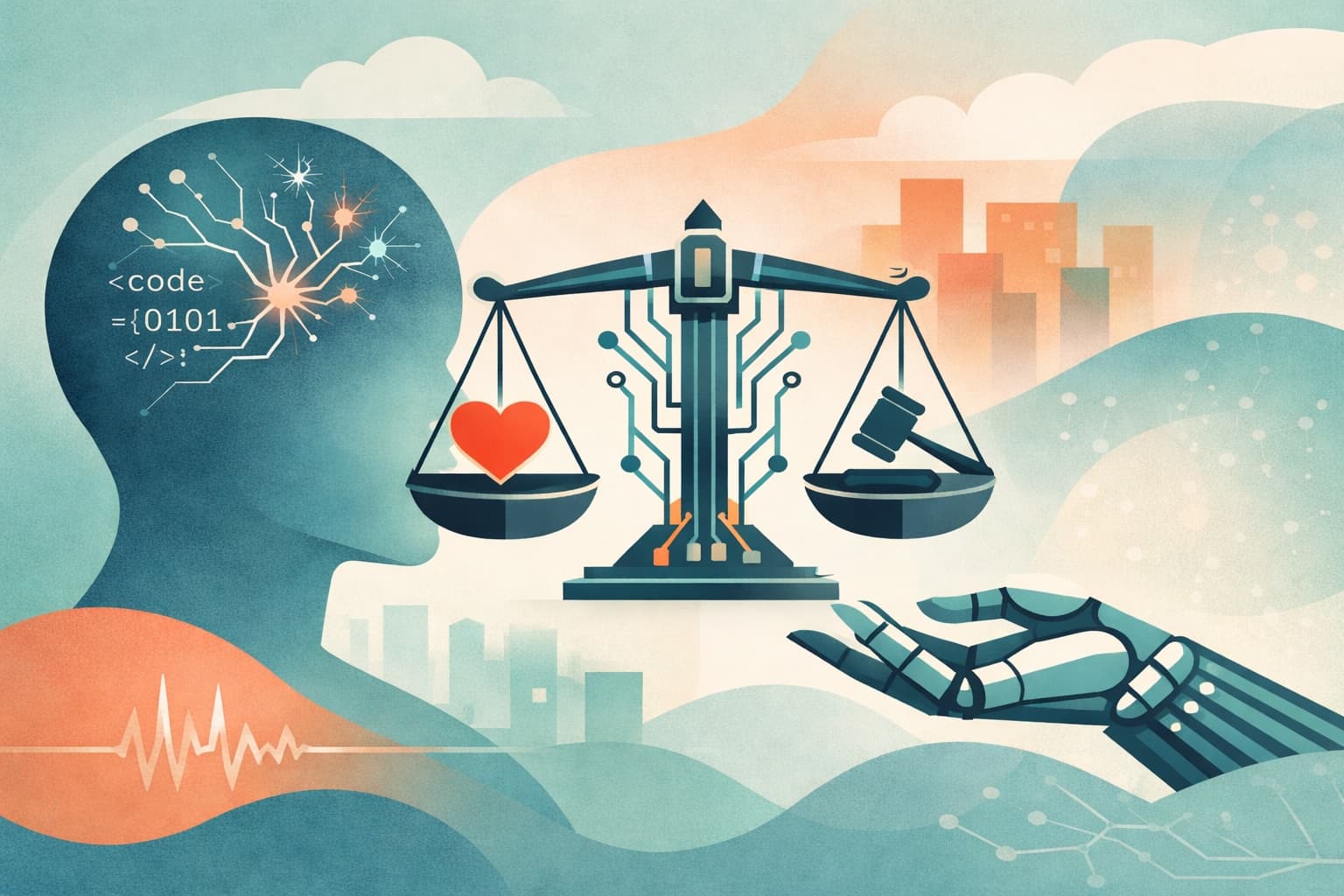
The Ethics of Technology: Who Programs Our Morality
 Andres Aguilar
The engineers who program self-driving cars, content moderation algorithms, and artificial intelligence systems are making moral decisions that affect millions of people every day. The problem is that most of them aren't philosophers — and most philoso...
In 2016, a self-driving car made by Tesla struck and killed a man in Florida. The autopilot system mistook the white side of a tractor-trailer for a clear sky. A technical tragedy, yes. But what happened afterward was philosophically more interesting than the accident itself: Tesla's engineers had to sit in a room and answer a question that philosophers have been debating for two thousand years. The question was simple to state and brutal to answer: if the car can't stop in time, who does it kill? The pedestrian or the passenger? The elderly person or the child? One person or several?
That room of engineers in Silicon Valley became, without anyone having planned it, the most influential moral tribunal of the twenty-first century.
Ethics Leaves the Books and Enters the Code
Let's start at the beginning, because if we don't understand where the problem comes from, we won't understand the magnitude of what's happening today.
Ethics, as a philosophical discipline, has spent centuries trying to answer one question that seems simple but is actually a maze: what is the right thing to do? The Greeks called it the question of the good life. Aristotle said we should seek virtue. Kant, centuries later, proposed that there are universal moral rules you can deduce through reason, regardless of consequences. And the utilitarians — with Jeremy Bentham and John Stuart Mill at the head — argued exactly the opposite: what matters are consequences, and the right thing to do is whatever produces the greatest happiness for the greatest number of people.
For a long time, these discussions lived in books, in classrooms, in debates between philosophers who drank too much coffee and fought over abstractions. But something changed. And it changed all at once.
When we started building machines capable of making decisions, the philosophical questions left the books and landed in the code. Because a machine that makes decisions needs criteria. It needs to know what to prioritize. And those criteria — whoever sets them — are moral judgments dressed up as technical parameters.
There's the heart of the matter: technology is not neutral. It never was.
Norbert Wiener: The Mathematician Who Saw All This Coming
There's a man named Norbert Wiener who deserves far more recognition than he gets. He was a mathematician, a child prodigy who started college at eleven because his father, a professor, didn't quite know what to do with him. In the 1940s, Wiener developed something he called cybernetics — basically the study of control and communication systems in both animals and machines. It was the theory behind how systems self-regulate, process information, and make decisions.
But what makes Wiener especially relevant to this conversation is what happened next. Because Wiener — who had helped design control systems for weaponry during World War II — sat down and thought about the implications of what he'd done. And in 1950 he published a book titled The Human Use of Human Beings. In it, Wiener warned about something that in those days sounded like science fiction and today sounds like a news report: that if we built machines to automate decisions without carefully thinking about the values we were coding into those machines, we were going to regret it.
Wiener said automation could be a blessing or a curse, depending on who controlled the machines and for what purposes. And if we set the machines to work toward the wrong goals, we would achieve those wrong goals with terrifying efficiency.
That guy wrote that in 1950. Seventy-six years ago.
The Trolley Problem Becomes Real
Let's go back to the self-driving car problem, because it's the most concrete way to understand what we're talking about.
In philosophy there's a thought experiment called the trolley problem, which you've probably come across at some point. The basic idea: a runaway trolley is about to kill five people tied to the tracks. You're standing next to a lever. If you pull it, the trolley diverts — but it kills one person on the other branch. What do you do?
The problem was invented by philosopher Philippa Foot in 1967. The point wasn't to give you an answer, but to show you that morality is complicated — that instincts contradict each other, that theory and practice collide.
Now: when the trolley problem lived in philosophy books, it was an intellectual exercise. You could drink coffee, think, discuss, reach a provisional conclusion, and go on with your life. But when that same problem has to be solved by a self-driving car's algorithm in a fraction of a second, someone had to make the decision beforehand. Someone had to write the code. And that code is, literally, the car's morality.
MIT ran an interesting experiment called the "Moral Machine." They published a platform online where millions of people around the world could answer different versions of the trolley problem applied to self-driving cars. Thirty-nine million responses from more than two hundred countries. And what they found was revealing: moral preferences vary enormously by culture. In some countries, the priority was saving the young over the old. In others, saving more people regardless of who they were. In some contexts there was a clear preference for saving pedestrians over passengers. In others, the reverse.
And who decides which of all those moral traditions becomes the algorithm installed in cars that drive all over the world? Basically, engineers at a handful of companies located in California. Who, however well-intentioned they are, have their own culture, their own background, their own blind spots.
That is what it means to say technology is not neutral.
When Algorithms Inherit the Discrimination of the Past
But the self-driving car is just the most dramatic example — the easiest to visualize because it involves life and death. The problem is far more everyday and far more silent than that.
Think about the system a bank uses to decide whether to give you a loan. Before, that process involved an employee who looked you in the eye, read your history, evaluated factors that weren't in the paperwork. Now it's done by an algorithm. The algorithm makes decisions based on historical data. And here's the problem: if historically banks denied loans to certain groups of people for discriminatory reasons, what happens when you train an algorithm on that historical data? The algorithm learns to discriminate. Automatically. Without anyone having explicitly programmed it to do so.
This is not theory. It happened. In 2019, it was revealed that the algorithm for Apple Card — Apple's credit card — was giving women significantly lower credit limits than men with identical financial profiles. The husband of well-known tech entrepreneur Rhonda Abrams discovered he had a limit twenty times higher than hers, despite sharing assets. Goldman Sachs, the company that developed the algorithm, denied any intentional discrimination. That was probably true. It wasn't intentional. It was structural. It was the past encoded in mathematics.
And there's another central philosophical problem: who is responsible when the machine discriminates? The programmers who wrote the code? The executives who decided which data to use to train it? The company? The economic system that produced the biased historical data? It's a question of moral responsibility, and it's hard to answer.
The Many Hands Problem: When Nobody Takes the Blame
In philosophy, when we talk about moral responsibility, we're talking about something very specific. For someone to be morally responsible for an action, philosophers typically require two conditions: that the person acted freely — meaning they could have done otherwise — and that they acted with knowledge — meaning they knew what they were doing.
Machines don't act freely. They have no intentions. They don't know what they're doing in any meaningful sense. So who is responsible? The person who designs them? The person who deploys them? The person who decides to use them?
There's a philosopher named Luciano Floridi who works extensively in this area — an Italian philosopher based at Oxford. He proposes talking about "distributed moral agency," which basically means that in complex technological systems, responsibility is not concentrated in a single point but distributed among multiple actors. Which sounds good in theory, but in practice can become a way for nobody to take responsibility for anything.
That problem has a technical name in ethics: the many hands problem. When many people contribute to an outcome, each one can point to the others and say "it wasn't my fault — I just did my part." It's what happens in many corporate scandals. It's what happens with the climate crisis. And it's what's beginning to happen with algorithmic technology.
The Facebook Experiment and Consent
Let's talk about another concrete case, because it's important to make this crystal clear.
In 2014, Facebook ran an experiment on nearly seven hundred thousand users. Without telling them, it modified the algorithm controlling which posts appeared in their news feeds. One group was shown more posts with positive emotional content. The other was shown more negative content. They then measured the emotional tone of the posts those users made. The result: people who were shown more negative content posted more negative things, and vice versa. In other words, Facebook confirmed it could influence users' emotional states by manipulating what it showed them.
When this became public, there was outrage. But the philosophical point worth making is a different one: that experiment was conducted without informed consent. The users didn't know they were subjects of an experiment. And in the field of research ethics, informed consent is a fundamental principle that emerged, among other things, as a response to the horrors of Nazi medical experiments documented at the Nuremberg Trials.
When did we cross that line with technology? At what point did we normalize platforms experimenting with our psychology without telling us? And who decided that was acceptable?
In Facebook's case, the answer was basically that the terms and conditions allowed it. Which in practice is like saying it's legal because nobody reads them. Philosophically unacceptable, even if legally clever.
Can There Be an Ethics of Artificial Intelligence?
I want to address a deeper question now: can there be an ethics of artificial intelligence? Does it even make sense to talk about machines acting morally?
Isaac Asimov, the science fiction writer, proposed his famous three laws of robotics back in the 1940s. Basically: robots can't harm humans, they must obey human orders unless that violates the first law, and they must protect themselves unless that violates the previous ones. Asimov was smart enough that a major portion of his stories showed precisely that these laws were insufficient — that in complex situations they could produce absurd or dangerous results. It was his way of saying: no, it's not that simple.
Today, eighty years later, artificial intelligence researchers are trying to solve exactly what Asimov was raising in his stories. The field is called "value alignment," and it's basically the research into how to make AI systems act in accordance with human values.
The problem is that human values are, to begin with, contradictory, contextual, and culturally variable. When a company like OpenAI or Google says it will ensure its AI has "human values," the immediate question is: whose values? Which humans? Is there consensus?
There isn't. And that's not a technical detail you solve with more engineering. It's a political and philosophical problem of the first order.
Timnit Gebru and the Power of Big Tech
Here's a figure worth mentioning: Timnit Gebru. She's a researcher of Ethiopian origin who worked on Google's AI ethics team — one of the most important people in the field. In 2020, Gebru and her colleagues published an academic paper pointing out problematic biases in large language models — basically the technology that later became ChatGPT and similar systems. Google fired her, under circumstances she described as retaliation for that research. The scandal was enormous in the tech world.
But the philosophical point is this: when the people raising ethical problems inside a company are silenced or removed, what mechanism remains for those problems to be corrected? This connects to a long tradition in political philosophy about how institutions can be structured to self-correct. Madison wrote about this in The Federalist Papers; Montesquieu talked about the separation of powers. The idea was that no part of the system should have so much power that it could ignore the rest.
The problem with big tech companies is that they concentrate extraordinary power with very limited external oversight. They exist somewhere between a private company, a public utility, and critical national infrastructure — but the regulations that apply to them in many countries are those of an ordinary private company.
Algorithmic Opacity: Decisions That Can't Be Explained
There's a concept that is key here: algorithmic opacity. The most powerful AI systems today — what are called deep neural networks — are basically black boxes. They produce results that in many cases even their creators cannot fully explain. If you ask a facial recognition system why it classified this face as suspicious, it can't give you an answer humans can understand. The internal process is mathematically complex to the point of being opaque even to experts.
This has enormous implications. In the legal system, for example, there's the principle that a person has the right to know what they're being accused of and what evidence is being used against them. That principle — what we call due process — is a fundamental right. But if the system that decided you're suspicious is a neural network that can't explain its reasoning, how do you exercise that right?
Several US states use a system called COMPAS to predict the likelihood of criminal recidivism and help judges decide sentences. The system is proprietary — private — and its creators refuse to reveal exactly how it works, arguing it's a trade secret. There are documented cases of people who received harsher sentences based partly on that algorithm's score, and who couldn't challenge it because nobody could explain how it reached that number.
That is a gravely serious ethical and philosophical problem. It's irrationality dressed in mathematical clothing.
What Can Be Done: Regulation, Ethical Design, and Active Citizenship
So what do we do? How do we get out of this?
Honestly, there are no easy answers. But there are interesting proposals.
A philosophical current that has gained a lot of weight in recent years is the ethics of technology centered on human dignity. The German philosopher Jürgen Habermas — though he doesn't speak directly about technology in most of his work — offers a very useful conceptual tool: the idea that decisions affecting the community must result from a rational, open communicative process in which all those affected can participate. Applied to technology, this would mean that decisions about which values to code into algorithms cannot be made unilaterally by engineers or executives, but require some form of public deliberation.
Some countries are starting to move in that direction. The European Union passed what is called the AI Act, which establishes risk categories and transparency requirements for high-risk systems, mandating human oversight. It's imperfect, criticized from all sides, but it's an attempt at a political response to a philosophical problem. The idea is that we can't leave tech ethics as just an internal conversation inside companies.
Another approach comes from the field of ethical design. Researchers and designers are proposing that ethics needs to be integrated into the technological development process from the start — not as a final check. When you're designing a system, you need to ask: who could this harm? Who does it exclude? Who isn't represented in the data we're using? What assumptions about the world are we encoding?
That's an important shift in mindset. Traditional engineering asks: does it work? Ethically aware engineering asks: does it work — and for whom, and at whose expense?
The Role of the Informed Citizen
There's something else worth noting before we close, and it's about us — ordinary users.
There's a tendency to think these are problems for specialists, that the ones who need to solve them are the engineers, philosophers, and regulators. And that's partly true. But there's also a role we play, and that's the role of the informed citizen.
Kant said that the Enlightenment, in the broad sense of the word, was "the human being's emergence from self-imposed immaturity." Self-imposed because the immaturity — not thinking for oneself — is often a comfortable choice. It's easier to let others decide. It's easier not to read the terms and conditions, and yes, I know, nobody reads them, and they're designed so nobody reads them. But there's a difference between not reading them and not knowing they exist — between not understanding the algorithms and not knowing they affect you.
The first form of resistance, if you can call it that, is simply understanding that these things exist and that they matter. That when you use an app, there are moral choices encoded in it. That when a platform shows you certain content and hides other content, someone made that decision. That it's not natural, not neutral, not inevitable.
Once you know that, you can ask questions. You can look for alternatives. You can support regulations. You can demand that your political representatives address the issue. You can, if you have children or students around you, talk to them about this.
It's not about becoming an expert in algorithmic ethics. It's about not closing your eyes.
The Question Aristotle Would Ask Silicon Valley
Let's go back to those engineers sitting in their conference room in Silicon Valley, trying to decide who the self-driving car kills. You can't blame them personally. They're doing the best they can with the tools they have. The problem is systemic, structural — a consequence of allowing philosophy and politics to show up late to a party that technology started decades ago.
But it's also solvable. Not easily, not quickly, but solvable. Because the philosophical problems raised throughout this piece — moral responsibility, consent, justice, transparency — are problems humanity has been thinking about for centuries. We don't have all the answers, but we have very well-developed conceptual tools. The challenge is applying them with the urgency the moment demands.
Aristotle said the polis — the political community — was the space where human beings could live well together. Today, much of our public life happens on digital platforms designed by private companies with commercial goals. The question Aristotle would ask Mark Zuckerberg, Sam Altman, all of them, would be very simple: does your technology help us live well together, or does it push us to live alone, angry, and surveilled?
That question has no technical answer. It has a philosophical and political one. And finding it is everyone's work.
Related episodes

Why did you choose this way? Because he thought that philosophy was neither poetry nor opinion.

Close your eyes and look for your self. That permanent center that is you. Look carefully. A friendly, chubby Scotsman did that same exercise nearly three hundred years ago — and didn't find it. What he found instead was one of the most unsettling idea...

The most powerful man in the world wrote a private journal every night that he never intended to publish: he challenged himself not to be an idiot, reminded himself he was going to die, and braced for setbacks before they arrived. Two thousand years la...