
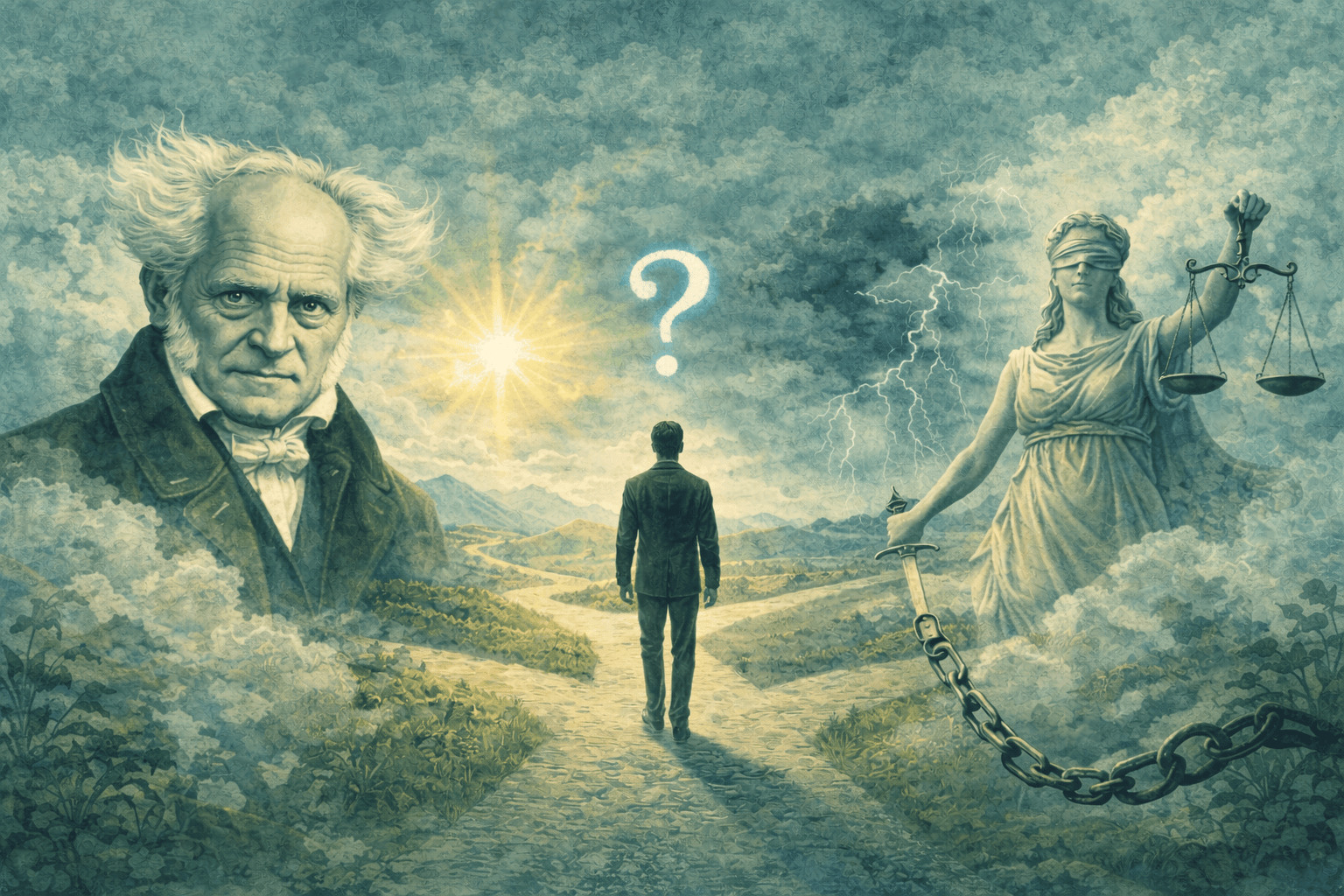
Schopenhauer and Free Will
 Andres Aguilar
Schopenhauer had a conviction that haunted him his entire life: you can do what you want, but you cannot want what you want. That seemingly subtle distinction dismantles the illusion of free will with brutal elegance — and explains why we spend our liv...
In 1839, the Royal Norwegian Society of Sciences organized an essay competition with a question that had been tormenting philosophers for centuries: Can the freedom of the human will be proven from self-consciousness? Arthur Schopenhauer — a guy so bitter he lived with a poodle he named "Atman" (the Hindu concept of the universal soul) — entered the competition convinced he was going to sweep it. He wrote a demolishing essay arguing that no, free will is an illusion, and that we are basically puppets of our own desires. He won the prize, but the Society added a note that must have made him grit his teeth: they were rewarding him for the clarity of his exposition, not necessarily because they agreed with him. Schopenhauer held that grudge for the rest of his life, obviously.
But here's what's remarkable: that essay, titled "On the Freedom of the Will," contains one of the most brutal and convincing arguments against free will ever written. And the surprising thing is that Schopenhauer wasn't trying to be provocative just for the sake of it. The guy genuinely believed, with an almost religious conviction, that he had discovered a fundamental truth about the human condition. And that truth, according to him, was pretty depressing: you can do what you want, but you cannot want what you want.
The Distinction That Changes Everything
Let me explain this because it's the core of the whole thing. Schopenhauer made a distinction that sounds like wordplay but is actually deeply profound. When you say "I am free," what are you saying exactly? Most people think being free means being able to choose between several options. You want coffee or tea, and you choose coffee. You exercised your freedom there, right? Schopenhauer would say yes — you were free to take the coffee. Nobody put a gun to your head, there were no physical laws preventing you from grabbing the cup. In that sense, your action was free.
But here's the twist: why did you want coffee instead of tea? That's where things get thorny. According to Schopenhauer, that desire, that preference for coffee, is not something you chose. It simply appeared in your consciousness. Maybe you like the taste of coffee because your brain is wired a certain way. Maybe you associate it with good memories. Maybe you're tired and know caffeine will wake you up. But all those reasons, all those causes of your desire — you didn't choose them. They're the result of your biology, your history, your context. And if you didn't choose to want what you want, then in what sense are you really free?
It's like being given a menu where you can freely choose any dish, but someone else has already decided which dishes you're going to like. And this isn't just an abstract philosophical metaphor — it happens literally every day. Look at how marketing works: companies spend fortunes studying exactly how to present information to you so you'll choose what they want you to choose. They put the most expensive item on the right because they know your eyes go that direction. They show you three options instead of two because they know you'll pick the middle one. They tell you "only a few left" because they know that activates your fear of missing out. And the most astonishing part is that it works. You can predict, with reasonable accuracy, what most people will choose if you correctly manipulate how the information is presented.
But didn't those people choose freely? Well, they felt like they were choosing freely. Nobody forced them. They deliberated, compared options, made a decision. But their decision was predictable because someone understood the causes that drive those choices. And here's where Schopenhauer shakes you: if your choices are predictable, if they respond to causes you don't control, are you really choosing? Or better yet — are you choosing in a way that's fundamentally different from how a billiard ball "chooses" its direction after it's been struck?
This idea messed with people's heads in Schopenhauer's day, and it's still unsettling now. Because if you think about it, it touches something very deep about how we understand ourselves. Our whole lives, from childhood on, we're taught that we're responsible for our actions, that our decisions matter, that we build our destiny. And then this grumpy German philosopher shows up and tells you: "Look, you can do what you want — but what you want, that you didn't choose."
The Metaphysics of the Will
To really understand why Schopenhauer arrived at this pessimistic conclusion, we need to get into his philosophical system a bit. Schopenhauer was a fanatical admirer of Kant but thought old Immanuel hadn't gone far enough. Kant had argued that the world we experience is only a representation our mind constructs. Behind that representation is the "thing-in-itself" — reality as it is independent of our perception. But Kant said this thing-in-itself was unknowable.
Schopenhauer thought Kant was being too modest. According to him, we can know the thing-in-itself, and we know it from the inside. How? Through our own experience. When you move your arm, you experience it in two ways: from the outside, as an object that moves, and from the inside, as an act of will. That will, that inner impulse — that is the thing-in-itself. And not just in you: the whole universe, according to Schopenhauer, is a manifestation of a blind, irrational will that strives constantly without any final purpose.
Schopenhauer's idea is that everything in the universe — from the stone that falls to the tree that grows, from the dog searching for food to the human searching for love — all of it is an expression of the same fundamental will. It's a completely a-rational force, not in the sense of being crazy or irrational, but in the sense that it lies beyond reason. It has no motives, no plans — it simply wills, simply strives.
And here's where the free will issue connects to everything. If all human action is a manifestation of this will, and if the will is blind and irrational, then our desires, our wanting, are not really "ours" in the sense that we chose them. They are the will manifesting itself through us. You feel like an individual with your own preferences and goals, but in reality you're like a wave on the ocean: you have your individual form, your specific movement, but at bottom you're water — part of the same ocean as all the other waves.
Determinism and the Three Types of Causality
Schopenhauer summed it up in a phrase that became famous: "Man can do what he wills, but he cannot will what he wills." It perfectly captures his argument. Think of any decision you made today. You chose to get out of bed, chose what to eat for breakfast, chose what to wear. All of those were free choices in the sense that no one forced you. But why did you choose those specific things? Because you wanted to get up more than stay in bed. Because you preferred toast to cereal. And all those desires, all those preferences — they simply appeared in your consciousness. You didn't decide to want to get up. You just found yourself wanting to get up.
This is where Schopenhauer starts analyzing causality, and here we have to talk about something that sounds intimidating but is actually pretty simple: determinism. Determinism is basically the idea that every event has a cause, and given a set of causes, the effect follows necessarily. It's the idea that the universe is like a giant chain of dominoes: one tile falls, that makes the next one fall, and so on. There are no events without causes, no effects that appear out of nowhere.
In the physical world, this is pretty obvious. If you heat water, it boils. If you drop a stone, it falls. Nobody thinks the stone "decides" to fall or the water "chooses" to boil. They simply respond to the causes acting on them in a predictable and necessary way. Determinism says everything works like this — not just stones and water, but also animals, plants, and — here's the controversial part — human beings too.
The question is: are our decisions fundamentally different from a falling stone, or are they just a more complex form of the same causal phenomenon? Schopenhauer thought the latter. He distinguished three types of causality. The first is physical causality, governing the inanimate world: one billiard ball strikes another and makes it move. The second is biological causality or stimulus, governing living organisms: the plant grows toward the light, the animal flees from danger. And the third is motivation, governing conscious beings like us.
But — and this is crucial — motivation is no less deterministic than the other two. It's just more complex, more sophisticated. When you say "I decided to go to the movies because I wanted to see that film," you're giving a reason. But that reason worked as a cause, exactly like heat causes water to boil. Given your personality, your tastes, your emotional state in that moment, and given the presence of that motive, your action followed with the same necessity as a billiard ball when it's struck. The only difference is that the cause passed through your consciousness, appeared as a desire or a thought. But it was still a cause, and you were still an effect.
Innate Character and Moral Responsibility
This sounds very deterministic, and it is. Schopenhauer was a convinced determinist — someone who thought that everything, absolutely everything, including each of your thoughts and decisions, is causally determined by prior events. But here's something interesting: he didn't think determinism eliminated moral responsibility. On the contrary, he thought moral responsibility came precisely from the fact that our actions flow from our character. If someone does something horrible, they are responsible not because "they could have chosen otherwise," but because that action expressed who that person truly is.
Character, according to Schopenhauer, is innate and immutable. You are born with a certain character, and that character will determine how you respond to the motives presented to you. Basically he's telling you that you're born as a good person, a bad person, or something in between, and there's not much you can do about it. You can learn new things, acquire knowledge that presents new motives, but your fundamental character — the way you respond to those motives — that doesn't change.
Now, you might be asking yourself: if everything is determined and our character is immutable, doesn't that turn us into biological robots with no real agency? It's a fair question. In one sense, yes — we are like robots. We don't choose our desires, we don't choose our character, and our actions flow from these with causal necessity. But on the other hand, there is something we can do, and that's become conscious of all this.
The Negation of the Will: The Buddhist Way Out
This is the most interesting twist in Schopenhauer's philosophy. He thought that by understanding the nature of the will — by seeing that all our suffering comes from this constant, insatiable wanting — we could, in a sense, free ourselves. Not free ourselves in the sense of acquiring free will, which is impossible according to him, but free ourselves from the suffering the will causes. And how is this achieved? Through what he called the "denial of the will to live."
Sounds like something out of a horror movie, but what Schopenhauer had in mind was quite similar to the Buddhist and Hindu ideas he so admired. The idea is that if you can see through the illusion of individuality, if you can recognize that your individual will is only a manifestation of the universal Will, then you can stop identifying with those desires. You can reach a state of quietude, of detachment, where you no longer cling to life and its pleasures and pains.
This doesn't mean suicide. Schopenhauer was very explicit that suicide is not the negation of the will — it's its most extreme affirmation. The person who kills themselves does so because they want to stop suffering, because life isn't giving them what they want. They're still enslaved by the will. The true denial of the will is more like a kind of asceticism, a gradual renunciation of all desires.
The Philosopher Who Couldn't Practice What He Preached
And here we need to mention something about Schopenhauer's personal life, because the guy was the embodiment of contradiction. He preached asceticism and the denial of the will, but he himself was a selfish man who spent his whole life living off the inheritance left by his merchant father. He never worked a day in his life, ate at good restaurants, went to the opera, and was famous for his terrible temper. There's a telling anecdote: he once shoved an elderly seamstress down the stairs of his building because she was talking too loudly in the hallway. The woman was hurt, sued him, and Schopenhauer had to pay her a monthly pension until she died. When she finally passed away years later, Schopenhauer wrote in his financial records: "Obit anus, abit onus" — Latin for "The old woman died, the burden is gone." Imagine being that heartless.
So you have this guy telling you to renounce desires and live at peace with the world, who couldn't go two minutes without picking a fight with someone. It's almost paradoxical. But maybe that contradiction actually reinforces his point about free will. Schopenhauer knew intellectually that he should be more compassionate, more detached, more peaceful. But his character was what it was. He couldn't want to be different from what he was, even if he could want to want to be different. He lived his own philosophy in the most tragic way possible: perfectly conscious of the nature of the will and his own character, but incapable of escaping them.
Neuroscience Confirms Schopenhauer's Suspicions
What do we do with all this in the present? Because the free will question didn't stay in the nineteenth century. In recent decades, neuroscience has been saying things that sound unsettlingly similar to what Schopenhauer was saying. There are famous experiments, like Benjamin Libet's from the 1980s, that showed that brain activity associated with a decision begins before the person is consciously aware of having made the decision. In other words, your brain "decides" before you notice you're deciding.
These experiments point to something Schopenhauer had already intuited: that consciousness might be more of a spectator than an author. That the feeling of freely choosing might be an illusion that comes after the fact — a narrative our mind constructs to make sense of actions that were already determined by unconscious processes.
And this has enormous implications. Because our entire society is built on the idea that people are responsible for their actions because they could have chosen to act differently. The criminal justice system, for example, is based on the idea that criminals deserve punishment because they chose to do wrong when they could have chosen to do right. But if Schopenhauer is right — if our actions flow from our character with causal necessity — does punishment make sense? Does praise make sense?
Compassion as the Foundation of Morality
Schopenhauer would say yes, but for different reasons. Punishment is not justified because the criminal "deserved" to suffer for having freely chosen wrong, but because punishment can function as a future motive for them and for others. It's a form of social causality. And compassion — which for Schopenhauer was the foundation of all genuine morality — makes sense precisely because you recognize that the other person didn't choose to be who they are, just as you didn't choose to be who you are. We're all manifestations of the same Will, all trapped in the same wheel of desire and suffering.
There's something profoundly egalitarian in Schopenhauer's vision, even if it's strange to say so about a guy who shoved elderly women down stairs. If nobody chooses their character, if we're all products of forces we don't control, then there's no real basis for pride or contempt. The criminal isn't morally inferior — they just had bad luck in the lottery of character. And the saint isn't morally superior — they just got lucky. This should generate an attitude of universal compassion.
Of course, there are plenty of objections you can raise. The most obvious one is: if we have no free will, if everything is determined, why bother doing anything? Schopenhauer would answer that this objection misunderstands the nature of determinism. The fact that your actions are determined doesn't mean they're predetermined independently of your deliberations. Your deliberations are part of the causal chain. When you think carefully about what to do, when you weigh reasons — all of that is part of the process that determines your action.
Another objection is that the subjective experience of freedom must count for something. When you're deliberating about what to do, you genuinely feel like multiple options are open to you. Schopenhauer acknowledged this experience but considered it illusory. It's a useful illusion, perhaps a necessary one for functioning, but an illusion nonetheless. It's like watching a movie for the second time: you know exactly what's going to happen, but while you're watching it you can experience the tension as if the outcome were still open.
Honest Pessimism as a Form of Liberation
And here's something that's fascinating about Schopenhauer: his brutal honesty. The guy doesn't sell you a comforting philosophy. He doesn't tell you everything is going to be okay, that you have a cosmic purpose. He tells you that you're a manifestation of a blind force that uses you to perpetuate itself, that your desires are a source of endless suffering, and that your only escape is to stop wanting altogether. Not exactly an inspirational message, but there's something refreshing about his unadorned pessimism.
And yet, paradoxically, understanding all this can be liberating in a strange way. If you accept that you don't have free will in the traditional sense, if you accept that your desires aren't really "yours," you can stop beating yourself up so much over your failures and stop taking so much credit for your successes. You can see your behavioral patterns more clearly, without the layer of justificatory narratives we normally construct. And you can start looking at others with more compassion, recognizing that they too are trapped in their own characters, their own causal chains.
The Legacy of a Philosopher Who Found Fame Late
Schopenhauer died in 1860, sitting on his sofa after breakfast, probably complaining about something. He had spent decades in relative obscurity, bitter that his masterpiece — The World as Will and Representation — had been ignored while Hegel and other German idealists dominated the philosophical scene. But in his final years he finally achieved some recognition. People started reading his books and discovered this singular figure who combined German metaphysics with Eastern mysticism and wrapped it all in brilliant, sharp prose.
His posthumous influence was enormous. Nietzsche read him as a young man and was fascinated, though he later repudiated many of his ideas. Freud acknowledged that Schopenhauer had anticipated the concept of the unconscious. Wagner put his ideas about music at the center of his aesthetic theory. And an entire movement of philosophical pessimism in the twentieth and twenty-first centuries can be traced back to him.
Today, when philosophers and neuroscientists debate free will, Schopenhauer remains a mandatory reference. Because he framed the problem in a way that's very hard to dodge. You can reject his metaphysics of the Will, you can think he overstated determinism, you can find problems in his arguments. But his central question remains: if you didn't choose to want what you want, in what sense are you really free?
And that question matters not just for academic philosophy but for how we live. Because it affects how we see ourselves, how we see others, how we think about responsibility, merit, punishment, compassion. If Schopenhauer is even partially right, maybe we should be more humble about our achievements and more understanding toward our own failures and the failures of others.
So — do we have free will? Schopenhauer would say flatly no, at least not in the sense we normally think. We can do what we want, yes, but we cannot want what we want. And that distinction changes everything. Whether or not you agree with him, it's impossible to think seriously about free will without confronting his argument. He's one of those philosophers who forces you to question your most basic assumptions about yourself and your place in the world.
And maybe that's the true freedom Schopenhauer offers: not freedom of the will, which is impossible, but the freedom that comes from knowledge. Knowledge of your limitations, of the forces that move you, of the nature of existence. You can't escape being what you are, but at least you can understand what you are and why. And in that understanding — cold and desolate as it may be — there is a kind of peace.
Related episodes
Why did you choose this way? Because he thought that philosophy was neither poetry nor opinion.
Close your eyes and look for your self. That permanent center that is you. Look carefully. A friendly, chubby Scotsman did that same exercise nearly three hundred years ago — and didn't find it. What he found instead was one of the most unsettling idea...
The most powerful man in the world wrote a private journal every night that he never intended to publish: he challenged himself not to be an idiot, reminded himself he was going to die, and braced for setbacks before they arrived. Two thousand years la...