
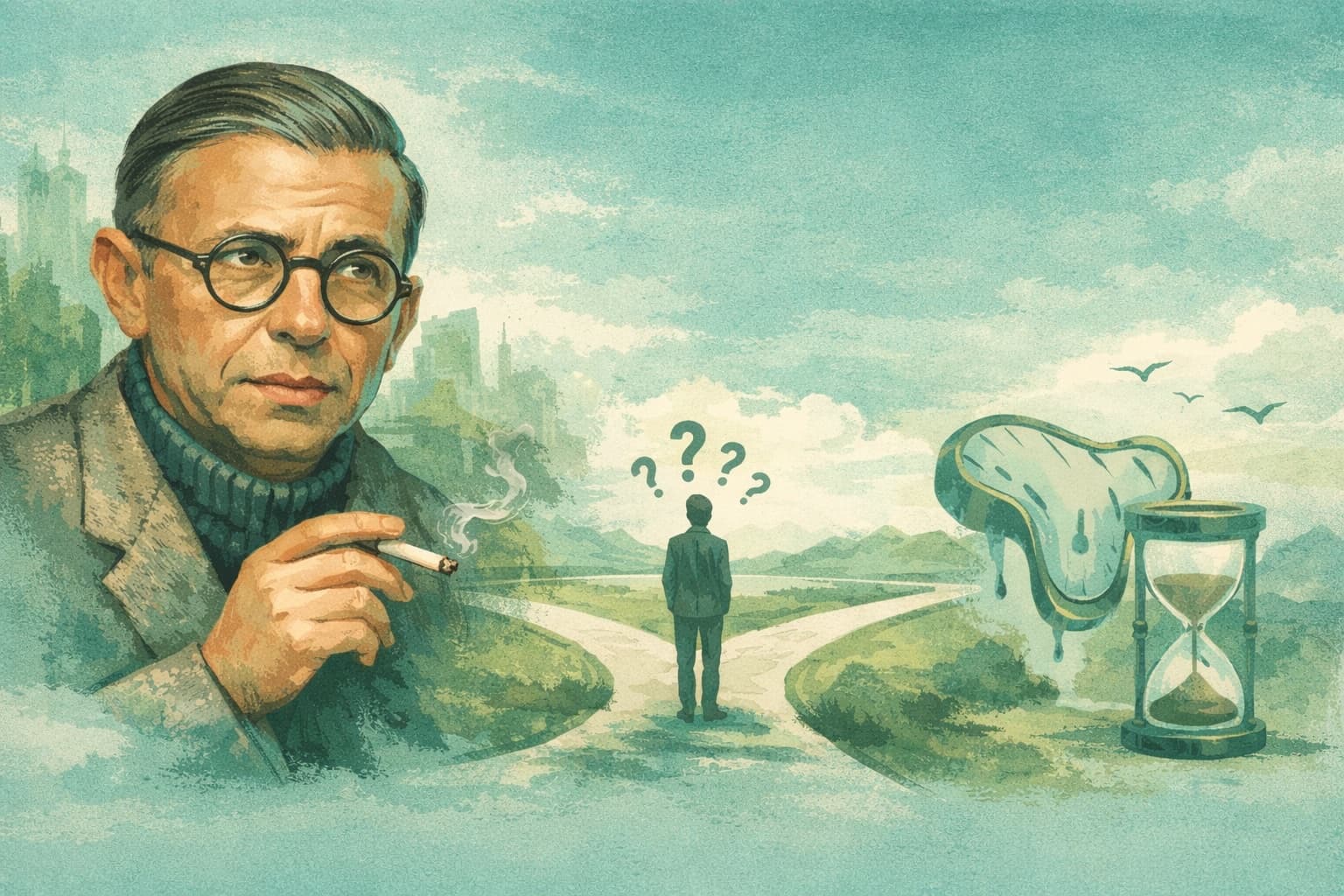
Sartre and Existentialism: It's All Up to You
 Andres Aguilar
Jean-Paul Sartre lived his philosophy with almost scandalous intensity: he turned down the Nobel Prize, threw himself into every political cause of his era, and spent decades telling the world there is no destiny, no predetermined human essence — which...
"We are condemned to be free." We explore Sartre's philosophy: there's no predetermined destiny — you create your essence with every decision. Absolute freedom as both blessing and condemnation.
A cross-eyed guy, five feet tall, smoking three packs of cigarettes a day, taking amphetamines to write, and turning down the Nobel Prize in Literature. That was Jean-Paul Sartre — the philosopher who looked at you through his thick lenses and said: "You are completely free, and that is your condemnation." And he didn't say it from some ivory academic tower. He said it sitting in the Café de Flore in Paris, surrounded by writers, artists, and students, arguing about politics, literature, and human freedom until three in the morning.
Sartre was not one of those philosophers who write incomprehensible treatises from total isolation. The guy lived his philosophy, put it into practice, took it to the streets. And his central idea was as simple as it was devastating: there is nothing and no one that determines who you are or what you have to do with your life. No instruction manual, no predetermined human essence, no God marking out your path. You're just thrown here, in this world, and you have to decide what to do. Every second that passes, you're choosing who you are.
For many, this idea was liberating. For others, terrifying. Because if everything depends on you, then you can't blame anyone else. You can't say "that's just how I am" or "I was born this way" or "God wants me to be this way." Nope. You choose. And with that choice comes all the responsibility in the world.
But let's start at the beginning. Who was this Jean-Paul Sartre, and why was half of Paris listening to him like he was a rock star in the forties and fifties?
A Philosopher Who Came from the Margins
Sartre was born in 1905 in Paris, into a middle-class family. His father died when he was barely fifteen months old, so he was raised mostly by his maternal grandfather, who was a professor of German. As a child he was sickly and odd-looking, with a wandering eye that gave him a terrible complex his whole life. But he made up for it with a ferocious intelligence and an almost diseased capacity for reading. By the age of nine he was already devouring everything, consuming literature like it was his drug.
He studied at the École Normale Supérieure — basically the Champions League of French philosophy. That's where he met Simone de Beauvoir in 1929, and where one of the most fascinating relationships of the twentieth century began. They never married, never permanently lived together, had open relationships with other people, but they were intellectual and emotional companions for over fifty years. An unconventional couple living by their own rules, not by what society expected. Very existentialist, if you think about it.
In the 1930s, Sartre traveled to Germany and discovered phenomenology, especially the philosophy of Heidegger and Husserl. He became fascinated by the idea of studying things "as they appear," without prejudices or prior theories. He returned to France with his head full of ideas and started writing. First he published Nausea in 1938, a philosophical novel about a guy named Antoine Roquentin who experiences the radical absurdity of existence. The character realizes that things simply are — without reason, without purpose — and this generates a physical feeling of nausea and disorientation. The novel was a success, but Sartre had not yet become the phenomenon he would later be.
The War That Transformed Him
And then came the war. World War II changed everything. Sartre was drafted, captured by the Germans in 1940, and spent nine months in a prisoner of war camp. There, in that confinement, he organized theatrical performances with other prisoners and kept reflecting on freedom, choice, and responsibility. When he was released for health reasons in 1941, he returned to Nazi-occupied Paris and joined the Resistance. His involvement was more intellectual than military — writing for clandestine publications. But the experience of living under Nazi occupation, of watching how people adapted or resisted, of facing concrete moral dilemmas, deeply marked his philosophy.
In 1943, during the occupation, he published Being and Nothingness, his most important philosophical work. A volume of nearly seven hundred pages, technical, dense, difficult to read, but containing the central ideas of his existentialism. And here's the surprising part: in the middle of a war, with Paris under occupation, the book became a bestseller. People read it in cafés, discussed it in the streets. Why? Because Sartre was giving them something they needed to read: you are free, even here, even now.
Existentialism Goes Mainstream
After the war, Sartre became a philosophical celebrity unlike anything seen before. Existentialism became fashionable. Young people dressed in black, gathered in cafés to argue about anguish and freedom, listened to jazz, smoked like chimneys. Sartre gave lectures where people fought to get in — barely enough room to breathe. In 1945 he gave a talk titled "Existentialism Is a Humanism" where he tried to explain his ideas in a more accessible way, because people were already accusing him of being a pessimist, a nihilist, and promoting despair.
But okay — what are we actually talking about when we talk about existentialism? Let's get to the heart of it.
Existence Precedes Essence
The central idea, the one that sums up everything, is this: existence precedes essence. Sounds weird, but it's simpler than it seems. Think of it this way: when someone makes a knife, they first have in mind the idea of the knife — what it's for, how it should be. In other words, first comes the essence (the idea, the purpose), and then comes the existence (the concrete object). The knife exists to cut; that's its essence, and it was made according to that purpose.
Now, for centuries, philosophers and religions thought the same thing applied to humans. That God, or nature, or some universal law first designed what the human being is — its purpose, its essence — and then created us according to that design. Like, you're born with a factory manual that says "the human being is rational," or "the human being is made to be good," or "the human being must seek happiness." We'd come with the essence already built in.
Sartre says no — it's the other way around. First you exist. You show up in the world, you're here, thrown out there, with no manual, no instructions. And then, through your decisions, through your actions, you create your essence. You define who you are. There is no universal human nature that determines how you have to be. You make yourself.
This is radical, you understand? It means you can't say "I'm just like this" as if it were something fixed and immutable. You can't say "I have a bad temper" or "I'm shy" as if those were facts of nature you can't change. For Sartre, in every moment you're choosing to be a certain way. If you're a violent person, it's because you're choosing violence. If you're generous, it's because you're choosing generosity. Nothing is written in advance.
The Condemnation of Being Free
And here comes the most demanding part: you are absolutely free. No matter what situation you find yourself in, you always have options. Even in extreme situations — like being in a concentration camp — you have the freedom to choose your attitude, how you respond. Sartre is not saying all situations are equal or that it doesn't matter which one you're in. Obviously it does. He's saying that even in the worst circumstances, you remain a subject who chooses, who decides.
And this absolute freedom is, at the same time, a condemnation. Because you can't escape it. You can't say "I didn't choose this." Well, sure — maybe you didn't choose to be born, didn't choose your family, didn't choose many of the circumstances of your life. But you are choosing, all the time, how to respond to those circumstances. And that choice defines you.
Anguish, Abandonment, and Despair
Sartre talks about three key concepts that accompany this freedom: anguish, abandonment, and despair. Sounds like a metal album, but it makes sense.
Anguish is what you feel when you realize you're truly free and responsible. It's not fear of something specific — it's something deeper. It's the vertiginous feeling that everything depends on you, that there are no guardrails, that every decision commits you. Sartre gives an example: a general who has to send troops to the front, knowing many will die. The order depends on him. He can't blame fate, God, or historical necessity. He decides, and with that decision comes all the anguish of responsibility.
Abandonment is the feeling of being alone in your decision, without a God to guide you, without absolute values telling you what to do. You're abandoned in the sense that no one else can decide for you. Sartre tells the story of one of his students during the war. The young man had to choose between staying to care for his widowed mother who desperately needed him, or going to England to join the Free French Forces and fight against the Nazis. Two options, both morally valid, but mutually exclusive. What to do? The student asked Sartre for advice. And Sartre told him: "You are free — you choose." There is no right answer written in the stars. Whatever you choose, that will define you. It's abandoning, yes, but it's the human condition.
Despair is not depression or sadness — it's more like giving up counting on things that are outside your control. It's accepting that you can only rely on what depends on your freedom. You can't control the future, can't control others. You can only control your own actions in the present.
Bad Faith: When We Lie to Ourselves
Now, with all that freedom and responsibility weighing on you — what do people do? Often, they flee. And here Sartre introduces a concept that is brilliant: bad faith.
Bad faith is when you lie to yourself about your own freedom. When you pretend you're not free, that you're determined by external circumstances, that you "have no choice." Sartre gives a famous example: the waiter in a café. Picture a waiter who plays his role so mechanically, so automatically, that he seems like a robot. He moves with studied gestures, speaks in a specific tone, does everything according to the manual of the perfect waiter. He's living in bad faith because he's pretending that he is a waiter — that it's his essence, that he has no option. He hides behind the role to avoid confronting his freedom and the decisions he could make.
Or think of more everyday examples. The guy who says "that's just how I am, what can you do?" when he acts irresponsibly. The woman who says "my sign is Scorpio, that's why I'm jealous." The kid who says "I grew up in this neighborhood, I can't be any other way." All forms of bad faith. All ways of escaping freedom and responsibility.
Love and the Other
Sartre is also very critical of conventional romantic love. He criticizes the notion that you can possess another person, that love is merging with the other until you lose your individuality. For him, each person is a free subject who is constantly choosing themselves. You can't reduce the other to an object, can't pretend someone belongs to you. The love relationship, for Sartre, is always a bit conflicted because it involves two freedoms that can never completely fuse. More honest, maybe — but less romantic.
The Rejected Nobel and Political Commitment
One anecdote that shows how Sartre lived these ideas: in 1964 he was awarded the Nobel Prize in Literature. It's the maximum recognition, every writer's dream. And Sartre turns it down. He's the first in history to voluntarily refuse it. Why? Because for him, accepting the prize meant being institutionalized — co-opted by the Western bourgeois establishment. He wanted to maintain his freedom, his ability to criticize without being bound by commitments or official recognition. Consistent to the bone.
Sartre also dove deep into politics. He was a Communist for a while, though a strange Communist — always critical of Stalinism. He supported decolonization movements, opposed the Algerian War, defended the Cuban Revolution. Traveled to Cuba, to the Soviet Union, to China. Broke with his friend Albert Camus over political differences. Signed manifestos, gave speeches, got involved in every kind of controversy. Because for him, philosophy wasn't something you do at a desk, separated from reality. If freedom is the fundamental thing, then you have to fight for the social and political conditions that allow people to be free.
Individual Freedom and Social Justice
Here's an interesting tension in his thought. On one hand, he says everyone is absolutely free and responsible. On the other, he recognizes that social, economic, and political circumstances terribly limit people's possibilities. Is a child born into extreme poverty with no access to education as free as one born into wealth? Obviously not. Sartre tries to resolve this tension by saying that freedom is not doing whatever you want, but rather the capacity to choose within a situation. You're always in a situation, conditioned by concrete circumstances — but within that situation, you choose how to respond. And those choices matter.
That's why his philosophy has a strong moral and political dimension. If we're all free and responsible, then we have a responsibility not only to choose for ourselves, but to create a world where others can be free too. When I choose, I'm creating an image of what it means to be human — I'm saying "I believe you can live this way." And that has consequences for everyone.
Sartre has a line that captures this: "In choosing myself, I choose man." When I decide what to do with my life, I'm also proposing a model of being human. I'm not just choosing for myself — I'm choosing what kind of world I want. If I choose cowardice, I'm saying cowardice is acceptable. If I choose courage, I'm proposing courage as a value. Every action you take is like a vote on what humanity should be.
Sartre in the Twenty-First Century
What does any of this have to do with the present, with us, right now, in the twenty-first century?
Look around. We live in an era where we're constantly being told who we have to be. Social media bombards us with models of success, beauty standards, "correct" ways to live. Algorithms classify us, predict us, trap us in bubbles. Advertising sells us pre-packaged identities. And it's very easy, very tempting, to adopt one of those ready-made identities and say "okay, that's me."
Sartre's existentialism is an antidote to that. It tells you: no, friend, you are not what Instagram says you are. You're not your likes, not your job, not your clothes, not your image. You are your choices. And those choices are yours to make, nobody else's.
It also applies when we justify ourselves by saying "that's just how society is" or "everyone does this." For Sartre, that's bad faith. You can choose differently. You can choose not to go along with the current. And yes, there are consequences — maybe it'll cost you — but it's your choice.
Or when we say "I have no choice," "I'm stuck," "I'm trapped in this job / relationship / situation." Sartre looks at you with that crossed eye and says: you're choosing to stay. Maybe the alternatives are hard, maybe they're costly, but they're always there. And not choosing is also a choice.
This can sound brutal, and it is. There's something almost relentless about Sartre. But there's also something deeply liberating. Because if everything depends on you, then you can change. You are not determined by your past, by your mistakes, by your circumstances. In every moment you can choose to be different.
The Legacy of the Philosopher Who Turned Down the Nobel
Sartre died in 1980, nearly blind, fairly sick, after a life of writing, smoking, drinking, activism, and philosophizing without pause. His funeral was massive — over fifty thousand people accompanied the procession through the streets of Paris. The guy who turned down the Nobel, who spent his life saying there were no authorities and no fixed essences, ended up as a kind of icon, almost a guru. The irony was lost on no one.
What does Sartre leave us? No easy solutions, that's for sure. No recipes for happiness, no charted paths. What he leaves us is a way of thinking about ourselves that is uncomfortable, demanding, but also honest. He says: look, the world is absurd, it has no intrinsic meaning, there's no divine plan and no cosmic purpose. But that's not a tragedy — it's an opportunity. Because it means you can create meaning, you can decide what matters, you can build your life project.
And yes, you'll make mistakes. You'll make decisions you'll regret. You'll feel anguish, abandonment, uncertainty. But you'll also be yourself — authentically yourself, not a copy of what others expect you to be.
Sartre's existentialism is not for everyone. It requires a level of brutal honesty with yourself that is exhausting. It requires embracing the loneliness of knowing no one can decide for you. It requires accepting full responsibility for your life. But for those who are up for it, it offers something valuable: the possibility of living a genuine, chosen, truly your own life.
The next time you catch yourself saying "that's just how I am" or "I have no choice," remember the short, cross-eyed, chain-smoking old philosopher who would say: "Hold on. You're choosing that. And if you're choosing it, you can choose differently." It's demanding, yes. But it's also liberating.
Related episodes

Why did you choose this way? Because he thought that philosophy was neither poetry nor opinion.

Close your eyes and look for your self. That permanent center that is you. Look carefully. A friendly, chubby Scotsman did that same exercise nearly three hundred years ago — and didn't find it. What he found instead was one of the most unsettling idea...

The most powerful man in the world wrote a private journal every night that he never intended to publish: he challenged himself not to be an idiot, reminded himself he was going to die, and braced for setbacks before they arrived. Two thousand years la...