
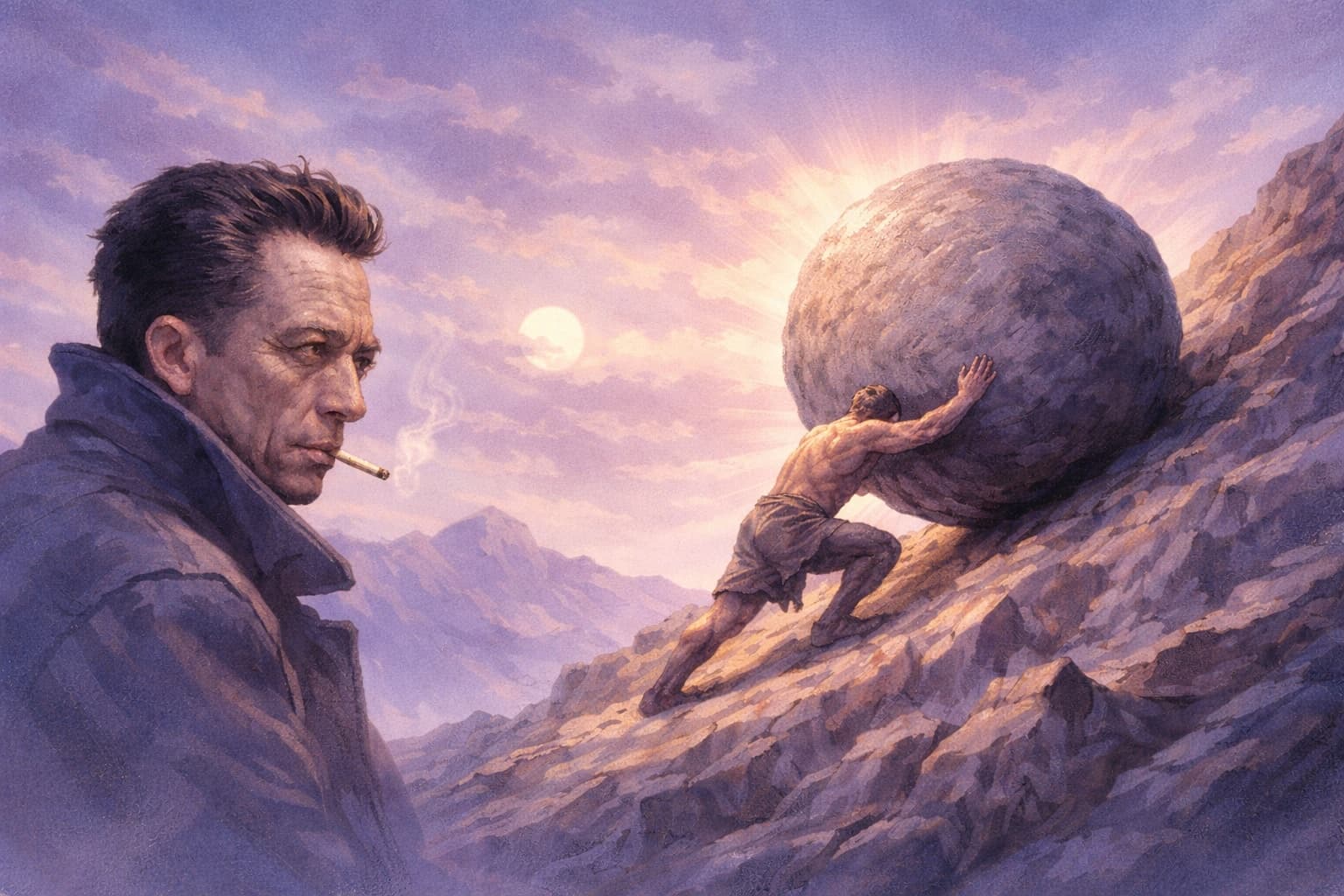
Camus and the Myth of Sisyphus: Living Without Meaning and Carrying On
 Andres Aguilar
Albert Camus wrote in the middle of World War II that the most urgent philosophical question isn't what happens after death — it's why keep living when life has no inherent meaning. His answer, as strange as it is bracing, was that this very absence of...
A man pushes an enormous rock up a mountain. He reaches the top, the stone rolls back down, and he descends to start all over again. This happens every day, forever. That probably sounds like a punishment — or at best, a disappointment. But in 1942, in the middle of World War II, a thirty-year-old French-Algerian named Albert Camus wrote an essay saying we have to imagine this man — Sisyphus — as a happy man. And with that half-crazy, half-brilliant line, he changed the way millions of people understand life.
Today we're going to talk about Camus, about the absurd, about why life has no inherent meaning and why that, far from being a death sentence, might be the most liberating thing that ever happens to you. Grab something to drink, pause everything else, because we're about to dive into one of the most powerful philosophical ideas of the twentieth century.
The Origins of Albert Camus
Albert Camus was born in Algeria in 1913, into a poor family. His father died when he was one year old — killed in World War I — and his mother was illiterate and nearly deaf. Camus grew up in a working-class neighborhood of Algiers, playing soccer in the dusty streets of North Africa. He didn't come from a family of intellectuals, didn't have books handed to him on a silver platter. He had to earn them. And that shows in everything he wrote afterward: there's a connection to the real, to the tangible, to the concrete experience of being alive that you don't find in many philosophers.
Soccer as a Teacher
As a kid he loved soccer so much he wanted to be a professional goalkeeper. In fact, he once said: "Everything I know with any certainty about morality and the obligations of man, I owe to soccer." No joke. For Camus, the sport taught him about camaraderie, about effort with no guarantee of reward, about the importance of keeping on playing even when you're losing. All of that shows up later in his philosophy.
The Encounter with Death
But life had other plans. At seventeen he was diagnosed with tuberculosis — a disease that in those days was practically a death sentence. He had to give up soccer. He had to give up a lot of things. And there, in that hospital bed, staring at the ceiling and knowing his body could betray him at any moment, he began asking the questions that would make him famous: Why live if we're going to die? Does it make sense to make plans, have dreams, fall in love, if everything ends in nothing?
These weren't rhetorical questions. They were urgent. They were existential in the most literal sense of the word.
From the Resistance to the Philosophy of the Absurd
Camus studied philosophy in Algiers, got into theater, wrote for newspapers, joined the Communist Party and then broke with them, got married, divorced, got married again. In 1940, when the Nazis invaded France, Camus was already in Paris working as a journalist. That's where he joined the French Resistance, risking his life writing and distributing an underground newspaper called Combat. While dodging the Gestapo, while watching friends die, while the world was falling apart, he wrote three works that would define him forever: the novel The Stranger, the play Caligula, and the essay The Myth of Sisyphus.
All three works are about the same thing: the absurd.
What Is the Absurd for Camus?
It's not that life is ridiculous or stupid. The absurd, for Camus, is the collision between two things: on one side, our human need to find meaning in everything, to search for answers, to understand why we're here; on the other side, the silence of the universe, the total indifference of the world toward our questions. We shout "why?" and the cosmos doesn't even look up.
Picture it this way: you're born without anyone asking your permission. You grow up in a world that was here before you and will keep going after you're gone. You spend years studying, working, building relationships, chasing goals. For what? You're going to die. Everyone you know is going to die. The sun will eventually burn out. Billions of years from now the universe will be a cold, dark void where nothing you did will matter in the slightest.
The Three Responses to the Absurd
Faced with this realization, Camus says you have three options.
First Option: Physical Suicide
"If life has no meaning, why go on?" Camus rejects this option completely. He says suicide is not a response to the absurd — it's an evasion. It's giving up. It's letting the absurd win.
Second Option: Philosophical Suicide
Accept some form of faith, religion, or belief system that tells you there is meaning, that there is a plan, that everything has a divine or transcendental purpose. For Camus, this is also an evasion. It's closing your eyes to the absurd instead of facing it head-on. Comforting, yes, but not honest.
Third Option: Accept the Absurd and Live Fully
The option Camus proposes — the hardest but also the most authentic — is to accept the absurd completely, to acknowledge that life has no inherent meaning, and to live with the fullest possible intensity anyway. Not in spite of the absurd, but precisely because of it. This is where Sisyphus enters.
The Myth of Sisyphus: The Absurd Hero
The original myth comes from Greek mythology. Sisyphus was a king who cheated the gods. First, he chained Death when she came to claim him, which meant no one could die for a while. Then, when he was finally sent to the underworld, he convinced the gods to let him return to earth "just for a moment" to settle some affairs — and then never came back. The gods, obviously, got tired of his tricks and gave him the worst punishment they could think of: pushing a giant rock up a mountain, watching it roll back down when he reached the top, and repeating this for all eternity.
For anyone, that sounds like hell. It's the definition of pointless work, effort without reward, repetition without progress. And yet Camus ends his essay with a line that stays with you: "One must imagine Sisyphus happy."
But How Can He Be Happy?
If the guy is condemned to the most meaningless task in existence?
Here's Camus's genius. He says Sisyphus is the absurd hero par excellence because he knows his condition perfectly. He knows the rock is going to fall. He knows tomorrow will be just like today and the day after will be just like tomorrow. He doesn't fool himself. He doesn't fantasize that someday the rock will stay up there. And it's precisely in that knowledge — in that lucid awareness of his absurd condition — that he finds his freedom and his happiness.
We Are All Sisyphus
Camus tells you: look, we're all Sisyphus. We get up, go to work, come home, sleep, get up again. We work to buy food, eat to have energy to work. We chase goals that leave us a little empty when we reach them, so we set new ones. We build things that time will destroy. We make plans for a future that's not guaranteed. We love people we'll eventually lose or who will lose us. Does that sound depressing? It could. But Camus flips the whole thing around.
The Moment of Descent: The Key to Freedom
The key moment in the essay is when Sisyphus walks back down the mountain after the rock has fallen. Camus pays close attention to that descent. It's the moment of pause, the moment of consciousness. Sisyphus sees the rock at the bottom, knows what's coming, and yet descends to start again. In that descent, says Camus, Sisyphus is superior to his fate. He's stronger than the rock. Because he's conscious and the rock isn't. He chooses and the rock doesn't.
And here's the point: freedom doesn't come from changing your fate — it comes from your attitude toward it. Sisyphus can't change his sentence, but he can decide how to live it. He can curse the gods every time he pushes the rock, he can cry out of frustration, he can drag himself along in bitterness. Or he can recognize the absurdity of his situation, accept it, and find meaning not in the unachievable goal but in the effort itself — in the process, in each push, in each drop of sweat.
The Quiet Rebellion
For Camus, living well means living wide awake to the absurd. It means not looking for easy escapes in promises of another life or in the hope that everything will eventually make sense. It means looking the indifferent universe in the eye and saying: "I know you don't care about me. I know all of this ends in nothing. And yet, I'm going to live. I'm going to love. I'm going to create. I'm going to experience. I'm going to rebel against you by refusing to give up."
This rebellion against the absurd is not violent, not angry. It's quiet, dignified, persistent. It's saying: "I don't need life to have cosmic meaning to value it. I give it meaning myself."
Beyond Self-Help: The Value of the Present Moment
Now, this is not cheap "think positive" advice. Camus is not selling you the idea that if you change your attitude everything gets fixed. This is not self-help. It's acknowledging that there is real suffering, real injustice, real pain. Camus's tuberculosis was real. The Nazis killing his friends were real. Death is real. But precisely because all of that is real, because time is limited, because there's no second chance, every moment you have is infinitely valuable.
Living in Quantity
Camus spoke of "living in quantity" more than in "quality" in the traditional sense. It's not about seeking the most refined or elevated experiences, but about living as many experiences as possible with total intensity. Feeling the sun on your face. Swimming in the ocean. Kissing someone you're into. Having a cup of coffee. Reading a book. Arguing with a friend. All of that has value not because it leads to something greater, but because it is life itself happening.
The Scene from The Stranger
There's a scene in The Stranger — the novel Camus wrote at the same time as The Myth of Sisyphus — that illustrates this perfectly. The protagonist, Meursault, is in prison awaiting his execution. He has just refused to see a priest because he wants no false comforts. And in his cell, the night before he is to die, he looks out the window and sees the stars. And he feels an unexpected happiness. Not because he's discovered some secret meaning to life, but precisely because he has accepted there isn't one. And that acceptance set him free to simply be present, to feel, to exist without the burden of having to justify his existence.
The Absurd in Modern Life
This resonates a lot today, don't you think? We live in an era obsessed with meaning, with purpose, with finding your "passion" or your "calling." Social media is full of people selling you the idea that you have to optimize your life, that every day has to count, that you have to leave a legacy, that you have to change the world. And when you don't — when you feel stuck in your repetitive job or your boring routine — you feel like a failure.
Camus would say: relax. You don't need to change the world. You don't need to leave a legacy that lasts a thousand years. Sisyphus isn't trying to make his rock famous. He's just doing his work, completely aware of how absurd it is, and finding his dignity in that very act.
Activism Without Illusions
That said, this doesn't mean passive acceptance of injustice. Camus was anything but passive. He fought against Nazism, denounced Soviet totalitarianism, opposed the death penalty, defended the oppressed. But he did it without the illusion that he was fulfilling some divine or historical plan. He did it because it was what his conscience told him he had to do, in that moment, in that place.
Absurd vs. Nihilism: A Crucial Distinction
And here's something important: Camus was not a nihilist. Nihilism says "nothing matters, so everything is equally meaningless." Camus says "nothing has objective meaning, so EVERYTHING matters — because you choose what matters." It's the difference between emptiness and freedom.
Let me give you a concrete example. Imagine you believe in a religion that promises eternal paradise if you live a certain way. Your goodness, your generosity, your love — all of it is aimed toward that future goal. You're being good to earn points, basically. Now imagine you know with certainty that there's no paradise, no hell, no cosmic reward. Do you stop being good? If your answer is yes, then you were never really good — you were just calculating. But if your answer is no — if you keep being kind, generous, and loving precisely because you choose to, without expecting anything in return — then that's authenticity. That's freedom. That's what Camus is proposing.
The Nobel Prize and Humility
One of my favorite anecdotes about Camus: in 1957 he won the Nobel Prize in Literature. He was forty-four — the second youngest winner in history. Many expected a triumphant speech about his achievements, his philosophy. But the first thing he did was dedicate the prize to his elementary school teacher, Louis Germain — a modest man who had seen something in that poor boy from Algeria and helped him get a scholarship. Camus wrote him a letter saying that without him, none of this would have happened. It's a beautiful detail because it shows that Camus wasn't arrogant, that he understood his success wasn't his alone — it was made of a thousand small acts by other people.
An Absurd Death
Three years later, in 1960, Camus died in a car accident. He was forty-six. He was on his way back to Paris with his publisher, Michel Gallimard, who was driving. The car skidded off the road and hit a tree. Camus died instantly. In the pocket of his jacket they found the unfinished manuscript of The First Man — an autobiographical novel that many consider would have been his masterpiece. They also found an unused train ticket in his bag. He had planned to travel by train but at the last minute accepted a ride in the car with his friend. It's one of those absurd ironies of life that the man who wrote about the absurd died in such an absurd, random way.
Camus vs. Sartre: A Philosophical Breakup
After his death, many philosophers and writers fought over his legacy. The existentialists wanted to claim him as one of their own, but Camus always rejected the label. He said he was not an existentialist, that his philosophy was different. And he was right. Existentialists like Sartre put heavy emphasis on anguish, nausea, and the weight of freedom. Camus put the emphasis on joy, on the beauty of the world, on the light of the Mediterranean, on the sensuality of being alive.
In fact, Camus and Sartre were friends for a time, but then had a serious falling-out. The break was public and bitter, mainly over political differences regarding Soviet communism. Camus denounced the gulags and repression; Sartre justified them as necessary evils for the revolution. They never spoke again. It's sad, but also very human. Even philosophers of the absurd have absurd arguments.
Camus's Living Legacy
Camus's legacy lives on today. The Myth of Sisyphus is still read in universities around the world. It's still debated in coffee shops, bars, and internet forums. Because it touches something fundamental in human experience. We all, at some point, feel like Sisyphus. We all have those days when we think "what's the point?" as we drag ourselves through something repetitive and seemingly meaningless.
And the beautiful thing about Camus's essay is that it doesn't give you an easy answer. It doesn't tell you that you'll find meaning if you search hard enough, or that God has a plan for you, or that everything will eventually make sense. It tells you something much harder and much more liberating: there is no transcendent meaning — but that's not a tragedy. It's an invitation to create your own meaning, to live each moment fully, to find joy in the effort itself.
Applying Sisyphus's Philosophy to Your Life
Think about your own life. How many things do you do that are cyclical, repetitive? You wash the dishes and the next day they're dirty again. You clean the house and a week later it's a mess. You go to the gym, get in shape, but if you stop going you lose it all. You study for an exam, pass it, and then there's another exam. At work you finish one project and they give you another. It's Sisyphus over and over again.
The Sentence or the Dance
But here's the trick: you can see all that as a sentence or as a dance. You can feel miserable because the laundry never ends, or you can find something meditative in the act of washing, folding, putting away. Not because you're fooling yourself into thinking it has some cosmic significance, but because you decide to be present in the act itself. Because while you're doing the dishes, you're alive. While you're cleaning the house, you're alive. While you're pushing your particular rock, you're alive.
Happiness in the Process
Camus doesn't promise you eternal happiness. He promises you something better: the possibility of being happy right in the middle of the absurd — not waiting for it to end. Sisyphus's happiness is not the happiness of reaching the summit and having the rock stay there. It's the happiness of each step, each push, feeling your muscles work, seeing the momentary progress, and then the conscious descent — knowing it's all going to start again, and being at peace with that.
The Power of Conscious Acceptance
There's incredible power in this. Because if you don't need things to have meaning in order to value them, then nothing can take away your capacity to value. You can lose your job, your home, your health, and still decide that this moment — this exact second of being alive — has worth. Not because it leads to something, but because it is.
It's hard to maintain this perspective all the time. We all have moments when the rock feels too heavy, when the absurd hurts too much. And that's okay. Camus was not a superhuman without emotions. He had depression, crises, dark moments. But what he proposes is a way of facing those moments without needing to escape into comforting fantasies.
The Practical Lesson of the Myth of Sisyphus
So what do you take away from all of this? What's the practical lesson of the Myth of Sisyphus?
I think it's this: stop waiting for life to give you permission to be happy. Stop thinking you'll be okay when you get that job, or get married, or have kids, or retire, or whenever. All of those are rocks that will eventually roll back down. The moment is now. Life is this exact instant. And if you can find value in this instant — without needing it to have some grand purpose — then you've discovered what Camus wanted you to discover.
You don't need to change the world. You don't need to be remembered. You don't need your life to tell a perfect story with a satisfying beginning, middle, and end. You need to be awake. You need to be present. You need to look the absurd in the eyes and smile.
Conclusion: The Dignity of Sisyphus
Because at the end of the day, Sisyphus's rebellion is not in refusing to push the rock. It's in pushing it with dignity, with awareness, with presence. It's in saying to the universe: "I know this doesn't make sense. And yet, here I am. Alive. Conscious. Free."
And maybe — just maybe — that's enough.
Related episodes

Why did you choose this way? Because he thought that philosophy was neither poetry nor opinion.

Close your eyes and look for your self. That permanent center that is you. Look carefully. A friendly, chubby Scotsman did that same exercise nearly three hundred years ago — and didn't find it. What he found instead was one of the most unsettling idea...

The most powerful man in the world wrote a private journal every night that he never intended to publish: he challenged himself not to be an idiot, reminded himself he was going to die, and braced for setbacks before they arrived. Two thousand years la...