
Foucault and the History of How We Learned to Behave
 Andres Aguilar
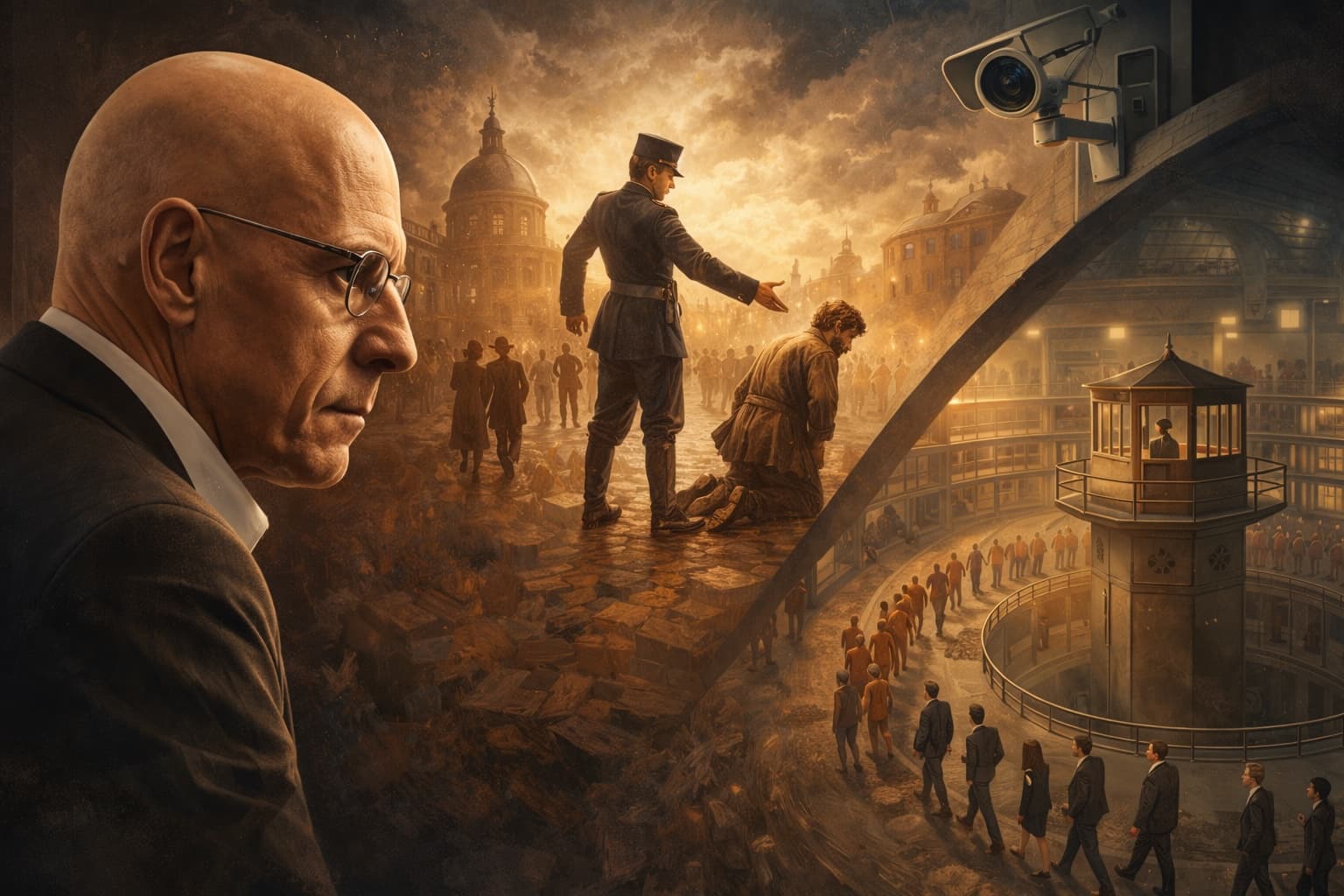
Michel Foucault watched two scenes from history side by side: in 1757, a man is publicly tortured for hours in a Paris square while the crowd eats and watches. In 1837, a prison manual schedules every minute of a prisoner's day in silence and routine. ...
The Invisible Power of Being Watched
Something strange happens when you know you're being observed. In an open office, surrounded by people, you sit up straight, you focus on your work, you don't touch your phone. But at home, door closed, everything changes: you slouch in the chair, scroll Instagram, eat at your desk. Same work, same person — but completely different behavior. Why? Because someone might be watching. And here's the incredible part: they don't even need to actually be watching. Just the possibility of being observed is enough to make you self-censor, to make you control yourself.
A guy in France, back in the 1970s, became obsessed with this. His name was Michel Foucault, and he wrote a book that makes you see the world in a completely different way. The book is called Discipline and Punish, and what he discovered will blow your mind: the way we behave, what we consider normal, and even how we think about ourselves — all of it was invented. And not that long ago.
From the Public Square to the Silent Cell
Before diving into Foucault, let me tell you about something that happened in Paris in 1757. A man named Damiens had attempted to assassinate King Louis XV. He barely scratched him, but the punishment was brutal. He was brought to the public square and for hours he was tortured in front of a crowd. His hand was burned with sulfur, his flesh was torn with red-hot pincers, molten lead was poured into his wounds, and finally they tried to quarter him by tying horses to his limbs. The horses pulled and pulled but the body wouldn't split apart, so they had to cut his tendons with knives. The crowd watched, ate, made comments. It was a spectacle — a horror show designed so everyone could see what happened to those who challenged the king.
Now jump forward a hundred and fifty years. 1837, same city, Paris. A prison manual is published. It says something like: "Prisoners will rise at six in the morning. They will have thirty minutes to wash and dress. At six-thirty they will line up for prayer. They will then go to the workshop where they will work in silence until eight. Twenty minutes for breakfast. Work until noon. Lunch. More work. Dinner. Bed at nine." Everything measured, everything timed, everything ordered. No public spectacles, no visible violence. Just routine, discipline, silence.
What happened in those hundred and fifty years? Why did we go from ripping the skin off a man in the square to locking him in a cell with a schedule? The easy answer would be to say we became more civilized, more humane, more enlightened. But Foucault says: hold on — not so fast. What changed wasn't that we became better people. What changed was the method of controlling people. And the new method is far, far more effective.
Who Was Michel Foucault?
Michel Foucault wasn't the kind of philosopher who sat in an ivory tower thinking about abstract ideas. He was born in 1926 in Poitiers, France, the son of a surgeon. He was gay at a time when that could ruin your life, and he spent much of his youth in considerable anguish. He attempted suicide as a student. He studied philosophy and psychology and became obsessed with understanding how power works — how societies decide what's normal and what isn't, who has the right to speak and who must stay silent. He wasn't interested in grand universal theories about human nature. He was interested in the concrete, the historical, the specific. He wanted to understand how we came to be what we are.
To do that, he did something unusual. Instead of reading the great philosophers, he went to the archives. He spent years reading old documents — prison manuals, military regulations, medical reports, police records. Things nobody was looking at. And there, in those forgotten papers, he found something astonishing.
From Body to Soul: The New Way to Punish
In Discipline and Punish, published in 1975, Foucault tells a story — the story of how we went from punishing the body to controlling the soul. In the era of absolute monarchies, when a criminal was punished, what was attacked was his body. The king had been offended, his power had been challenged, and the response was a physical display of power. The condemned man's body became a stage on which the sovereign's absolute power was performed. It was theater, ritual, propaganda. But it had a problem: sometimes it backfired. The crowd in the square might feel pity for the condemned, might riot, might turn the punished man into a martyr. Power was visible but also fragile.
Then, in the late eighteenth and early nineteenth centuries, everything changes. The reformers arrive — the Enlightenment thinkers who talk about human rights and dignity. They say the barbarism of public punishment must end. And sure, many of them were probably sincere. But Foucault says: look at what they invented in its place. They invented something far more sophisticated. They invented discipline.
The Invention of Discipline
What is discipline? It's not simply telling someone what to do. Discipline is a method — a technology. It's a way of organizing space, time, and body movements to produce useful and docile individuals. And it was invented in very specific places: in monasteries, in armies, in schools, in factories. Places where large numbers of people had to be controlled efficiently.
Think about an eighteenth-century military barracks. A soldier had previously been basically just a guy who knew how to fight. But the new armies needed something different. They needed thousands of men to move in unison, to obey orders instantly, to function like a machine. So they invented training. Not just teaching you to shoot — teaching you how to stand, how to walk, how to turn, how to hold your rifle, what exact angle your elbow should be at when you aimed. Every movement of the body was broken down into parts, analyzed, improved, repeated until it became automatic. The result was a soldier who didn't think — he reacted. A disciplined body.
And this same logic was exported everywhere. To schools, where children learned to sit in rows, raise their hands, ask permission to go to the bathroom, write with a certain posture. To factories, where workers had to perform precise, repetitive movements in sync with the machines. To hospitals, where patients had to follow strict routines. Discipline became the fundamental mechanism of control in modern society.
The Panopticon: The Perfect Prison
But here's where things get really interesting. In his research, Foucault found a building — or rather, a building design — that perfectly encapsulated all of this. It was called the Panopticon, and it had been designed by an English philosopher named Jeremy Bentham in the late eighteenth century. The Panopticon was a circular prison. In the center stood a watchtower. Around it, in a ring, were the cells — each with one window facing inward toward the tower and another facing outward to let in light. The guard in the tower could see all the prisoners at all times. But the prisoners couldn't see the guard. They never knew when they were being observed.
Bentham was enormously proud of his invention. He said it was the perfect way to control people with minimum effort. Because the trick of the Panopticon isn't that you're watched all the time. The trick is that you don't know whether you're being watched. And since you don't know, you have to assume you are. So you behave as if you're always being watched. You stop needing anyone to control you — because you control yourself. You internalize the surveillance. You become your own guard.
The Disciplinary Society
For Foucault, this is both brilliant and terrifying. The Panopticon is the perfect metaphor for how power operates in modernity. You no longer need the violent spectacle in the public square. You no longer need the king punishing bodies. Modern power is silent, invisible, omnipresent. It's in the architecture of schools, in the layout of offices, in evaluation systems, in security cameras. And the cruelest part: we surveil ourselves. We behave well not because we're afraid of a specific punishment, but because we've learned that this is how one behaves.
Foucault gives this a name: the disciplinary society. A society where power is exercised not through brute force but through subtle techniques of normalization. Norms are created, standards of behavior established, and everyone is measured against those norms. Those who conform are normal. Those who don't are abnormal, deviant, sick, delinquent. And there's an entire apparatus of professionals dedicated to detecting, studying, classifying, and correcting abnormality: doctors, psychiatrists, social workers, criminologists, educators. All of them exercise a power that doesn't look like power because it presents itself as scientific knowledge, as help, as treatment.
The School as a Disciplining Machine
Think about how a school works. It's not just a place where you learn math and history. It's a place where you learn to sit still for hours, to follow instructions, to respect hierarchies, to compete with your classmates for grades, to accept that your performance is constantly being evaluated and recorded. You're being disciplined — being prepared to be a docile body that fits into society. And when a kid doesn't fit, when they're restless or rebellious or different, a specialist appears to diagnose them, classify them, medicate them. To normalize them.
This doesn't mean Foucault thought everything was bad or that there was a conspiracy. There are no villains meeting in a dark room deciding how to control us. Disciplinary power has no center, no author — it's diffuse, it's everywhere, operating through thousands of institutions and everyday practices. And it often has positive effects: thanks to discipline, there's less violence, people live longer, societies are more productive. Foucault's point isn't that we should return to the age of public torture. His point is that we should understand how power works — that we shouldn't settle for the feel-good story that we simply progressed and became more civilized. We need to see the mechanisms, the techniques, the effects.
The Digital Panopticon
And if you think this is just ancient history, consider this: Foucault died in 1984 — before the internet, before smartphones, before social media. If he were alive today, he'd probably write another book. Because what he described in Discipline and Punish has intensified in ways he couldn't have imagined. Today we carry in our pockets devices that record every place we go, every search we make, every message we send. There are facial-recognition cameras in the streets. Algorithms that predict our behavior. Companies that know more about us than we know about ourselves. And none of this feels like oppression because it's convenient, because it's voluntary, because it makes our lives easier. The perfect digital Panopticon: we surveil ourselves and we pay for the privilege.
Power Produces — It Doesn't Only Repress
Foucault has another central idea in the book that's important to understand. He says power doesn't only repress — it doesn't only say no. Power also produces. It produces reality, produces knowledge, produces subjectivities. What does this mean? That we're not autonomous individuals who are then controlled by power. We are produced by power. The very idea of being an individual, of having an identity, of knowing yourself — all of that is the product of techniques of power. The human sciences — all those disciplines that study human beings (psychology, sociology, criminology) — aren't neutral discoveries about human nature. They're ways of making human beings knowable, measurable, governable.
Here's a concrete example Foucault analyzes in the book: sexuality. From the eighteenth century onward, there's an explosion of discourse about sex. Doctors, educators, clergy — all start talking about children's sexuality, studying it, regulating it. Categories are invented: masturbation is dangerous, it can cause illness. Children must be watched, their hands controlled, dormitories designed to prevent them from touching themselves. This is not repressing sex. It's producing a certain kind of sexuality, creating knowledge about it, turning it into an object of intervention. And simultaneously, a certain kind of subject is being created: the individual who must know and control their impulses, who has an inner life that must be explored and regulated. Modern sexuality — with all its categories (heterosexual, homosexual, deviant, normal) — didn't exist before. It was invented by these discourses of power-knowledge.
There Is No True Self Waiting to Be Liberated
This is a little unsettling when you think about it. Because we tend to believe there's a basic human nature that's just there, and then societies come along and control it in different ways. But Foucault says there's nothing outside those techniques of power. There's no true self waiting to be liberated. The self itself is an effect of power. And this has important political consequences. You can't simply seek to liberate some true human nature — because that nature is a historical product. Resistance has to be more complex, more cunning.
Punishment Becomes Technical and Neutral
Another thing Foucault does in the book is show how punishment was transformed into something that looks technical and neutral. In the era of public torture, it was obvious that this was about power, about revenge, about politics. But when the modern prison is invented, everything changes. The prison presents itself as something rational, scientific, humanitarian. The goal is not to make the criminal suffer but to reform them, to transform them into a useful citizen. Experts study the delinquent, write reports, propose treatments. Punishment is medicalized. This makes it far harder to criticize — because if you criticize the prison, you're told you're against science, against progress, against rehabilitation.
But Foucault shows that the prison failed from the very beginning. Already in the nineteenth century there were reports showing that prisons rehabilitated nobody, that criminals came out worse than they went in, that recidivism rates were sky-high. And yet prisons multiplied. Why? Because their function isn't to reform. Their function is to produce delinquency — to produce a category of marked, separated, surveil-able people. The prison creates the delinquent as a human type, with psychological characteristics, a file, a record. And this is useful to society. Because the delinquent becomes the internal enemy — the justification for more police, more surveillance, more control. Delinquency is functional to social order.
The Prison Produces Delinquency
This idea is radical. Foucault is saying that the penal system doesn't exist to eliminate crime but to manage it, to give it a specific form, to turn it into something useful for power. And if you look at the last two hundred years of history, it's hard to argue with that. The war on crime never ends — there's always a new threat, always a need for more security. And meanwhile, the prisons are full of the usual people: the poor, the marginalized, minorities. The wealthy don't go to prison — they have other forms of penalty. The prison is a technology of class.
The Context and the Criticisms
Foucault wrote Discipline and Punish during a period of intense political ferment — post-May '68 France, a time of much activism and institutional questioning. Foucault himself participated in prison reform movements, visited prisons, talked with inmates. He wasn't an academic locked in his office. He believed thinking had to serve to change things. And his book was dynamite. Suddenly, many people began to see institutions differently. They started asking uncomfortable questions about school, the hospital, the factory, the family.
But it also received many criticisms. Some said it was too pessimistic — that it painted a picture where everything is power and no escape is possible. Others said it romanticized the past, that public torture was objectively worse than prison. Some feminist critics noted that he didn't address patriarchal power — how discipline specifically affects women. And there's some truth to all of this. Foucault can sometimes sound as if there's no difference between a democracy and a dictatorship, as if everything is the same. And clearly it isn't.
The Legacy: A New Way of Thinking About Power
But what Foucault did right was open a new path for thinking about power. Before him, political philosophy focused on the state, on law, on sovereignty. Foucault said: let's look lower — let's look at everyday practices, at institutions, at forms of knowledge. Power isn't just something that represses you from above. It's something that constitutes you, that runs through you, that's present in every relationship, every social practice. And this allows a much finer analysis of how societies actually work.
Today, Foucault's ideas are everywhere. Any time someone talks about surveillance, normalization, biopolitics, how power operates through knowledge — they're using concepts that came from him. His way of doing history, what he called genealogy (borrowing the term from Nietzsche), is used across all fields. The idea is not to assume things were always as they are now, not to look for glorious origins, but to show how practices and institutions that seem natural and eternal are actually contingent, historical, full of conflict and power.
Reading Foucault Changes You
Personally, I believe that reading Foucault changes you. It makes you more suspicious, more critical — but also more aware. You start to notice all the ways you're being shaped, how you internalized norms you never chose. And that's not necessarily depressing. It can be liberating. Because if everything is historical, if everything was constructed, then everything can be changed. There's no fixed human nature that condemns us. We're plastic, malleable, capable of reinventing ourselves. Power forms us, yes — but we can also resist, deviate, create new ways of being.
Foucault lived all of this firsthand. He was gay, he was different, he didn't fit the norms. He spent his life trying to understand why certain ways of living are considered normal and others aren't, who decides that, with what consequences. And he paid a price for living on the margins. He died of AIDS in 1984, when the disease still carried a terrible stigma. He was only fifty-seven. But he left an enormous body of work — books that still help us think today.
What Foucault Teaches Us Today
If there's one thing you can take from Discipline and Punish, it's this: look carefully at the things that seem obvious to you. Ask where they come from, who benefits from them being the way they are, what other possibilities exist. Don't accept the story that we live in the best possible society, that things are as they are because they have to be. Everything is political, everything is power — and that means everything could be otherwise.
Foucault teaches you to be a genealogist of your own life. To ask yourself: why do I think what I think? Why am I ashamed of certain things? Why do I behave differently when someone is watching? What norms did I internalize without noticing? And when you start asking those questions — when you start to see the invisible threads connecting you to institutions, discourses, and practices of power — that's when you begin to have real freedom. Not the romantic freedom of being your "authentic self" (because that self is also constructed), but the freedom to modify yourself, to experiment, to become something else.
The Panopticon is everywhere today. In your phone, in your workplace, in the social media platforms where you perform your identity for an invisible audience. But knowing it's there, understanding how it works — that's already a first step. Not to escape (there's no outside of power), but to relate to it differently. To be less docile, less predictable, less useful to those who want to control you.
And with that, this journey through one of the most important books of the twentieth century comes to an end. If you stayed with us this far — if you made it through three thousand words on prisons, discipline, and power — it's because something resonated. And that's good. It means you're already thinking differently.
Related episodes

Why did you choose this way? Because he thought that philosophy was neither poetry nor opinion.
Close your eyes and look for your self. That permanent center that is you. Look carefully. A friendly, chubby Scotsman did that same exercise nearly three hundred years ago — and didn't find it. What he found instead was one of the most unsettling idea...
The most powerful man in the world wrote a private journal every night that he never intended to publish: he challenged himself not to be an idiot, reminded himself he was going to die, and braced for setbacks before they arrived. Two thousand years la...