
Nietzsche and the Death of God
 Andres Aguilar
When Nietzsche wrote "God is dead," he wasn't celebrating. He was sounding an alarm: if we remove the foundation on which Western civilization built its morality for two thousand years, what do we replace it with? That question — still unanswered — is ...
The most terrifying announcement in modern philosophy, and why it still haunts us.
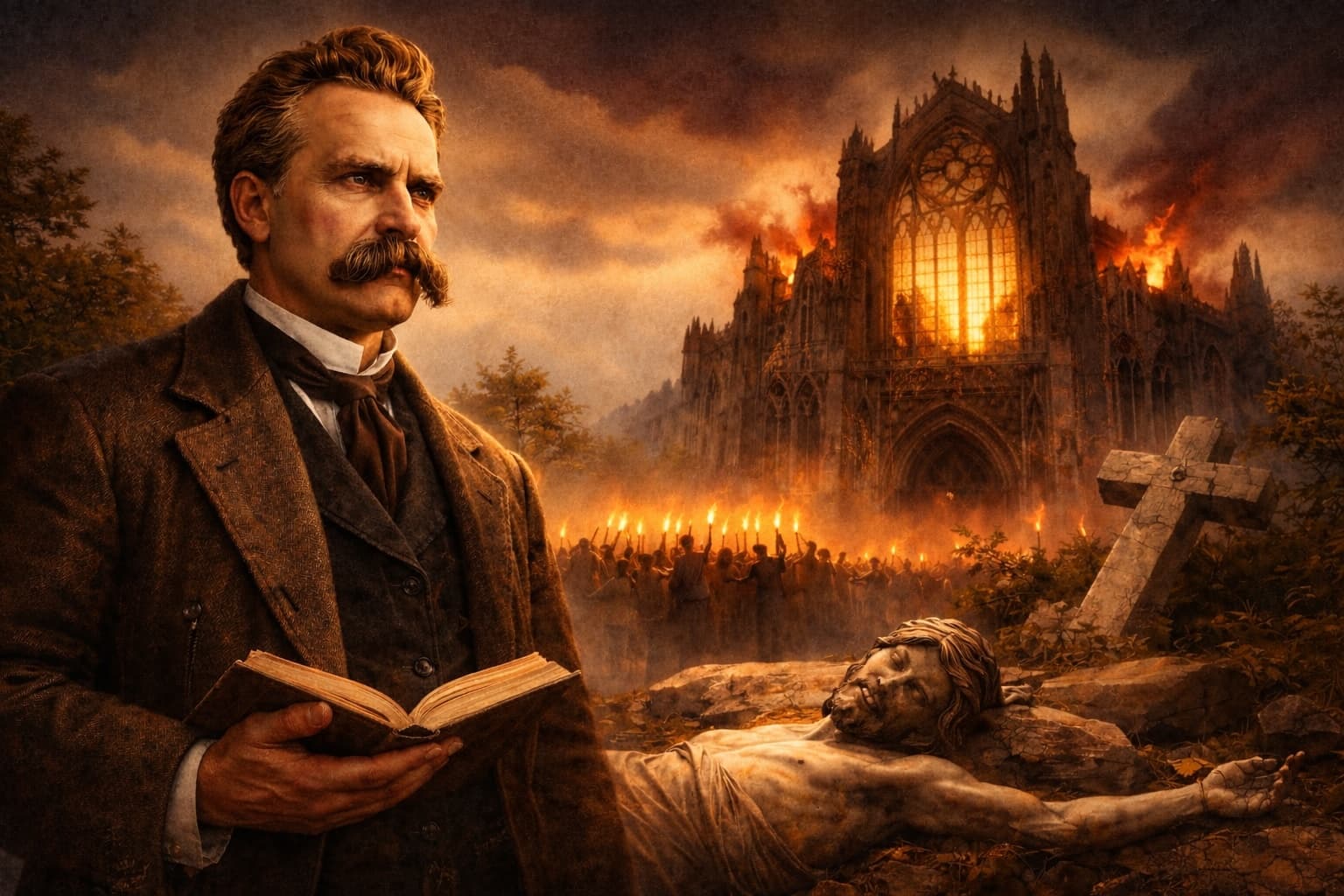
You're walking through the market one ordinary morning — buying vegetables, saying hi to your neighbors, everything calm. Suddenly a man appears with a lit lantern in broad daylight, screaming like a madman: "I'm looking for God! I'm looking for God!" People laugh at him, make jokes. And then the man stops, fixes them with a stare, and says something that chills you to the bone: "Where has God gone? I will tell you. We have killed him — you and I. All of us are his murderers."
Dead silence. This scene isn't from a horror movie. It's from a philosophy book. It's the famous "madman" passage of Friedrich Nietzsche, and today we're going to unravel what he meant by "God is dead" — because I'll tell you upfront: it has almost nothing to do with what most people think.
It Wasn't a Celebration — It Was an Alarm
Before diving into Nietzsche, we have to understand something fundamental: when this German philosopher wrote "God is dead" in 1882, he was not making a triumphant announcement. He wasn't celebrating like a modern atheist who just won an internet debate. In fact, Nietzsche was terrified. What he was saying was something more like: "We've realized we killed God and we have no idea what the consequences of what we've done will be." It's like someone telling you "we just cut the cable holding the elevator" right when you're inside. Not good news. An alarm.
The Man Behind the Diagnosis
But let's back up. Who was this Nietzsche who dared to say such an outrageous thing in nineteenth-century Europe? Friedrich Nietzsche was born in 1844 in Prussia, the son of a Lutheran pastor who died when Nietzsche was just five years old. He grew up surrounded by women — his mother, his sister, his aunts. He was a brilliant kid, so brilliant that at twenty-four he was already a professor of classical philology at the University of Basel. Twenty-four years old. Most of us at that age are still trying to figure out what to do with our lives, and this guy was teaching ancient Greek at a university.
The Suffering That Forged the Philosopher
But Nietzsche had terrible health problems. Constant migraines, vision problems, insomnia, stomach pain. He spent weeks at a time in bed, writhing in agony. Some historians think he contracted syphilis as a young man, others say it was a brain tumor, others point to mercury poisoning from the medications of the era. What's certain is that the man suffered physically in a brutal way, and that definitively influenced his philosophy. When you spend half your life with a headache splitting your skull, you start to question the idea that there's a benevolent God taking care of you.
The Final Collapse
At age forty-four, Nietzsche went completely mad. The story goes that in January of 1889, in Turin, Italy, he saw a coachman beating his horse. Nietzsche ran to the animal, embraced it weeping, and collapsed. He never recovered his sanity. He spent the last eleven years of his life in a childlike mental state, cared for first by his mother and then by his sister. He died in 1900, right at the turn of the century, never knowing that his ideas would explode and change the world in the decades that followed.
What Does the Death of God Actually Mean?
Now, back to the death of God. What does this actually mean? Nietzsche obviously didn't think there was a literal God who had been alive and then died. He wasn't that naive. What Nietzsche was diagnosing was something far deeper and more disturbing: the death of God as the foundation of all morality, meaning, and values in Western civilization.
For nearly two thousand years, Europe had lived under Christianity. It didn't matter if you were rich or poor, king or peasant — the structure of values came from Christianity. The difference between good and evil, the meaning of your life, the hope for the future — all of it was anchored in God. If you asked "why shouldn't I kill?", the answer was "because God forbids it." If you asked "why should I be good?", it was "because God will judge you." If you asked "what is the meaning of my suffering?", they told you "it's part of God's plan — heaven awaits."
The Earthquake Nobody Saw Coming
But in the nineteenth century, things were changing fast. Science was explaining more and more things that had previously been attributed to God. Darwin had proposed evolution, eliminating the need for a divine designer. Astronomy revealed a vast and indifferent universe. Geology proved the Earth was millions of years old, not the few thousand the Bible claimed. And philosophically, thinkers like Kant had shown you couldn't rationally prove God's existence.
So, little by little, Europe's educated class had stopped really believing in God. They kept going to church out of habit, social pressure — but deep down, they no longer believed. And here comes what Nietzsche saw with bone-chilling clarity: these people thought they could throw out God while keeping Christian morality. They thought they could say "I don't believe in God, but compassion is still good, humility is still virtuous, all humans have equal worth." Nietzsche was shouting at them: "No! That's not how it works! If you kill God, you kill the entire moral edifice that rested on him!"
A Building Without Columns
It's like spending centuries living in a building supported by columns. One day you decide the columns are ugly and you remove them — but you expect the building to keep floating in the air. Nietzsche was saying: "This building is going to come down, and we'd better prepare for the crash."
In the madman passage, after announcing the death of God, the man says increasingly frantic and poetic things: "Who gave us the sponge to wipe away the entire horizon? What were we doing when we unchained this earth from its sun? Where is it moving now? Away from all suns? Are we not plunging continually? Backward, sideward, forward, in all directions? Is there still any up or down? Are we not straying as through an infinite nothing? Do we not feel the breath of empty space?"
These aren't rhetorical questions. Nietzsche is describing total disorientation. If God was the absolute point of reference, his death means there is no longer up or down, good or evil, meaning or purpose given in advance. We are floating in the void, and we have to accept that vertigo.
We Arrived Too Early
And here's something a lot of people miss: the people at the market in Nietzsche's story laugh at the madman. They don't understand what he's saying. And at the end, the madman realizes this and says: "I come too early. My time is not yet. This tremendous event is still on its way." In other words, Nietzsche was saying that European civilization still hadn't grasped what it had done. They had killed God but kept living as if he were alive. The consequences would come later.
And come they did. Nietzsche predicted that the twentieth century would be the bloodiest in history. He was right. Two world wars, totalitarianism, the Holocaust, the gulags — all of that came after. I'm not saying Nietzsche caused those tragedies. But he did see coming a crisis of values and meaning that effectively materialized.
Nietzsche's Response: Create Values
Now, this is where Nietzsche differs from other philosophers. Many, faced with the death of God, would say "what a tragedy — let's find a way to bring him back" or "let's find another absolute foundation." Not Nietzsche. He said: "No, God is dead and he's not coming back. That's a fact. Now — what do we do with that?" His answer wasn't to sink into passive nihilism and say "nothing matters." His answer was far more active and defiant.
The Superman: Beyond Good and Evil
Nietzsche proposed that humans had to create their own values. Instead of receiving them from God or tradition, we had to become creators of meaning. This is what he called the "Superman" or "Overman" — the Übermensch. Not Superman with a cape, but the human being who can live without the consolations of God, who can say yes to life with all its suffering, who can create values rather than just receive them.
The Eternal Return: The Ultimate Test
And here Nietzsche introduces another famous idea: the eternal return. Imagine being told that your life — exactly as you've lived it, with all its good moments and bad ones — will repeat infinitely, exactly the same, for all eternity. Would you say "yes, I want that"? For Nietzsche, the ability to say yes to your life to that degree, to affirm it completely without needing a heaven to justify the sufferings of earth — that's the hallmark of the Overman.
It's a heavy idea. Because Christianity had always said "hold on here on earth — everything will be better in heaven." That was a way of bearing suffering, but also a way of denying real life in favor of a future promise. Nietzsche said: "No, this life is all there is. You'd better live it fully and love it as it is, because there's no afterlife coming to compensate."
The Slave Morality: The Inversion of Values
Now, this has a consequence Nietzsche developed that is deeply controversial: his devastating critique of Christianity and what he called "slave morality." For Nietzsche, Christianity had inverted all natural values. It had taken the qualities of the weak — humility, compassion, submission — and turned them into virtues. While the qualities of the strong — pride, ambition, power — it had turned into vices.
Nietzsche saw this as a kind of revenge by the weak against the strong. Unable to win physically, they invented a morality that condemned strength itself. This is what he called "ressentiment." The slaves, unable to become masters, invented a morality where being a master is evil and being a slave is virtuous. And this slave morality had triumphed in the West through Christianity.
Necessary Clarification: Nietzsche Was Not a Nazi
Now, before you conclude that Nietzsche was some kind of proto-Nazi who believed the strong should trample the weak, I need to make an important clarification. Nietzsche despised antisemitism and German nationalism. When his sister married a notorious antisemite and left for Paraguay to found an Aryan colony, Nietzsche cut off his relationship with her. What happened is that after Nietzsche lost his sanity, his sister Elizabeth took control of his unpublished manuscripts and edited them to make them compatible with her own Nazi-sympathetic ideas. She was the one who introduced Nietzsche's works to Hitler. Nietzsche himself would have been repulsed by Nazism.
What Nietzsche meant by his critique of slave morality was not "be cruel to the weak." It was more like: "don't turn weakness into a virtue, don't deny life, don't invent imaginary worlds to escape from this one." He wanted a humanity that affirmed life in all its aspects — including conflict, suffering, desire, ambition.
The Man Behind the Hard Philosophy
There's a somewhat charming story about Nietzsche that reveals his personality. In person, he was extraordinarily polite and gentle — nothing like the aggressive image of his books. Once, a friend asked how he reconciled his personal kindness with the harshness of his philosophy. Nietzsche replied something along the lines of: "One can think with hardness without ceasing to feel with tenderness." I think that captures his position well — he was intellectually tough, not emotionally cold.
The Two Paths of Nihilism
Returning to the death of God: there's one aspect we can't ignore. Nietzsche was deeply worried about what would come after. He feared the death of God would lead to two possible paths — both bad. Either passive nihilism, where people would say "nothing matters" and fall into apathy and despair. Or new collective idols, new secular religions that would fill the void left by God. And he was right. The twentieth century saw both.
On one side, you have the existential anguish described by philosophers like Sartre and Camus — that feeling of absurdity and meaninglessness. On the other, you have the totalitarianisms: Nazism, Stalinist communism, which functioned as secular religions — with their own dogmas, their rituals, their martyrs, their promises of collective salvation. They filled the void of God with the State, the Race, the Party. Nietzsche would have hated both paths.
What he wanted was something different: strong individuals who could create their own values without falling into either despair or mass fanaticism. An extraordinarily hard balance to achieve. Perhaps impossible. But that was his bet.
What Does This Mean for Us Today?
What does all this mean for us today? Because we live in an era that is, in many ways, the one Nietzsche predicted. In the West, most people are no longer religious in the traditional sense. You can live perfectly well without setting foot in a church, without praying, without thinking about God. And yet we keep searching for meaning, purpose, values.
Some find it in political ideologies that have something religious about them. Others in consumerism, accumulating experiences and things. Others in social causes, activism. Others in self-improvement, yoga, meditation, self-help books. These are all ways of filling the void left by God. Nietzsche would tell you that most of them are cheap substitutes — new ways of escaping the real challenge: creating value and meaning without external support.
The Uncomfortable Question
Nietzsche's question is still current: Can you live without guarantees? Without meaning given from outside? Without the promise that "everything happens for a reason" or that "there's a plan"? Can you affirm your life even if it were to repeat eternally, with all its pains and joys? It's a question that puts you on the spot.
And here's something important: Nietzsche isn't telling you that you must become an Overman. It's not a moral demand. It's more like a possibility, a challenge. He recognized that most people couldn't or wouldn't want to live that way. And he was okay with that. He wasn't a revolutionary who wanted to change all of society. He was more like a solitary explorer of new possibilities of existence.
Passive Nihilism vs. Active Nihilism
There's a concept of Nietzsche's I find particularly useful for understanding our era: "passive nihilism" versus "active nihilism." Passive nihilism says "nothing matters" and sinks into apathy. Active nihilism says "nothing matters in advance — which means I'm free to create what matters." One is paralyzing, the other is liberating. Nietzsche bet on the second.
Perspectivism: No Absolute Truth
Worth mentioning too is his idea of "perspectivism." Nietzsche didn't believe there were absolute truths. For him, all knowledge is from a perspective, from a particular point of view. There is no "God's eye view" that sees things as they really are. This doesn't mean all perspectives are equally valid — but it does mean we have to be honest about the fact that we're always looking from somewhere.
This idea was about a hundred years ahead of postmodernism and all the current discussions about narratives, interpretive frameworks, and so on. Nietzsche was one of the first to say: "Hold on — all these truths we consider eternal are actually historical constructions from certain points of view." In other words, what we consider "natural" or "self-evident" is actually contingent and could be otherwise.
But here's another interesting twist: unlike many postmodernists who came after, Nietzsche didn't conclude that therefore everything is arbitrary and nothing matters. He still believed some perspectives were more valuable than others, that some ways of life were more life-affirming and creative than others. He didn't fall into total relativism.
The Problems with Nietzsche
Now, not everything about Nietzsche is rosy. He has serious problems. His philosophy is tremendously elitist — he basically wrote for a spiritual aristocracy, for the few who could rise above the herd. He had little sympathy for ordinary people. And while his critique of Christian morality has valid points, it also carries the danger of justifying selfishness and cruelty. If you discard compassion as a value, what's left to justify caring for the most vulnerable?
The Problem of Suffering
There's also the issue of suffering. Nietzsche glorified suffering as something that strengthens. His famous line "what doesn't kill me makes me stronger" sounds great on a motivational poster, but ignores that there are forms of suffering that simply destroy you, full stop. Not all suffering is productive or ennobling. Sometimes it's just something terrible that ruins your life. His own mental collapse could be seen as evidence of this.
The Ambiguous Style
And then there's his writing style. Nietzsche is brilliant but also confusing. He wrote in aphorisms, metaphors, parables. He didn't build systematic arguments. This makes his texts literarily powerful but philosophically ambiguous. You can interpret Nietzsche in a thousand different ways — and that's exactly what has happened. From Nazis to hippies, existentialists to postmodernists, everyone finds something useful in Nietzsche.
The Legacy: The Questions That Matter
But I think Nietzsche's central legacy is the challenge he left us: What do we do now that God is dead? How do we live in a universe without pre-established meaning? How do we create values without absolute foundations? These are questions we can't avoid if we're honest. And even if we don't accept all of Nietzsche's answers, we have to thank him for posing the questions with such force and clarity.
Today, when someone says "God is dead," they usually say it with a celebratory tone, as if it were a victory of atheism over religion. But that completely misses Nietzsche's point. He wasn't celebrating. He was announcing a civilizational crisis. He was saying: "We killed the foundation of everything we believed, and now comes the hard part."
The Diagnosis We Can't Ignore
And look — you can disagree with Nietzsche on many things. You might think he was wrong in his critique of Christianity, or that his Overman is a dangerous ideal, or that his perspectivism leads to problems. All fair. But what you can't do is ignore the diagnosis: we live in a post-religious, post-metaphysical era, where the old foundations have collapsed and we still don't quite know what replaces them.
Some say science replaces them. But science can tell you how things are, not how they should be. It can tell you how the brain works, not whether you should be honest. Others say human rights, democracy, reason. But Nietzsche would ask: And why those values? Where do they come from if not from the Christian tradition you claim to have surpassed?
The Uncomfortable Questions That Remain
These are uncomfortable questions. That's why Nietzsche remains relevant and unsettling. He doesn't let us rest in our certainties. He forces us to face the vertigo of the radical freedom that comes with the death of God — freedom to create, yes, but also freedom to fall into the abyss.
Nietzsche's madman, after nobody listens to him in the market, goes into the churches and sings a requiem for God. The churches, he says, are now God's tombs. We keep going, keep performing the rituals, but the deceased is no longer there. It's a powerful image. And you can extend it: how many of our institutions, our practices, our values are tombs of something that has already died — places we keep visiting out of habit?
The Mirror He Left Us
In the end, Nietzsche left us a mirror to look into. And what we see there isn't always pleasant. We see our hypocrisy, our illusions, our fears. But also, potentially, our possibilities. The possibility of living without metaphysical crutches. The possibility of creating rather than only receiving. The possibility of affirming life rather than denying it.
I don't know if Nietzsche was right about everything. Probably not. But he asked the right questions. And in philosophy, as in life, asking the right questions is sometimes worth more than having the wrong answers.
Note: If this piece sparked your interest, we recommend reading Nietzsche directly. In particular: Thus Spoke Zarathustra, Beyond Good and Evil, and The Gay Science (where the madman passage appears). His texts are challenging but worth the effort.
Related episodes
Why did you choose this way? Because he thought that philosophy was neither poetry nor opinion.
Close your eyes and look for your self. That permanent center that is you. Look carefully. A friendly, chubby Scotsman did that same exercise nearly three hundred years ago — and didn't find it. What he found instead was one of the most unsettling idea...
The most powerful man in the world wrote a private journal every night that he never intended to publish: he challenged himself not to be an idiot, reminded himself he was going to die, and braced for setbacks before they arrived. Two thousand years la...