Psychopolitics: The Invisible Power
 Andres Aguilar
Korean-German philosopher Byung-Chul Han has a thesis that is hard to argue with: the greatest achievement of modern power is making you feel completely free at the exact moment it controls you most. Surveillance no longer comes from outside — it comes...
Byung-Chul Han discovered something terrifying: the system no longer exploits you through threats — it convinces you to exploit yourself. Welcome to psychopolitics, where you're free to work yourself into collapse and happy to hand over your data.
The Freedom Trap
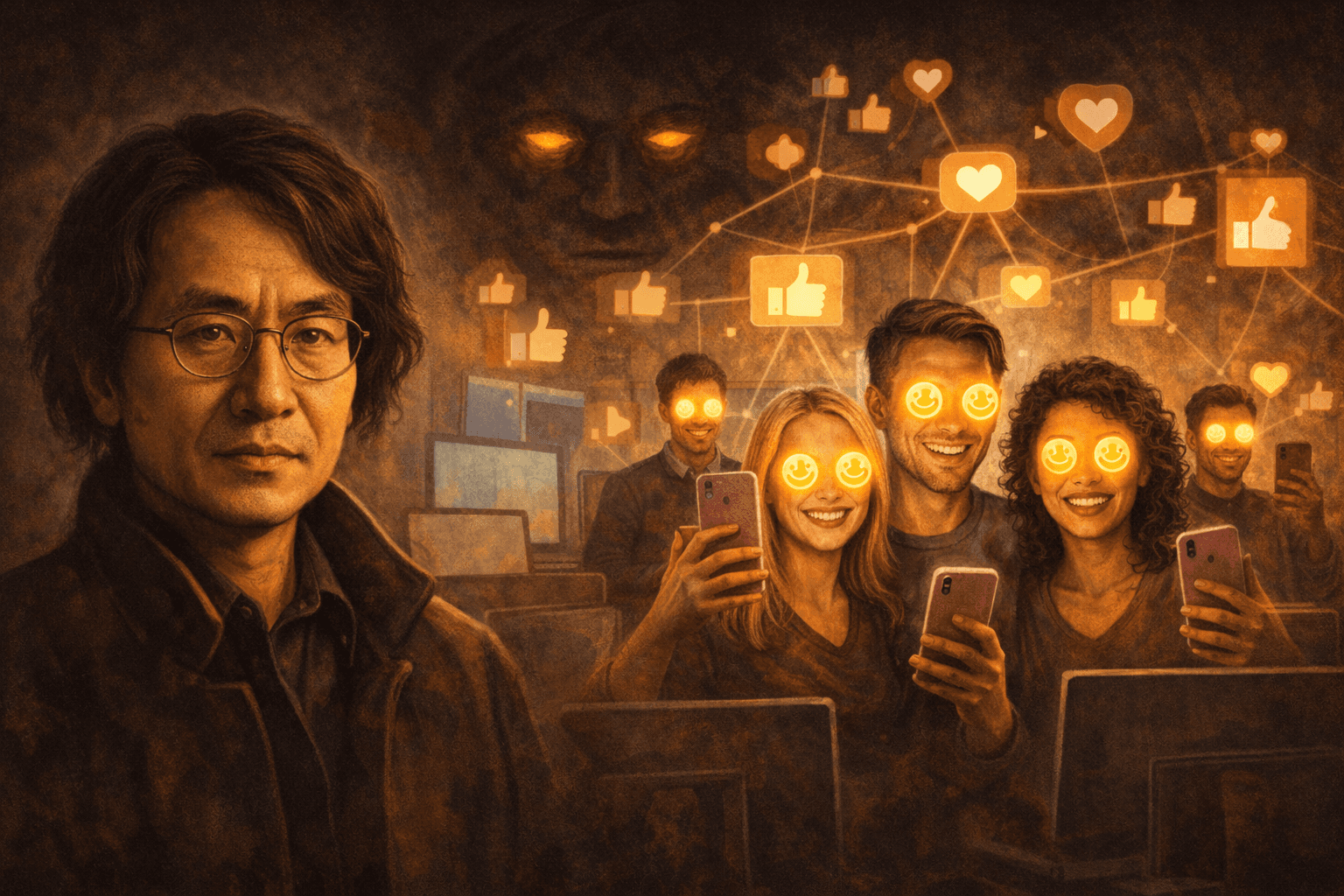
Picture this: you're scrolling Instagram at two in the morning, looking at the perfect vacations of people you've never met, feeling bad because your life looks boring by comparison. You post a photo of your breakfast with a filter and anxiously wait for the likes. You check your work email even though it's Sunday. You feel guilty for not being more productive. And here's the heavy part: nobody is forcing you to do any of this. There's no mustached dictator threatening you. There's no secret police. You're exploiting yourself on your own — and the worst part is you think you're free.
Welcome to psychopolitics — the concept a Korean-German philosopher named Byung-Chul Han used to blow our minds and explain how power works in the twenty-first century. Fair warning: after reading this, you're going to look at your phone differently.
Who Is Byung-Chul Han?
Byung-Chul Han isn't your typical philosopher. He was born in Seoul in 1959, started out studying metallurgy because his family wanted him to have a "serious" career, but then headed to Germany in the eighties to study German philosophy and literature. Today he lives in Berlin, teaches at the Berlin University of the Arts, and has become something of a rock star of contemporary philosophy — without ever having social media accounts. Ironic, right? The person who best explains how social media works has no Instagram, no Twitter, nothing.
His book Psychopolitics came out in 2014 in German, and it's been generating debate ever since. The central idea is as simple as it is disturbing: power no longer works the way it used to. It no longer needs to repress us, ban things from us, or threaten us. The new power is far more cunning, far more invisible — and for exactly that reason, far more effective.
From Disciplinary Power to Psychopolitics
To understand this, Han asks us to take a trip back in time. Think about the twentieth-century dictatorships you studied in school. Disciplinary power, as Foucault called it. There you had a State that controlled you through institutions: school, the military, the factory, the prison. Everything was organized to monitor you and punish you if you stepped out of line. Power came from outside, it was external, and you felt it as something alien to you. That's why you could rebel against it. There was a clear enemy: the exploiting boss, the dictator, the oppressive system.
But something changed in recent decades, and this is where Han gets interesting. Neoliberalism, he says, invented a far more sophisticated form of power. It no longer says "you have to do this or I'll punish you." It says "you can do whatever you want — you're free." And that freedom is precisely the biggest trap of all.
Entrepreneur of Yourself
Because now, instead of obeying a boss who exploits you, you become your own exploiter. You're the CEO of yourself, as Han puts it. You stay late at work not because anyone forces you, but because you want to grow, develop, become better. You optimize every minute of your day. You network. You work on your personal brand. And if you fail, it's your fault — because after all, you were free to choose.
This is psychopolitics: a power that doesn't act on your body, the way nineteenth-century factories did, but on your psyche — your mind, your desires, your emotions. A power that doesn't prohibit but seduces. That doesn't say "no" but says "yes, you can." You can be successful, you can be happy, you can self-actualize — but only if you work hard enough, perform at your peak, never stop.
From the Disciplinary Society to the Achievement Society
And here comes one of Han's most striking concepts: the shift from the disciplinary society to the achievement society. In the twentieth-century disciplinary society, the key modal verb was "must." You must go to work, you must obey, you must behave. It was a society of negativity, of "you can't do this." But today's achievement society runs on a different verb: "can." You can achieve whatever you want, you can be whoever you want, the sky's the limit. That sounds positive, right? Sounds liberating.
But Han shows us it's exactly the opposite. Because when everything is possible, when there are no limits, you become a slave to your own infinite potential. You could always be doing more, you could always perform better. It's never enough. And when you inevitably fall short of that impossible ideal, you don't blame the system — you blame yourself. You weren't resilient enough, you didn't try hard enough, you didn't seize the opportunities.
The Violence of Positivity
The result is what Han calls the "violence of positivity." Not the violence of "no," of prohibition and punishment. The violence of "yes" — of excess possibility, of the obligation to be happy and successful. And this violence is worse because it's invisible. You don't see it coming. You can't rebel against it because it comes from inside you.
Think about the explosion of burnout, depression, and anxiety happening around the world. For Han, these aren't just individual psychological problems. They're social symptoms — signals that something is rotting in the system. They're the characteristic diseases of the achievement society. In the disciplinary society, the typical illnesses were infectious, coming from outside. Now, Han says, they're neurological — coming from inside, from a brain overloaded from having to perform constantly.
Social Media: The Voluntary Panopticon
And this is where social media and digital technology enter the picture as the perfect tools of psychopolitics. Facebook, Instagram, TikTok — these aren't just entertainment platforms. They're devices of voluntary surveillance. You surveil yourself, you exhibit yourself, you expose yourself. You upload every aspect of your life, you measure your worth in likes and followers. You become your own panopticon.
The panopticon was that prison designed by Jeremy Bentham with a central tower from which all the cells could be seen — but prisoners never knew whether they were being watched or not. So they behaved as if they were always being watched. Foucault used this as a metaphor for disciplinary power. But Han goes further: now you don't even need the tower. You surveil yourself, you control yourself, you optimize yourself — all while constantly putting yourself on display on social media, waiting for others' approval.
Big Data: Beyond 1984
And here's the brilliant part of the system: while you're doing all this, you're constantly generating data. Every like, every search, every click, every second you spend watching a video — all of it generates information about you. Information that companies use to know you better than you know yourself, to predict your behavior, to sell you things, to manipulate you in ways you don't even perceive.
Han calls this Big Data. But it's not just surveillance the way Orwell's 1984 imagined. It's something subtler and more effective. In Orwell's dystopia, Big Brother watches you and you know you're being watched — so you can resist, you can secretly rebel. But in the psychopolitics of Big Data, you hand over all your information voluntarily, happy to share every detail of your life because you think that makes you more visible, more successful, more connected.
Obama vs. Bush: Smart Power
Han tells an anecdote I find perfect for illustrating this. He says Obama was more effective than Bush — not because he used less violence, but because he used smarter violence. Bush was pure old-school disciplinary power: invasions, prohibitions, the axis of evil. Obama, by contrast, was pure smart power: drones, digital espionage, surgical strikes. Less visible, less scandalous, but equally lethal. And he applied the same logic domestically: instead of telling you what to do, he empowered you to optimize yourself. "Yes, we can." We can. We're free. But that freedom is functional to the system.
The Dictatorship of Transparency
Another heavy concept from Han is "transparency." We live in a society obsessed with transparency. We want everything to be visible, measurable, quantifiable. Governments must be transparent, companies must be transparent, people must be authentic and share everything. Sounds pretty progressive, right?
But Han tells us that total transparency is another form of control. Because when everything is transparent, when there are no secrets, when everything can be measured and compared, it becomes easier to surveil, control, and homogenize. Transparency eliminates trust, Han says. In a society where everyone trusts everyone, you don't need transparency. But in a society where everyone distrusts everyone, you demand total transparency. And that transparency is perfect for contemporary capitalism, because it allows everything to become a commodity, everything to be compared, everything to be reduced to numbers.
The Rating Society
Think about how you rate everything now. You give stars to your Uber driver, the restaurant, the hotel, the doctor. And they rate you back. We're constantly evaluating and being evaluated. It's as if we lived inside a Black Mirror episode called "Nosedive," where your social score determines your worth as a person. The heavy part is that episode is no longer fiction — it's a fairly accurate description of how China's social credit system already works, and in subtler ways, how our own society works too.
Absolute Time: Working Always, Everywhere
Han also talks about time, and I find this particularly interesting. He says psychopolitics has changed our relationship with time. In the disciplinary society, time was structured: time to work, time to rest. But now, in the achievement society, time becomes absolute. You work all the time because you can always be doing something productive. There are no real breaks, no sacred moments protected from work.
You check your phone at seven in the morning before getting out of bed and at midnight before going to sleep. You answer emails at dinner, in the bathroom, on your supposed vacation. Work invades every space of your life, and you don't even see it as exploitation because they call it "flexibility," they call it "freedom." You can work from wherever you want, whenever you want. But in practice that means you work from everywhere, all the time.
The Multitasking Myth
And here Han introduces a concept I love: multitasking. This idea that you can do a thousand things at once, that you can split your attention across twenty screens simultaneously. Han says this is a myth. In reality, multitasking isn't a superior ability — it's a deficient form of attention. Animals under threat, when they're being hunted, have to be alert to everything simultaneously. But that scattered attention prevents them from concentrating deeply on anything. It prevents contemplation, deep thought, real creativity.
We, Han says, have become like those frightened animals. We jump from one thing to the next, always distracted, always anxious, unable to focus on one thing for more than two minutes. And that's not evolution — it's regression. Because humanity's most important cultural achievements came from deep attention, from being able to concentrate on something for hours, days, years. But psychopolitics needs us scattered, jumping from stimulus to stimulus, because that makes us more controllable, more predictable, better consumers.
How to Resist: Han's Proposal
Now, what makes Han so interesting is that he's not a Luddite telling you to smash your phone and go live in the woods. He understands you can't simply opt out of the system. The solution isn't individual. It's not a matter of you alone unplugging and calling it done. Because the problem isn't the technology itself — it's how it's used, what it serves, what logic it responds to.
Han proposes instead that we understand how this power works so we can resist it collectively. He talks about recovering what he calls "contemplative forms of life" — spaces where we're not constantly producing, optimizing, performing. Spaces of genuine leisure, not that productive leisure where you also have to be learning something, improving something, sharing something.
The Capacity to Say "No"
He also talks about recovering the capacity to say "no." Because the achievement society is the society of "yes." Yes to everything, all the time — new projects, new opportunities, new experiences. But the ability to refuse, to set limits, to defend spaces of not-doing — that's revolutionary in a world where your value is measured by how much you do.
And there's something very Eastern in Han's thinking that I find fascinating. He comes from a Korean philosophical tradition where concepts like emptiness, stillness, and non-action have a positive value. They're not the absence of something — they're presences in their own right. But in the West, especially in late capitalism, emptiness terrifies us. We have to fill every second with something: content, productivity, stimulation.
The Smartphone as a Rosary
Han once said, when someone asked why he didn't have a smartphone: "The smartphone is an instrument of domination. It functions like a rosary. It's an object of devotion." Think about that. We pull it out of our pocket and look at it constantly — as if we were praying, waiting for some revelation, some notification to save us from boredom, from emptiness, from ourselves.
A System Without Conspirators
What Han describes is not a conspiracy. There's no group of evil men in a dark room planning how to dominate us. It's worse than that. It's a system that operates almost automatically, that reproduces itself, in which we're all complicit — the people who design the apps, the people who use them, the people who invest in the companies, the people who govern the countries. We're all inside the same logic of performance, optimization, transparency.
And the cruelest part is that this system presents itself as the opposite of oppression. It presents itself as maximum freedom, as democracy, as progress. That's why it's so hard to resist — because if you complain, if you say you're exhausted, that you don't want to participate in this constant performance circus anymore, the response is: "But you're free to do whatever you want, nobody's forcing you." And technically that's true. Nobody forces you. But the system is built in such a way that not participating means being locked out of everything: out of work, out of social life, out of the very possibility of existing in the contemporary world.
The Future: Transhumanism and Biological Optimization
Han also warns about where all this is heading. He talks about transhumanism — how the logic of constant optimization will eventually want to optimize the human body itself. Being productive isn't enough anymore; you have to be smarter, live longer, be chemically happier. The next frontier of psychopolitics is genetic engineering, neural implants, modifying the brain to make it more efficient.
And again, this isn't science fiction. People are already taking nootropics to perform better at work, tech entrepreneurs are implanting chips, research is underway on editing genes to eliminate disease — and to "enhance" human characteristics. The question Han asks is: enhance by whose criteria? By the logic of performance and productivity? Because if so, we're at the last frontier of psychopolitics: it no longer just controls your mind and emotions — it redesigns your biology itself.
Psychopolitics in Everyday Life
What Han describes isn't just abstract philosophy. You can see it every day. Look at how offices changed: they're no longer gray, boring cubicle farms. Now they're "cool" spaces with ping-pong tables, free fruit, beer on Fridays. It seems like companies got more human, right? But Han would tell you it's exactly the opposite. They can no longer force you to stay late, so they seduce you into wanting to stay. They make your work "fun," make the office feel like home, make your coworkers feel like family. And so you work more hours than ever — but happily, because it feels like your choice.
The Language of Power
Or look at the language we use: you don't have a job anymore, you have a "passion." You don't work — you "do what you love." You're not an employee, you're a "collaborator" or part of the company "family." All this positive vocabulary conceals very concrete power relationships. But wrapped in the language of personal fulfillment and freedom, we don't question it.
Han's Legacy
Han's legacy in contemporary philosophy is enormous. He gave words to something many of us were feeling but didn't know how to name — that feeling of being exhausted without quite knowing why, of sensing that something doesn't add up in this hyper-connected, supposedly free world. His books have been translated into many languages and are read in universities worldwide, but they're also read by ordinary people who never studied philosophy but feel that something is wrong.
The interesting thing is that Han is neither optimist nor pessimist. He doesn't tell you everything is lost, nor that there's an easy solution. He says: look, this is how power works now — understand it, become conscious of it. And from that consciousness, maybe we can imagine other ways of living, other ways of relating to technology, to work, to ourselves.
Criticisms and the Value of the Diagnosis
Some critics say he's too fatalistic, that he romanticizes the past, that he offers no concrete alternatives. And there's truth to that — sometimes he can sound that way. But I think Han's value lies in the diagnosis, in showing us with brutal clarity how this system works, a system so naturalized that it seems inevitable to us.
Because here's the key: psychopolitics works best when it's invisible — when we don't even know it exists, when we think we're free and everything is a personal choice. The first step to resisting power is seeing it, naming it, understanding it. And that's what Han does.
The Questions Han Leaves Us
So the next time you're scrolling at two in the morning, feeling bad about not being productive enough, ask yourself: who benefits from me feeling this way? What logic is behind this constant anxiety to perform more, be more, do more? Where does this idea come from that I have to be available all the time, constantly optimizing myself, turning myself into my own business project?
Han is telling us that the dictatorship of the twenty-first century doesn't look like the ones from the twentieth. There's no uniformed dictator giving you orders. The new dictatorship tells you that you're free, that you can do whatever you want — while programming you to want exactly what the system needs you to want. It's the most sophisticated power that has ever existed, because it acts on your very desires, on your most intimate subjectivity.
And the question it leaves us with is: can we recover any real freedom in this context? Can we create spaces of resistance when power is no longer outside us but inside? I don't have the answer, and I don't think Han does either. But asking these questions, making them visible — that's already an act of resistance in itself.
Conclusion
The next time someone tells you "you need to be more positive" or "everything depends on you," remember Byung-Chul Han and his warning about the violence of positivity. Sometimes the problem isn't you. Sometimes the problem is a system that makes you believe everything is your individual responsibility. And recognizing that — well, that's the first step toward something resembling real freedom.
Related episodes

Why did you choose this way? Because he thought that philosophy was neither poetry nor opinion.

Close your eyes and look for your self. That permanent center that is you. Look carefully. A friendly, chubby Scotsman did that same exercise nearly three hundred years ago — and didn't find it. What he found instead was one of the most unsettling idea...
The most powerful man in the world wrote a private journal every night that he never intended to publish: he challenged himself not to be an idiot, reminded himself he was going to die, and braced for setbacks before they arrived. Two thousand years la...