
Gramsci and Cultural Hegemony
 Andres Aguilar
Antonio Gramsci reached a conclusion that unsettled every power structure of his era: the most stable regimes don't hold through force — they hold because they've convinced you that the world as it is is the only world possible. That idea, written from...
From inside a fascist prison cell, a hunchbacked Sardinian wrote the idea that explains how we're controlled without ever noticing: cultural hegemony. Find out why we obey voluntarily, how the culture war is fought, and what Gramsci has to do with social media.
Imagine being in a fascist prison — sick, your spine deformed by tuberculosis, knowing you'll probably die there. And instead of giving up, you start writing thousands of pages of political philosophy that will change how we understand power. That was the life of Antonio Gramsci, a man who, from a cell in Mussolini's Italy, developed one of the most powerful ideas of the twentieth century: cultural hegemony. I'll tell you upfront that this idea explains a great deal of what's happening today — from social media to the culture wars. Because it turns out that power isn't maintained only through police and armies. It's maintained primarily by convincing you that the world as it is is natural, inevitable, and that thinking differently is simply ridiculous. Today we're going to unravel how this works, and I guarantee you'll start seeing the world differently.
The Brilliant Hunchback from Sardinia
Antonio Gramsci was born in 1891 in Sardinia, which at the time was basically the poorest, most forgotten part of Italy. His family was lower-middle class, and when he was a child he suffered some kind of accident or illness — it was never entirely clear which — that deformed his spine. He ended up hunchbacked, short in stature, physically frail. Kids at school mocked him mercilessly. Imagine growing up like that in a small Sardinian town at the turn of the twentieth century. But the kid was brilliant. Extraordinarily brilliant.
He won a scholarship to study at the University of Turin, where he threw himself into politics. Italy was in upheaval — labor strikes, factory occupations, failed revolutions. Gramsci joined the Socialist Party and later helped found the Italian Communist Party in 1921. He was a left-wing intellectual at the most dangerous possible moment to be one, because Mussolini and his fascists were taking power.
The Prison Notebooks
In 1926, with Mussolini already entrenched as dictator, Gramsci was arrested. The prosecutor at his trial said something chilling: "We must prevent this brain from functioning for twenty years." He was sent to prison, where he spent eleven years until his death in 1937. He was only forty-six. But here's the extraordinary thing: during those eleven years in jail — sick, under constant surveillance — he wrote more than three thousand pages across thirty-three notebooks. Those Prison Notebooks contain some of the most influential ideas in modern political theory.
The Problem That Obsessed Gramsci
To understand what Gramsci was doing, you first need to understand the problem he was trying to solve. Gramsci was a Marxist — he believed in Marx's ideas about class struggle and all that. But there was a huge problem with traditional Marxism: Marx had predicted that the proletarian revolution would happen first in the most industrialized countries, where there were more workers and more exploitation — England, Germany, places like that. But the only successful socialist revolution up to that point had been in Russia, a backward and mostly agricultural country. And in the industrialized countries of the West? Nothing. Workers were voting for bourgeois parties, settling for gradual improvements, not making revolutions.
Why? That was the question that obsessed Gramsci. Why weren't workers rebelling against a system that was clearly exploiting them? The easy traditional Marxist answer was: false consciousness, bourgeois propaganda, they're being deceived. But Gramsci thought that was too simple. People aren't that naive. You can't maintain a system of domination for centuries through lies and propaganda alone.
Cultural Hegemony: The Invisible Power
And this is where Gramsci develops his brilliant idea: cultural hegemony. The word "hegemony" comes from the Greek for leadership or dominance. But Gramsci gives it a specific meaning. Hegemony is when a social class doesn't just dominate through force, but manages to make its worldview become the common sense of the entire society. It's when their values — their ideas about what's normal, desirable, possible — simply become "reality" for everyone.
Let me give you a concrete example. In the nineteenth century, most people thought monarchies were natural and necessary. The idea of ordinary people choosing their rulers seemed ridiculous, dangerous, unnatural. Not because kings had soldiers forcing you to think that way. It was simply the common sense of the era. The monarchical hegemony was so complete that thinking about democracy automatically made you a dangerous radical.
Or take a more recent example: until not so long ago, the idea of two people of the same sex getting married seemed absurd to most people. Not just morally wrong — literally unimaginable. "Marriage" meant a man and a woman, period. Today that hegemony has broken down in many places. What was once unthinkable is now legal and accepted. That's a hegemonic shift.
Domination Without Guns
Gramsci argued that domination in Western capitalist societies operated primarily through this cultural hegemony — not through brute force. Sure, the State had police and armies, but it used them relatively rarely against its own population. Most of the time, people obeyed voluntarily. They went to work, paid taxes, followed the rules — not because they were forced at gunpoint, but because it seemed right, natural, inevitable.
Political Society vs. Civil Society
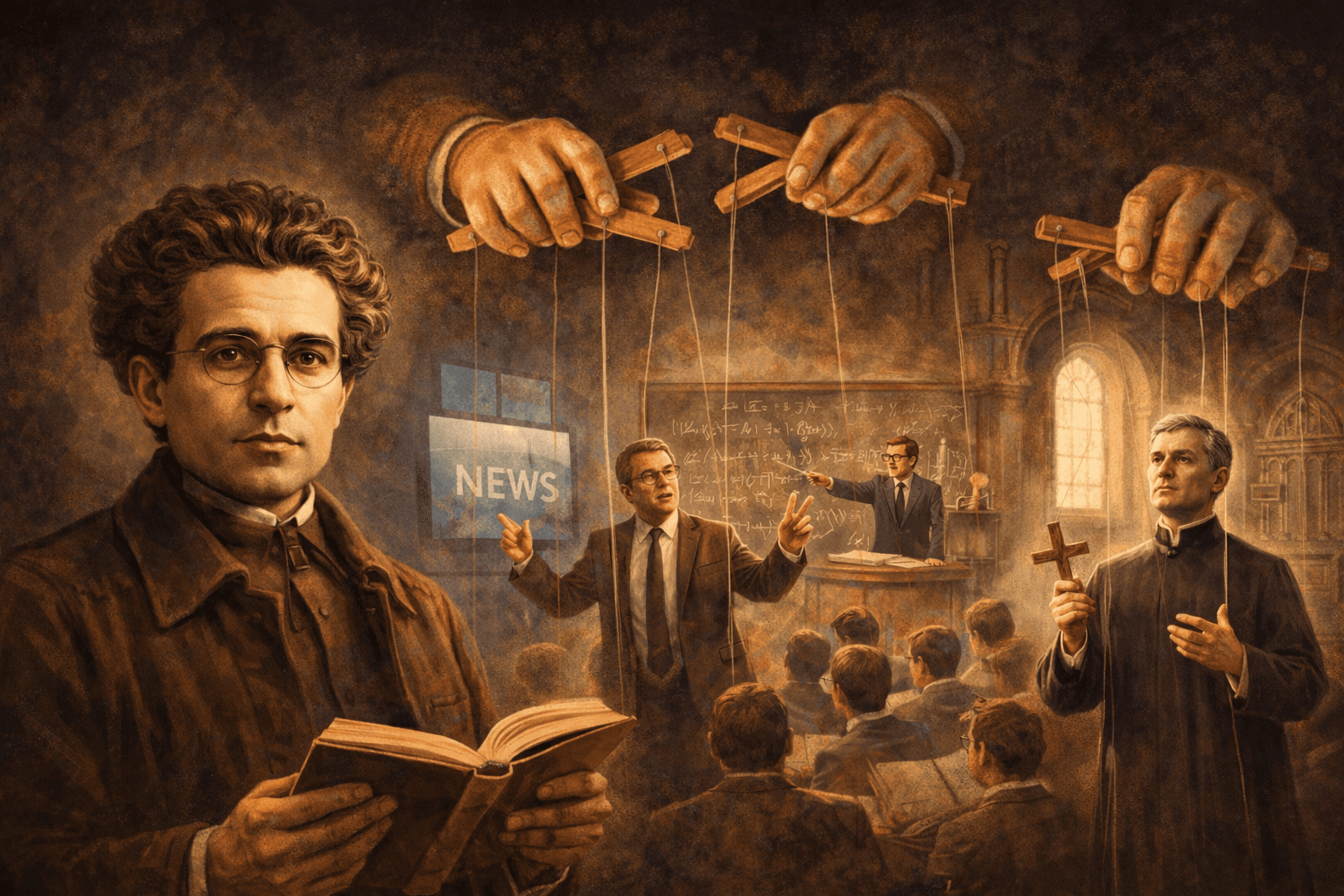
And how was this hegemony built? Here Gramsci introduces another key concept: civil society. For him, society was divided into two major spheres. First, political society: the state, governments, laws, courts, police — the coercive part, the part that compels you. Second, civil society: schools, churches, media, cultural institutions, clubs, associations — the part that convinces you.
In developed Western societies, the hegemony of the ruling class was maintained primarily through civil society. Schools taught you certain values, a certain vision of history, a certain idea of what success looks like. Churches preached obedience and resignation. The media portrayed a certain lifestyle as natural. All of this created an environment where certain ideas simply "made sense" and others seemed crazy.
It's Not a Conspiracy — It's Worse Than That
And here's something important that sets Gramsci apart from other Marxists: he didn't think the ruling class was consciously conspiring to deceive everyone. There was no group of capitalists meeting in a dark room to plan how to manipulate the masses. It was subtler than that, and harder to fight. Hegemony worked because even the dominated participated in reproducing it. Teachers believed what they taught. Priests believed their sermons. Journalists believed their narratives. Everyone — including workers — had internalized certain ideas about how the world works.
The Lesson of the Occupied Factories
Gramsci had a personal story that illustrates this perfectly. As a young man, he worked for a time as a journalist and covered the great strikes and factory occupations in Turin. He watched how the workers, once they took over the factories, basically kept running them exactly the same way as before — same hierarchies, same methods, same attitudes. They had taken the physical space but hadn't changed the mindset. They kept thinking the way they'd been taught to think. That showed him that revolution wasn't just about seizing state power — it was about changing an entire culture, an entire way of seeing the world.
War of Position vs. War of Maneuver
That's why Gramsci developed the idea of "war of position" versus "war of maneuver." In Russia, where civil society was weak and the State was everything, a direct assault on power was enough — a rapid revolution, a war of maneuver. But in the West, with its dense network of civil society institutions, a different strategy was needed: a long war of position, capturing spaces in culture, education, and media, building an alternative hegemony before attempting to seize state power.
This sounds abstract, but it has enormous implications. It means that if you want to change the system, winning elections or storming the Winter Palace isn't enough. You have to change people's common sense. You have to build a counter-hegemony — an alternative worldview so convincing, so naturalized, that it eventually replaces the dominant one.
Organic Intellectuals
And who does that work? Here Gramsci introduces his concept of "organic intellectuals." For him, we are all intellectuals in some sense — we all think and reason. But organic intellectuals are those who articulate and spread the worldview of a social class. They can be teachers, journalists, writers, artists — anyone who works with ideas and culture. Every class has its organic intellectuals.
The bourgeoisie has its economists who explain why capitalism is efficient, its philosophers who justify individual freedom, its historians who narrate history as inevitable progress toward the present. And the working class, if it wants to build its own hegemony, needs its own organic intellectuals to articulate an alternative vision.
Gramsci himself was a perfect example of an organic intellectual. He didn't come from the working class in the strict sense, but he devoted his life to articulating a worldview from the perspective of the dominated. And he did it from prison, with a broken body, under constant surveillance. It's heroic and tragic at the same time.
Today's Culture Wars
Now, this is where Gramsci's ideas become super relevant to understanding the present. Because if you pay attention to today's cultural debates, you'll see that everyone is fighting for hegemony. Each side is trying to establish what's "normal," what's "common sense," what's "beyond question."
Think about what people call the culture wars. They're not just about specific policies. They're about who defines reality. Is climate change an existential crisis or an exaggeration? Is immigration enriching or threatening? Are gender differences social constructions or biological facts? These battles aren't fought primarily through rational argument. They're fought by trying to make one vision seem obvious and the other absurd.
And notice where they're fought: in universities, in the media, in Hollywood, on social media, in memes. Exactly the civil society spaces Gramsci identified as crucial for hegemony. When conservatives complain that universities are dominated by the left, they're making a Gramscian analysis — saying "we lost hegemony in that cultural space and need to win it back." When the left criticizes that media is controlled by corporations, they're also making a Gramscian analysis.
The Chaos of Social Media
Social media added a new dimension. Before, the spaces where culture was produced were more concentrated. Now anyone with a phone can be an organic intellectual, producing and spreading worldviews. That makes the battle for hegemony much more chaotic and fragmented. There's no longer a single common sense everyone shares. There are multiple bubbles, each with its own internal hegemony.
Hegemony Is Never Total
And here's something Gramsci understood but that many people forget: hegemony is never total or permanent. There are always cracks, contradictions, spaces of resistance. The dominant hegemony has to constantly renew itself, adapt to new challenges, incorporate criticism. That's how systems of power survive — they're flexible, they transform, they co-opt their critics.
Look at capitalism. It has survived crisis after crisis precisely because it's been able to renew its hegemony. After the Great Depression, it incorporated the welfare state. After the social movements of the 1960s, it incorporated discourses of diversity and inclusion. Now it's trying to incorporate environmental concerns through green capitalism. It's not that it's immutable. It's that it's hegemonically flexible.
Religion and Popular Needs
Gramsci also had interesting ideas about the role of religion in hegemony. He distinguished between religion as an institution of power and popular religiosity as an expression of real feelings and needs. The Catholic Church was clearly part of the dominant hegemonic bloc in Italy. But Gramsci didn't want to simply attack it — he wanted to understand what needs it fulfilled, what aspirations it expressed, in order to offer alternatives that connected with those same needs.
This is something the left sometimes misses. You can't just tell people their beliefs are false and expect them to follow you. You have to offer something that satisfies the same emotional, social, and spiritual needs that existing institutions already fulfill. You have to build not just a political alternative but a complete cultural alternative.
Beyond Marxist Economism
And here Gramsci sets himself apart from traditional Marxist economism. For many Marxists, only the economy mattered — the material base. Culture was just a reflection, a superstructure determined by relations of production. Gramsci said: no, culture has its own density, its own relative autonomy. You can't change the culture simply by changing economic relations. And vice versa — you can't change economic relations without changing the culture.
It's a more complex and, I think, more realistic vision. Social change isn't unidirectional. It's dialectical, as he liked to say. Economy and culture mutually influence each other. That's why revolution has to be both material and cultural, both economic and hegemonic.
When the Right Learned from Gramsci
One fascinating thing about Gramsci is that he influenced both the left and, indirectly, the right. The Western cultural left, from the 1960s onward, took his ideas about cultural hegemony very seriously. This is where the famous "long march through the institutions" came from — the idea of infiltrating and transforming cultural spaces from within. It was, in many respects, a very successful strategy. Progressive academia, arts, journalism — all of that has Gramscian roots.
But then, ironically, the right learned the same lessons. Conservative thinkers like Patrick Buchanan began explicitly talking about the culture war in Gramscian terms. They built think tanks, alternative universities, media outlets. Today's alternative right and populist movements also use hegemonic strategies, trying to create a new common sense.
Hegemonic Crisis: When the Monsters Appear
So we end up in a situation where everyone is fighting for hegemony but nobody manages to establish a stable dominant one. We live in a crisis of hegemony — which is exactly what Gramsci identified as the most dangerous moment. When the old hegemony is dying but the new one hasn't fully been born, Gramsci said, monsters appear. It's a line that gets quoted a lot, for good reason.
And what monsters have appeared? Well: authoritarian populism, xenophobic nationalism, mass conspiracy theories, extreme polarization, political violence. All symptoms of a hegemonic crisis. When people no longer share a basic common sense, when they can't even agree on which facts are real, coexistence becomes impossible.
A Tragic Ending
Gramsci died without seeing the world he had predicted. Mussolini kept him imprisoned even when he was dying. They released him just in time for him to die outside the prison walls, to avoid carrying the responsibility of having killed him directly. His mind was brilliant but his body was destroyed. His final years were marked by constant pain, near-total isolation, and the anguish of knowing that outside, the war and fascism kept advancing.
But his notebooks survived. His companion Tatiana Schucht smuggled them out of the prison and preserved them during the war. They were later published and began to circulate — first in Italy, then around the world. And it turned out that the ideas of this hunchbacked Sardinian had explosive power.
Between Cynicism and Naive Idealism
What's brilliant about Gramsci is that he gives you tools to understand power without falling into cynicism or naive idealism. The cynic says "everything is manipulation, people are dumb, the powerful always win." The naive idealist says "just be right and good ideas will triumph on their own." Gramsci shows you a middle path: yes, there is real domination — but it's sustained through complex cultural processes in which people actively participate. And yes, ideas matter enormously — but they don't float in a vacuum; they're rooted in institutions, practices, power relations.
To change the world, being right isn't enough. You have to build an alternative hegemony, win over common sense, make your worldview seem natural and desirable. And that is a long, patient, molecular process, as Gramsci called it. There are no revolutionary shortcuts. It's an educational, cultural, organizational effort that takes generations.
The Realism of Historical Patience
That might sound discouraging. Generations? I want to change the world now, not in fifty years. But it's also realistic. Truly deep changes are slow. The abolition of slavery, universal suffrage, civil rights — all of it took decades or centuries of cultural struggle before crystallizing into legal change. And even after the legal changes, you still have to transform mentalities, common sense.
Take feminism as an example. Suffragists won the right to vote more than a century ago in many countries. But patriarchal hegemony didn't magically disappear. There was still discrimination, violence, glass ceilings. It took generations more of hegemonic work — changing how we think about gender, family, work, sexuality. And we're not done yet. The hegemonic battle continues.
The Problems with the Theory
Now, does this mean Gramsci had all the answers? Not at all. There are problems with his theory. It's quite vague on specifics. How exactly do you measure hegemony? How do you know when it's changing? How do you coordinate a war of position without falling into the reformism he criticized? He doesn't give clear answers.
There's also a tension in his thinking between Marxist determinism and cultural voluntarism. On one hand, he's still a Marxist — he thinks the economy matters, that classes exist. On the other hand, he gives so much weight to culture and will that he almost sounds idealist. He never fully resolves this.
And then there's the question of whether his strategy actually works. The Western left followed his prescription for decades — it won spaces in culture, education, media. And what happened? Capitalism grew stronger. Inequality increased. Workers voted for the right. Maybe the Gramscian strategy achieved cultural successes but material failures.
An Invaluable Legacy
But even with these problems, Gramsci gave us something invaluable: a way of thinking about power that goes beyond direct coercion. He showed us that the most important battles are fought at the level of common sense — of what we take for granted without questioning. And he reminded us that we're all participants in these battles, whether we want to be or not. Every time we repeat an idea, every time we accept or reject a narrative, we're participating in the hegemonic struggle.
So the next time something strikes you as "just obvious" or "common sense," remember Gramsci. Ask yourself: where does this obviousness come from? Who benefits from me thinking this way? What alternatives am I failing to see because they seem unthinkable? It's not paranoia. It's hegemonic analysis.
Related episodes

Why did you choose this way? Because he thought that philosophy was neither poetry nor opinion.
Close your eyes and look for your self. That permanent center that is you. Look carefully. A friendly, chubby Scotsman did that same exercise nearly three hundred years ago — and didn't find it. What he found instead was one of the most unsettling idea...
The most powerful man in the world wrote a private journal every night that he never intended to publish: he challenged himself not to be an idiot, reminded himself he was going to die, and braced for setbacks before they arrived. Two thousand years la...