
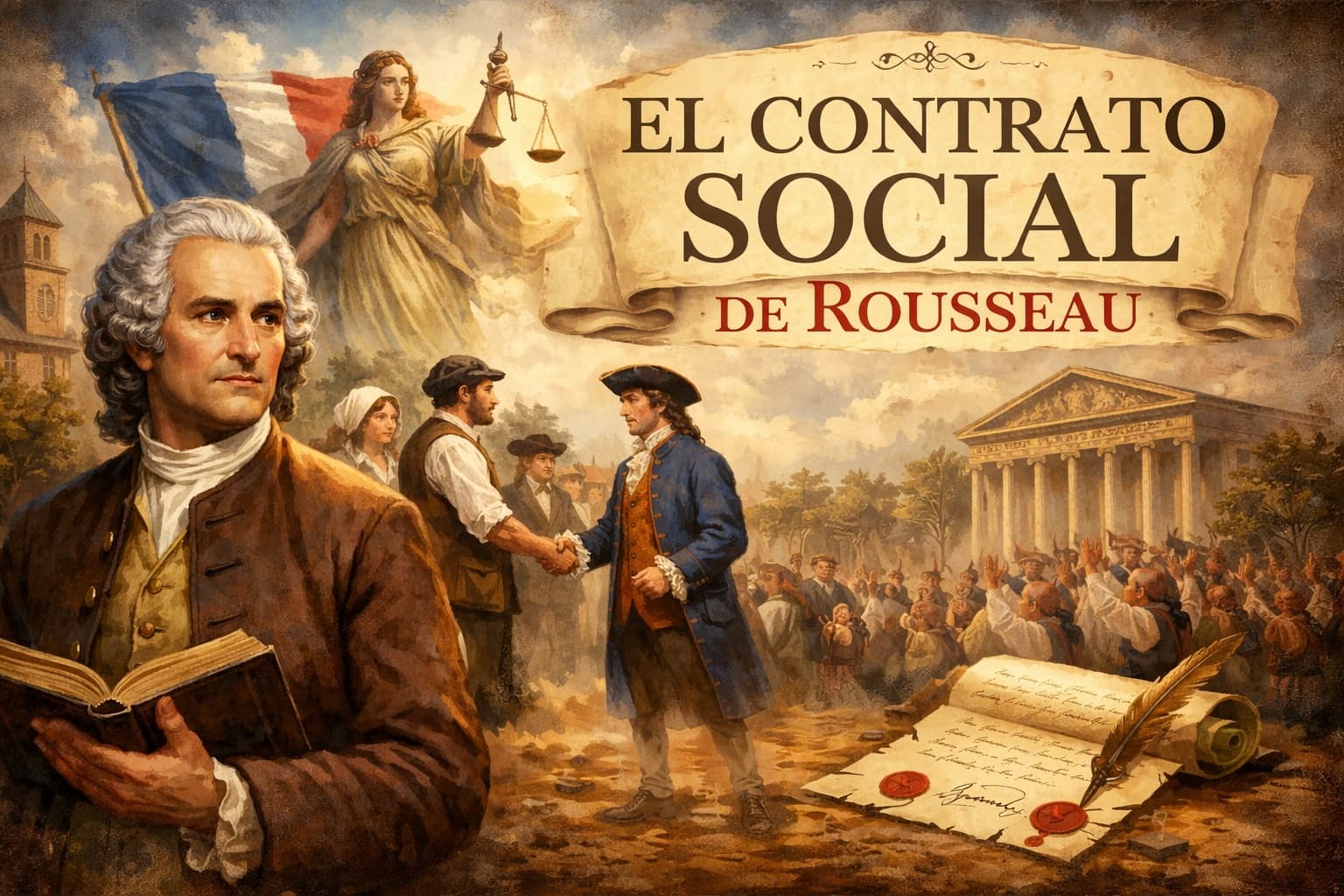
Rousseau's Social Contract
 Andres Aguilar
Rousseau wrote a book that European kings wanted to burn and French revolutionaries turned into their bible. His central idea was as simple as it was explosive: no one is born a subject of anyone, and all legitimate authority must arise from a free agr...
Picture this scene: it's 1762, you're in Paris, and a book suddenly appears that basically argues all the kings of Europe are illegitimate usurpers. That people have every right to overthrow them. That true freedom doesn't lie in doing whatever you want, but in obeying laws you gave yourself. Sounds contradictory, right? Welcome to the world of Jean-Jacques Rousseau and his Social Contract — probably one of the most revolutionary and polarizing ideas in the entire history of philosophy. So revolutionary that it literally helped trigger the French Revolution. Today we're going to dive into this idea that changed the world, and I promise that by the end you'll understand why this book left Rousseau fleeing France with an arrest warrant on his heels.
The Ones Who Came First: Hobbes and the Leviathan
But before jumping into Rousseau, we need the context. Because Jean-Jacques didn't invent the idea of the social contract out of nowhere. Two people had already been playing with this notion, and the differences between the three of them are fascinating. We're talking about Thomas Hobbes and John Locke — two English philosophers who had already been wrestling with the same question that would eventually obsess Rousseau: why do we obey governments? Where does their authority actually come from?
Hobbes, writing in the middle of the seventeenth-century English Civil War, had a pretty grim view of human nature. For him, the natural state of human beings — before any society or government — was a war of all against all. His famous summary line: life in the state of nature was "solitary, poor, nasty, brutish, and short." Imagine a world with no laws, no police, nothing to protect you except your own strength. In that world, according to Hobbes, we'd all be constantly trying to kill each other for resources, territory, sheer survival. It's a pretty apocalyptic vision, but given that he was writing this while England was bleeding through a civil war, you can see where his paranoia was coming from.
Hobbes's solution was radical: people needed to make a social contract where they essentially handed all their rights over to an absolute sovereign — a Leviathan, as he called it. This sovereign would have total, unquestionable power, because the alternative was returning to chaos. For Hobbes, better to live under a tyrant than to die stabbed in an alley by the first stranger who wanted your boots. Not exactly an optimistic view of humanity, but internally consistent.
Locke: A More Hopeful Vision
Then came Locke, who was a bit more optimistic about human nature. For Locke, the state of nature wasn't so terrible. There were problems, sure, but humans had some capacity for reason and cooperation. The issue was that without a government, there was no one to arbitrate disputes impartially or to systematically protect the natural rights we all have: life, liberty, and property. So people made a social contract — but instead of handing all power to an absolute monarch as Hobbes proposed, they created a limited government whose only job was to protect those natural rights. And here's the key move: if the government failed to protect those rights, people had every right to rebel and replace it. This idea, predictably, was hugely influential on revolutions like the American and French ones.
Rousseau: The Person Behind the Ideas
Now, let's get to Rousseau himself. Jean-Jacques was a fascinating figure — born in Geneva in 1712, he led an absolutely chaotic life. His mother died when he was born, his father abandoned him as a child, he worked all kinds of jobs from engraver's apprentice to secretary, had five children with a woman and sent them all to an orphanage, feuded with practically every philosopher friend he had (including Voltaire and Diderot), and developed such severe paranoia in his later years that he believed everyone was conspiring against him. Not exactly a stable personality, but his mind was brilliant.
"Man Is Born Free, but Everywhere He Is in Chains"
When Rousseau turned his attention to the social contract, he rejected both Hobbes's and Locke's visions. For him, both had fundamentally misread the state of nature. Rousseau thought that human beings in their natural state were basically good, free, and happy. It was society that had corrupted them. This is where his famous opening line of The Social Contract comes from: "Man is born free, but everywhere he is in chains." It hits you like a punch, right? Because it forces you to ask: how did we go from being free to being in chains? And more importantly, how can we be free again within a society?
The General Will: The Heart of the Theory
Rousseau's answer is where things get really interesting — and a little controversial. He says the only way to be truly free in society is through what he calls the "general will." Don't confuse this with the will of all, which is simply the sum of what each individual wants for themselves. The general will is something deeper: it's what we would all want if we genuinely thought about the common good, if we set aside our particular selfish interests for a moment.
When we make the social contract in Rousseau's version, we're not handing our rights to a king or an external government like in Hobbes, and we're not just creating a limited government to protect natural rights like in Locke. We're creating a political body of which we are part. We are giving ourselves laws as a community. And here comes the conceptual move that a lot of people struggle to swallow: by obeying those laws, we're not losing our freedom — we're exercising it. Because we're obeying laws we gave ourselves.
It's a little like deciding to join a book club. Nobody forces you, but once you join, you accept certain rules: read the monthly book, show up to meetings, listen to other people's opinions even when you disagree. Are you less free for following those rules? Rousseau would say no, because you freely chose to subject yourself to them. In fact, those rules are what make the club possible and deliver the benefits you get from it.
"Forced to Be Free": The Most Controversial Line
But here's where Rousseau gets more contested. He says that if someone refuses to obey the general will, the rest of the community can compel them. And he uses a phrase that sounds absolutely Orwellian: they will be "forced to be free." Yes, you read that right. Forced to be free. It's like telling someone, "I'm going to make you do what you actually want." Sounds like a total contradiction, right?
Rousseau's idea is that sometimes our immediate individual desires blind us to the true common good that, if we thought about it rationally, we would recognize as right. It's a bit like when your drunk friend wants to drive and you take the keys. Technically you're "forcing" him to do something he doesn't want to do in that moment, but you're actually helping him act in accordance with his real rational interest. Rousseau extends this logic to society as a whole.
The problem, as you can imagine, is that this idea of forcing people to be free lent itself to all kinds of abuses later on. The Jacobins during the Reign of Terror in the French Revolution justified their atrocities by citing Rousseau. Twentieth-century totalitarian regimes also found in this idea a convenient excuse: "We're not oppressing you — we're liberating you from your false consciousness." It's one of those cases where a philosophical idea that has a certain logic on paper can become genuinely dangerous in practice.
Direct Democracy: The Participatory Ideal
But we have to be fair to Rousseau. He wasn't proposing a dictatorship. In fact, he was deeply democratic. For him, sovereignty resides in the people and is inalienable — it can't be delegated or fully represented. This set him apart radically from Hobbes, who placed all sovereignty in the monarch, and from Locke, who did allow for representation. Rousseau was skeptical of representative democracy. He thought that when you elect a representative, you're free only at the moment you vote — after that, you're a slave again until the next election. True freedom required constant direct participation.
The Philosopher's Hypocrisy
Here's a somewhat amusing anecdote about Rousseau that illustrates his contradictory personality. He wrote extensively about education in his book Emile, proposing an entire system for raising children in a natural and virtuous way. But as I mentioned, he had five children with his companion Thérèse Levasseur and sent them all to an orphanage. When critics pointed out this monumental hypocrisy, Rousseau defended himself by saying he was too poor to raise them properly and they'd be better off there. Nobody bought it, and rightly so. It's one of those cases where the thinker fails to live up to his own ideas. But that doesn't necessarily invalidate the ideas themselves — it just reminds us that philosophers are human, with all their contradictions.
Sovereign vs. Government: A Key Distinction
Back to The Social Contract: another key idea of Rousseau's is his distinction between the sovereign and the government. The sovereign is the people united by the general will — it's where legislative power resides, the power to make laws. The government, by contrast, is simply the body charged with executing those laws. It's a servant of the sovereign, not its master. If the government starts acting against the general will, the sovereign has every right to change or abolish it.
This sounded incendiary in the eighteenth century, when most of Europe lived under absolute monarchies that believed themselves ordained by God. Rousseau was saying that all those kings were basically employees who could be fired if they didn't do their job well. It's not hard to understand why The Social Contract was immediately banned in both Paris and Geneva, and why Rousseau had to run.
From Banned Book to Revolutionary Banner
The fascinating thing is that the book's ideas seeped through anyway. The French revolutionaries read it and took it seriously. Robespierre was a declared fan of Rousseau. The Declaration of the Rights of Man and Citizen is steeped in these ideas. The concept that sovereignty resides in the nation — that all citizens have the right to participate in forming the laws that govern them — comes directly from Rousseau.
The Practical Problems with the Theory
But we have to acknowledge the practical problems with his theory. Rousseau was writing with small communities in mind — essentially city-states like his native Geneva. How do you apply direct participatory democracy in a country of millions of people? It's not very practical for all citizens to constantly gather together to decide every law. That's why modern democracies ended up being representative, despite Rousseau's objections.
Then there's the question of the general will itself. How do you know what it is? How do you distinguish between the legitimate general will and, say, the tyranny of the majority? Rousseau doesn't give a super clear answer. He says the general will always aims at the common good and is never wrong — but that sounds more like a statement of faith than a solid argument. In practice, a lot of people can be convinced their vision represents the common good while they're actually oppressing minorities.
The Civil Religion: The Dark Side
Rousseau also had some pretty strange ideas about civil religion. He thought that for a society to function, it needed a kind of civic religion that everyone shared — not necessarily a traditional religion with God and all that, but certain basic civic dogmas: the sanctity of the social contract, respect for the laws, things like that. And here it gets heavy: he thought that anyone who didn't accept these civic dogmas should be exiled — not for being impious, but for being antisocial. And if someone publicly accepted these dogmas but then acted as if they didn't believe in them, they deserved death. It's pretty extreme, and it shows the potentially authoritarian side of his thinking.
A Diagnosis That Still Holds
But beyond these problems, we have to recognize that Rousseau touched on something deep. His diagnosis about inequality and social corruption is still relevant. In another of his books, Discourse on the Origin of Inequality, he traces how private property and civil society created artificial hierarchies between people who were naturally born equal. It's a critique that resonates even today.
And his basic intuition about political legitimacy remains powerful: a government is legitimate only if it serves the common good and only if the governed have a voice in decisions that affect them. This seems obvious to us now, but in his time it was revolutionary. We're so accustomed to democracy as an ideal (even if not always as a practice) that we forget there was a time when most of the world lived under monarchies or empires that didn't even pretend to represent the will of the people.
A Paradoxical Influence
One curious thing is how Rousseau influenced people in opposite directions. The French revolutionaries adored him and used his ideas to justify the democratic republic. But nineteenth-century Romantics also fell in love with Rousseau — especially his emphasis on feelings, nature, and the individual against corrupt society. And then in the twentieth century, both democrats and authoritarians found useful things in his work. Participatory democrats cite him to defend greater citizen involvement. Critics of liberalism use him to argue that individual rights aren't the only thing that matters — that the common good exists too. And authoritarians, well, they grab onto that idea of "forcing people to be free" to justify the unjustifiable.
Three Visions, One Shared Legacy
It's interesting to compare how the ideas of the three social contract philosophers played out. Hobbes, with his all-powerful Leviathan, basically justified any strong government capable of maintaining order. It's no coincidence his philosophy is popular among people who value stability above all else. Locke, with his limited government and natural rights, became the patron saint of classical liberalism and of revolutions like the American one that sought individual freedom and protection from government overreach. And Rousseau, with his general will and participatory democracy, inspired both the best democratic aspirations and some of the worst revolutionary excesses.
What all three shared — and this matters — is the radical idea that political power requires justification. It's not enough to say "I'm king because God willed it" or "obey me because I said so." Power has to come from some kind of agreement between rulers and the ruled. That idea — the social contract in any of its versions — is the foundation of all modern politics. Even modern dictatorships feel the need to justify themselves, to claim they act in the name of the people or the revolution or whatever. None openly admits "I dominate you because I have more force." That hypocrisy itself is a tribute to these ideals.
A Melancholy Ending
Rousseau died in 1778, eleven years before the French Revolution. He never saw how his ideas shook the world, nor how they were used and abused. His final years were sad. Increasingly paranoid, convinced there were conspiracies against him, estranged from almost all his friends, living in relative poverty. It's a melancholy ending for someone who wrote about the natural goodness of human beings and how we might build a perfect society.
The Permanent Legacy
But his legacy is undeniable. Every time we talk about popular sovereignty, every time we demand that our leaders be accountable, every time we say that laws should serve the common good and not private interests, we're repeating ideas that Rousseau helped articulate. We may not agree with all his conclusions — some may seem dangerous or impractical — but the questions he raised are still our questions.
How can we be free and still live in society? What makes a government legitimate? How do we balance individual freedom with the common good? What do we owe our community and what does it owe us? These questions don't have easy answers, and they probably never will. But the fact that we keep asking them, keep wrestling with them, is partly thanks to people like Rousseau who dared to question everything their era took for granted.
Human Contradictions, Transcendent Ideas
And there's something almost poetic about Rousseau's life itself. A man who wrote about the general will but was profoundly individualistic. Who praised egalitarian society but abandoned his own children. Who defended democratic participation but fought with everyone around him. His personal contradictions don't invalidate his ideas, but they do remind us of something important: great political theories are built by complicated, fallible, contradictory humans. There are no perfect gurus and no flawless political systems.
In the end, what Rousseau left us wasn't an instruction manual for the perfect society — even though he sometimes seemed to be trying to write one. What he left us was a set of provocative ideas that force us to think critically about politics, freedom, and power. He left us uncomfortable questions we can't ignore. And in philosophy, good questions are often worth more than the wrong answers.
A Conversation That Continues
The next time you vote, or complain about your elected officials, or wonder why you have to obey this or that law, you're participating in a conversation that Rousseau, Locke, Hobbes, and others started centuries ago. It's a conversation that will probably never end — because as long as human societies exist, we'll keep trying to figure out how to live together without going completely crazy or killing each other in the process.
Related episodes
Why did you choose this way? Because he thought that philosophy was neither poetry nor opinion.
Close your eyes and look for your self. That permanent center that is you. Look carefully. A friendly, chubby Scotsman did that same exercise nearly three hundred years ago — and didn't find it. What he found instead was one of the most unsettling idea...
The most powerful man in the world wrote a private journal every night that he never intended to publish: he challenged himself not to be an idiot, reminded himself he was going to die, and braced for setbacks before they arrived. Two thousand years la...