
The Myth of the Cave: Why We're Still in Chains
 Andres Aguilar
Plato used a cave, some chained prisoners, and shadows on a wall to make a point that still stings today: the reality we perceive might be just a filtered, distorted version of something far deeper. What makes the allegory so unsettling isn't the chain...
Have you ever stopped to wonder whether everything you believe is real might actually be a lie? Not conspiracy theories or anything like that. Something deeper: what if the reality you perceive every day is just a blurry shadow of what actually exists? Here's the wild part: a guy who lived more than two thousand years ago had already figured this out, and he explained it with a story so simple it still blows our minds today. His name was Plato, and what he told is known as the Allegory of the Cave. Fair warning: when you finish reading this, you're going to look at your Instagram feed very differently.
Picture the scene. It's 380 BCE in Athens. Plato is writing one of the most important books in the history of philosophy — The Republic — where he essentially tries to design the perfect society. And in the middle of this massive political treatise, he drops this allegory that is so powerful it's still being studied, cited, and misread twenty-four centuries later. But before we dive into the cave, I have to tell you something about Plato that almost nobody knows: that wasn't even his real name.
His actual name was Aristocles. "Plato" was a nickname — it comes from platýs, the Greek word for "broad." He was a serious athlete with wide shoulders, and apparently someone gave him the nickname and it stuck forever. Think about that: one of the most important philosophers in history is basically known by his gym nickname. It's like if two thousand years from now people talked about "Big Mike" Aristotle or "Slim" Socrates. But let's get back to the cave, because that's where things get interesting.
The Story of the Chained Prisoners
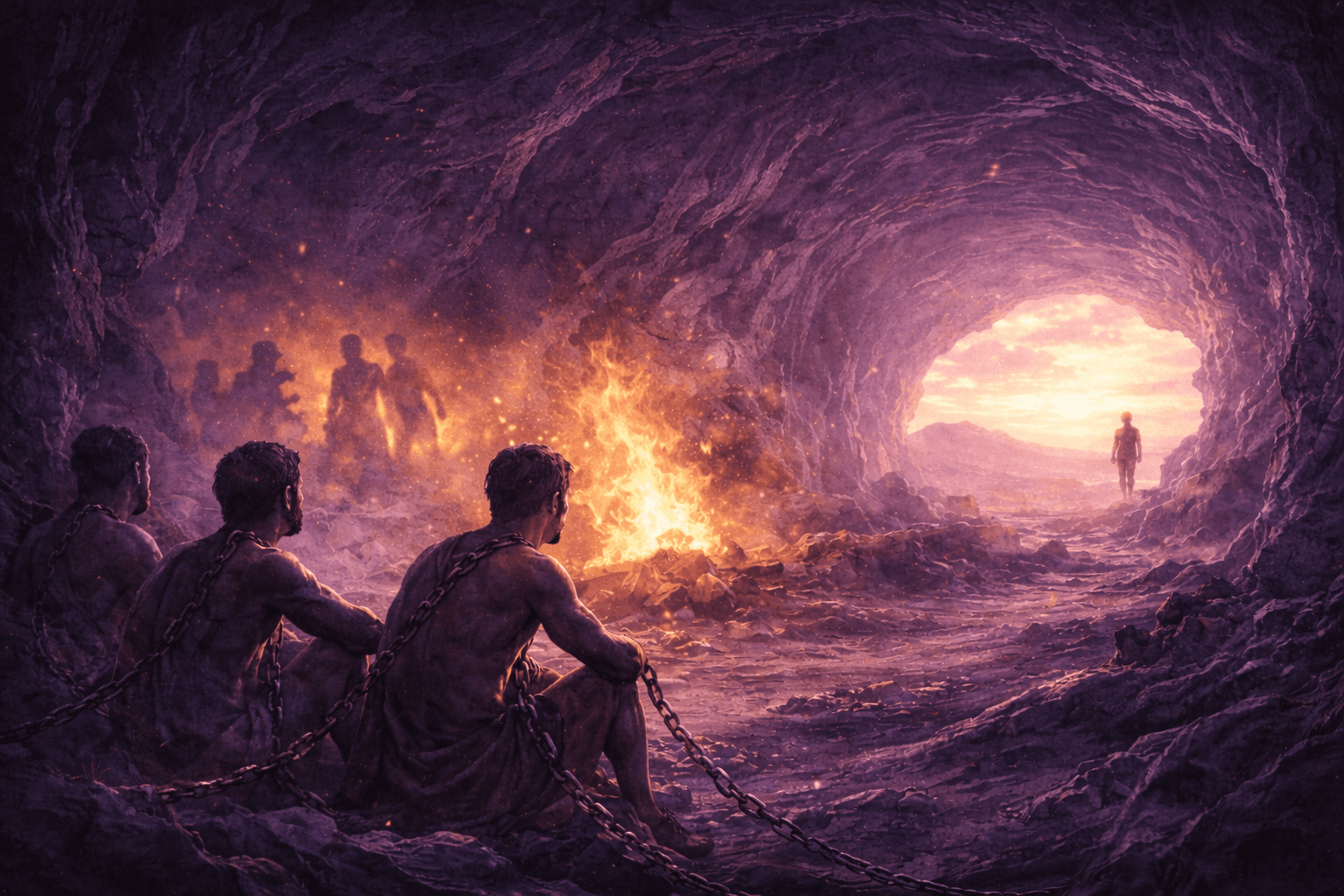
Here's the story Plato tells: imagine a group of people who have lived their entire lives chained inside a cave. They weren't put there as adults, mind you — they were born there, chained, having never known anything else. They sit facing the back wall, unable to turn their heads and look behind them. That wall is their entire world.
Now, behind these prisoners there is a fire burning. And between the fire and the prisoners, there's a raised path where people walk by carrying objects — statues, animals carved from wood. What the prisoners see aren't those real things, but the shadows they project onto the wall. A shadow of a horse. A shadow of a tree. A shadow of a person walking. And because they've never seen anything else in their entire lives, those shadows are reality to them. They don't think "that's the shadow of something" — they think "that is something." Full stop.
Here's the brilliant part of Plato's setup: these prisoners even have their own experts. There are people who specialize in identifying the shadows. "Oh look, there's that horse shadow again," they'd say. They probably even have competitions to see who can best predict which shadow comes next. The best at this are respected, admired. They're the smart ones of the cave. They have an entire system of knowledge and prestige built around... shadows on a wall.
Sound familiar? We'll come back to that.
The Painful Road Toward the Light
But let's continue. Plato now asks us to imagine that one of these prisoners is, for some reason, freed. His chains are removed. For the first time in his life he can move his neck, stand up, turn around. What happens? At first, he feels pain. His eyes, accustomed to the cave's dimness, are assaulted by the firelight. It hurts to look. And when he sees the real objects that had been projecting the shadows, he can't make sense of them. He'd actually think the shadows on the wall are more real than these three-dimensional objects now in front of him.
What's being shown to him contradicts everything he believed to be true his entire life. His mind resists. "No, reality is what I've always seen," he'd think. "This thing they're showing me now must be an illusion, a trick." And here Plato is showing us something profound: that knowledge hurts. That emerging from ignorance is uncomfortable, disorienting, even painful. It's not the pleasant, glowing experience of enlightenment we sometimes imagine. It's a mess.
But the story doesn't end there. Say this freed man is forced to keep going, dragged toward the cave's exit. He's brought out to the surface, the outside world, the sun. Now he's completely blinded. The sunlight is too much for his eyes. He can't see anything. At first, he could only look at shadows of things on the ground, or reflections in water. Gradually, as his eyes adjust, he'd begin to see the real objects themselves: trees, mountains, people. And finally, in a moment of ultimate revelation, he could look at the sun itself — the source of all light, the source of all reality.
At that point, he understands everything. He realizes he spent his whole life looking at shadows of shadows. That what he thought was real was just a distorted reflection of something much larger and truer. He probably feels something between enlightened and cheated. Like when you find out Santa Claus isn't real, but multiplied by a thousand.
The One Who Goes Back to Free the Others
Now comes the part I find most interesting and most heartbreaking about the whole allegory. Plato asks: what would happen if this man, who now knows the truth, went back into the cave to free his fellow prisoners? You'd think they'd welcome him as a hero, right? A liberator coming to pull them out of ignorance.
But no. Plato says that when this man goes back into the cave, his eyes — now accustomed to the sun — won't see well in the darkness. He'll stumble, he'll move clumsily. And the other prisoners, still chained to the wall, will laugh at him. "Look at him," they'd say. "He left with perfectly good eyesight and came back ruined. Clearly leaving the cave destroys your vision." And if he tries to unchain them and drag them out, Plato says they'd probably kill him.
Plato was thinking about his own teacher here — Socrates, who was condemned to death by Athens essentially for trying to make people think, for questioning their beliefs, for making them uncomfortable with hard questions. The Athenians accused him of corrupting the youth and not believing in the city's gods. They made him drink hemlock. They killed the man who only wanted them to think.
What Does the Cave Actually Mean?
So what does all this mean? Why did Plato go to all the trouble of telling this elaborate story?
At the most basic level, the cave represents the human condition for Plato. We are the prisoners. The world we perceive through our senses — everything we see, touch, hear — is, for Plato, merely a shadow of true reality. True reality, in his view, exists on a higher plane accessible only through reason and philosophical thought. That higher world is the realm of Ideas or Forms, where perfect, eternal, unchanging versions of all things exist.
For example: you might see many different horses in your life — big ones, small ones, brown ones, white ones, fast ones, slow ones. They're all different, all imperfect in some way, and they'll all eventually die. But for Plato, there exists an Idea of Horse — a perfect form of what a horse is — that exists eternally in that higher realm. The horses we see are only imperfect copies of that Idea.
And the sun in the allegory — that light that makes everything else visible — represents for Plato the Idea of the Good: the supreme truth, the highest knowledge a philosopher can aspire to. It's what gives meaning and reality to everything else.
But here's what I find most fascinating: it doesn't matter whether you believe in Plato's Theory of Forms. Honestly, most philosophers today don't fully buy it. But the cave works as a metaphor on so many different levels, and that's why it's still so relevant.
Think about it in terms of knowledge and education. We all start in the dark, ignorant, seeing only the shadows of things. The educational process is that painful journey out of the cave. Learning new things — especially things that contradict what we thought we knew — is uncomfortable. It makes you question, doubt, rethink. But it's the only path toward truth.
Or think about it in social and political terms, which is what Plato originally intended in The Republic. Most people live their lives without questioning, consuming what they're given, believing what they're told, watching whatever shadows are projected for them. The philosophers — the ones who leave the cave and see the truth — are the ones who should govern. Because only they truly understand how things are. Yes, Plato was basically saying philosophers should be kings. Spoiler alert: that part hasn't worked out great historically.
We Live in the Cave of the 21st Century
But where the cave metaphor becomes genuinely unsettling is when you apply it to today's world. Because we live in the cave. Literally.
Think about social media. Each of us sits inside our own personalized cave, watching the shadows that the algorithms decide to show us. If you're into sports, you get more sports. If certain political news makes you angry, you get more of it — because outrage drives engagement. If you watch cat videos, your feed fills with cats. The algorithm learns which shadows make you stare at the wall the longest, and gives you more of those.
And here's the messed-up part: you think you're seeing the world, but you're seeing an ultra-filtered version of the world, specifically designed to keep you hooked. You're not seeing what's important or what's true. You're seeing what makes you keep scrolling. The shadows being projected behind you were carefully curated by an algorithm trained on billions of data points about human behavior.
And we all have our "shadow experts," right? The influencers, the journalists, the politicians who only tell us what we want to hear. The ones who confirm our beliefs instead of challenging them. The ones who make us feel comfortable in our chains.
And what happens when someone tries to pull people out of their particular cave? Exactly what Plato predicted. They get angry. They push back. "He came back ruined," they say. "He's crazy," they say. Because accepting that what you believe might be a shadow means questioning your entire belief system, your identity, your whole way of seeing the world. And that hurts. It's easier to stay chained.
Here's a fact that genuinely blows my mind: recent studies show that when people are presented with information that contradicts their political beliefs, the areas of the brain associated with physical pain actually activate. It literally hurts to be wrong. Plato knew this twenty-four hundred years ago: knowledge hurts.
And it's not just social media. Think about news echo chambers. If you only read one newspaper, only watch one news channel, only talk to people who think like you do, you're in the cave. The shadows you see confirm your version of reality over and over again — but that doesn't make it real.
Plato also tells us something important about those who leave the cave. When they come back, they're initially clumsy, can't see well in the dark. Translated to the present: people who step out of their information bubble and start exploring other perspectives often seem confused at first, may change their minds, may seem uncertain. And that's a good sign. That means they're actually thinking. But we live in a culture that punishes doubt and rewards absolute certainty. We want politicians who never change their minds, influencers who are always confident, experts who never say "I don't know." We admire the experts in shadows, not the ones who squint because they've seen the sun.
How Do We Get Out of Our Own Cave?
Now, the million-dollar question: how do we leave the cave? How do we know whether we're seeing shadows or reality?
Plato would say through philosophy, rational thought, constant questioning. And he's partly right. The first step is acknowledging that you might be wrong. That what you see might be just a shadow. That requires intellectual humility — something that's pretty rare these days.
The second step is actively seeking out different perspectives. Reading things that make you uncomfortable. Listening to people you disagree with. Getting off your personalized feed. It's uncomfortable, yes. It'll sting a little, yes. But it's the only path.
The third step — and this one is crucial — is questioning even those who claim to have found the truth. Because history is full of people who said they'd left the cave and seen the sun, but had really just moved to a bigger cave. Fanaticism, totalizing ideologies, anyone who tells you only they have absolute truth — those are all just caves in disguise.
And here's something Plato didn't fully consider but that matters enormously: maybe nobody fully leaves the cave. Maybe we're always seeing some kind of shadow, some people's just a little sharper than others. Maybe wisdom isn't about believing you've seen the sun — it's about constantly recognizing you might still be in the dark. The only difference between the wise person and the ignorant one is that the wise person knows they don't know. That, actually, is something Socrates — Plato's own teacher — said.
The Responsibility of Those Who See the Light
There's one final thing I'd like you to take away from this allegory. Plato tells it as part of a dialogue about the ideal society, about how a city should be governed. And one of his conclusions is that the philosophers — those who have seen the sun — have an obligation to go back into the cave. They can't simply stay outside, enjoying the warmth of knowledge. They have to go back, even if it's dangerous, even if they might be killed, even if it's painful. They have a duty to try to free others.
And this feels tremendously relevant today. It's very easy to realize that most people live in information bubbles, in mental caves, and just walk away from it — to think, "I get it now, let the others figure it out." But Plato says that's cowardice. If you've truly understood something, if you've genuinely climbed out of any cave, you have a responsibility to help others do the same. Even if they resist. Even if they push back. Even if it's hard.
Of course, it has to be done carefully. You can't just drag people out into the sunlight and expect them to not be blinded. The process has to be gradual. First the less blurry shadows, then reflections, then real objects, and only at the end, direct light. In other words: empathy, patience, care. Not moral superiority or intellectual arrogance.
Because here's the final paradox of the cave: if you act like a self-important enlightened person looking down at those still in chains, then you haven't really left the cave at all. You just found another cave where you can feel superior. True wisdom comes with humility.
The Chains of Every Age
Plato — that broad-shouldered man who spent his life wrestling with the question of what is real and what is knowledge — left us with this image of the cave that, after twenty-four centuries, still rattles us. Because at bottom, every generation has to face its own version of the cave. In Plato's time, it was unquestioned traditional beliefs. In the Middle Ages, religious dogma. In the twentieth century, mass propaganda. And now, in the twenty-first, it's algorithms and information bubbles.
The chains change shape, but they're still chains. The shadows are projected on touchscreens instead of stone walls, but they're still shadows. And the pain of leaving the cave — the pain of facing the possibility that what you believed to be true might be false — that pain is the same one the Athenians felt when Socrates asked his irritating questions.
The good news is we can choose. We can choose to stay comfortable watching familiar shadows, or we can choose the discomfort of growth, the unease of questioning, the vertigo of doubt. Plato is telling us: yes, it will hurt. Yes, your eyes will burn. Yes, you'll stumble at first. But on the other side is something real, something true, something worth it.
And maybe — just maybe — if enough of us start questioning our own chains, examining our own shadows, we can build something better than a cave. Not a perfect society of philosopher-kings as Plato imagined, because that's pretty utopian and more than a little elitist, but a society where more people are willing to look outside their bubble, where critical thinking is valued more than absolute certainty, where we can actually disagree without destroying each other.
Plato's cave isn't just a historical curiosity we study in philosophy class. It's a mirror showing us our own condition — right now, today. And the question it asks is simple but frightening: are you going to keep watching the shadows, or are you willing to turn your head?
Related episodes

Why did you choose this way? Because he thought that philosophy was neither poetry nor opinion.

Close your eyes and look for your self. That permanent center that is you. Look carefully. A friendly, chubby Scotsman did that same exercise nearly three hundred years ago — and didn't find it. What he found instead was one of the most unsettling idea...
The most powerful man in the world wrote a private journal every night that he never intended to publish: he challenged himself not to be an idiot, reminded himself he was going to die, and braced for setbacks before they arrived. Two thousand years la...