
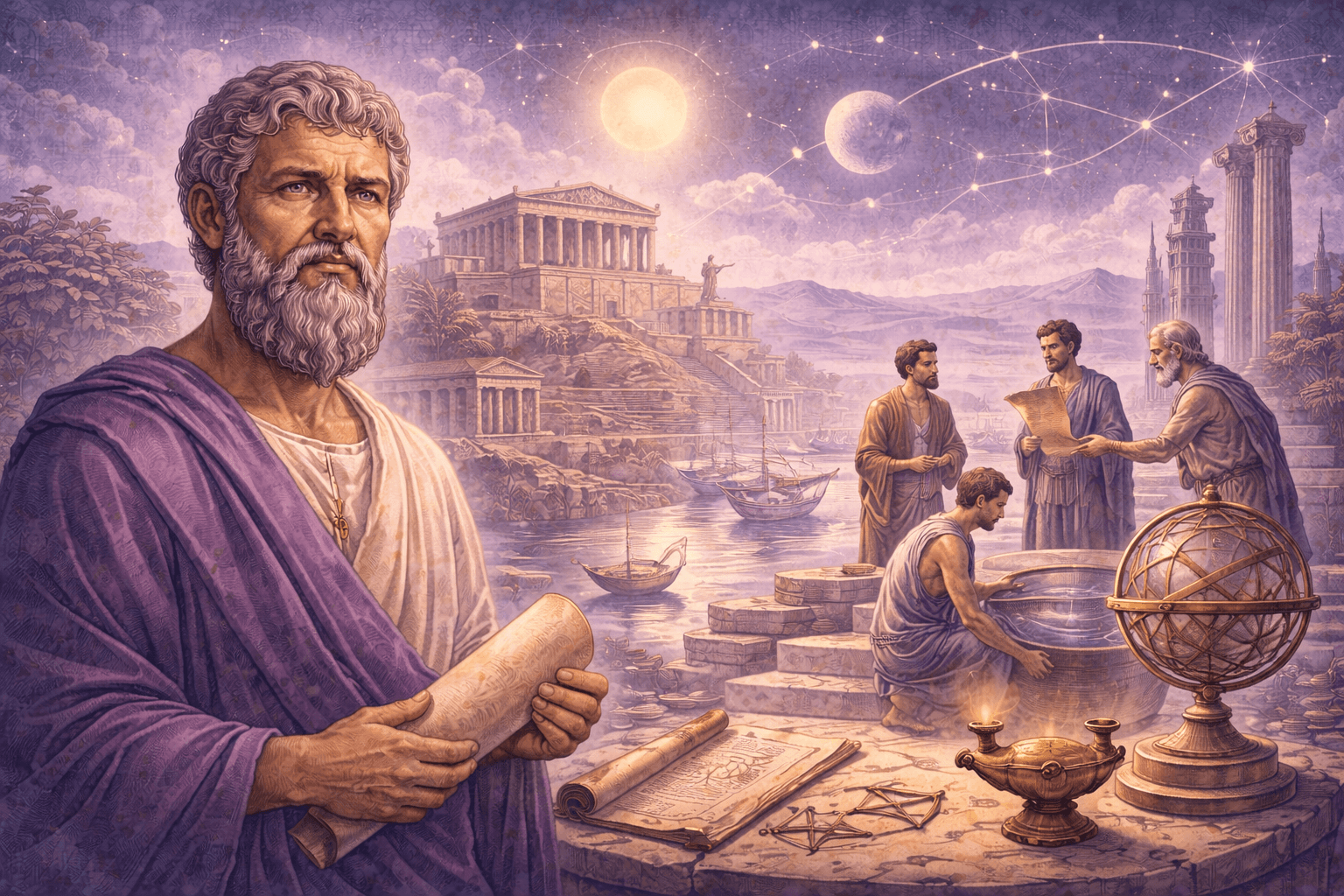
Thales: The Man Who Changed the History of Thought
 Andres Aguilar
Before Tales of Miletus, if you wanted to explain why the world worked the way it did, you called on a god. He was the first to say: no, let's think it through. That single shift — from myth to reason — is arguably the most consequential intellectual m...
A guy was walking around staring at the stars, so absorbed in his astronomical observations that he didn't watch where he was going and fell into a well. A servant woman who saw it happen laughed at him: "How do you expect to understand what's happening in the sky when you can't even see what's right under your feet?" That guy was Thales of Miletus, and the anecdote Plato tells about him is probably the first philosopher joke in history. But what that servant didn't know was that the man in the well had just invented something that would change the world forever: the idea that you can understand the universe through reason, without needing gods or myths.
Thales was the first person to say "water is the origin of everything" — not because some god revealed it to him, but because he reasoned it out. And with that seemingly simple act, philosophy, science, and the entire Western way of knowing came into being. Today we're talking about the guy who fell into a well and changed history.
Thales lived in the sixth century BCE, roughly from 624 to 546. He was from Miletus, a prosperous city on the coast of what is now Turkey. At the time, that region was called Ionia and was part of the Greek world, but it sat on the frontier with other civilizations: Persians, Egyptians, Babylonians. This geographic location is key, because Miletus was a massive trading port. There was an exchange not just of goods but of ideas. Thales probably traveled to Egypt and Babylon, learning mathematics and astronomy from those ancient cultures. Just think about what it must have been like for a Greek of that era to see the pyramids for the first time, or the ziggurats of Babylon. Those experiences didn't just broaden knowledge — they changed the very way of thinking about the world.
Why Philosophy Was Born in Miletus
Before going further with Thales, we need to understand why philosophy emerged specifically there, in Miletus, and not somewhere else. Because this was no accident. For millennia, incredible civilizations like Egypt, Babylon, China, and India had built enormous bodies of knowledge in astronomy, mathematics, and medicine. But none of them had made the leap to philosophy as we know it. Why did the Greeks?
The answer has to do with a unique combination of factors. First, Miletus was a stable and prosperous city. They weren't in constant war or fighting just to survive. They had achieved what anthropologists call "productive surplus": they produced more food and resources than they needed to get by. And when a society reaches that point, something fundamental changes. Not everyone has to focus on finding food anymore. Some people can specialize in other things: craftsmanship, trade, art, and yes, thinking.
Nomadic peoples can't do philosophy. They're too busy surviving, moving, searching for water and food. But when you settle down, when you plant crops and build cities, when your grain stores are full and your irrigation systems are working, then you can afford to let some folks sit down and stare at the sky and wonder what everything is made of. Philosophy is, in a real sense, a product of settled, prosperous civilization. It's a luxury — but a luxury that ends up being essential to human progress.
Second factor: Miletus's strategic location. It literally sat at the crossroads of the known world. To the west, Greece. To the east, Mesopotamia and Persia. To the south, Egypt. Ships from everywhere stopped in Miletus. And with those ships came not just cloth and spices but ideas. An Egyptian merchant could describe how they measured the Nile floods. A Babylonian astronomer could share his eclipse tables. A Phoenician navigator could explain how they oriented themselves by the stars in open water.
Philosophy could have emerged in other places, but Miletus had a particularly potent combination: prosperity, geographic position, and intellectual freedom.
This mix of knowledge from different cultures is crucial. Because when you only know one way of explaining the world, you take it as absolute truth. But when you encounter three different explanations of the same phenomenon, you start to doubt. The Milesians were exposed to multiple mythologies: Greek, Egyptian, Persian, Babylonian — all different, all contradictory. This probably led them to think: what if they're all wrong? What if there's a more fundamental explanation that doesn't depend on stories about gods?
Third factor: Miletus was a commercial center, and commerce requires rational thinking. If you're a merchant, you have to measure, calculate, compare, predict. A merchant can't afford to say "Zeus will decide if my ship arrives." He needs to know about currents, winds, seasons. Commercial thinking is inherently secular and pragmatic.
Fourth factor, and perhaps the most important: Miletus had no powerful priestly class. In Egypt, priests controlled astronomical and mathematical knowledge as a secret reserved for the religious elite. Questioning the official cosmology meant questioning the entire social order. But in the Greek cities of Ionia, religion was different. There were temples and rituals, but no institutionalized church with absolute political power. The Greeks told myths about the gods, but those myths were transmitted by poets like Homer and Hesiod, not by an authoritarian priestly hierarchy. There was no single dogma everyone had to accept. This created an extraordinary space of intellectual freedom.
Miletus also had democratic institutions where citizens debated laws and policies. This habit of public debate — presenting arguments and counterarguments — naturally carried over into other domains. All these factors together created the perfect breeding ground for something new to be born. And Thales was the one who made the leap.
The Philosopher Who Was Also a Businessman
We have no writings by Thales. Everything we know comes from references by later philosophers like Aristotle, Herodotus, and Plato, who lived centuries after him. This makes it hard to know what is historical and what is legend. But even the legends are interesting because they show how later Greeks saw him: as a mixture of sage, scientist, and successful entrepreneur.
One of the most famous stories comes from Aristotle. He recounts that people used to mock Thales for being poor, suggesting that philosophy was useless because it didn't make you money. So Thales, to prove that philosophers could be rich if they wanted to but simply didn't care to be, used his knowledge of astronomy to predict that there would be an exceptional olive harvest. During the winter, when prices were low, he bought or leased all the olive presses in Miletus. When the bumper harvest arrived, everyone needed the presses and Thales leased them out at premium prices. He made a fortune in one shot, and then went back to his philosophy.
The message was clear: philosophers could make money easily if they chose to, but they have more important goals. The story shows that Thales had practical knowledge he could use to predict natural phenomena, that he was shrewd and understood basic economics, and that from the very beginning there was a tension between philosophy as the pursuit of wisdom and as a practical tool.
Another famous story involves the prediction of a solar eclipse. According to Herodotus, Thales predicted a solar eclipse that occurred during a battle between the Lydians and the Medes in 585 BCE. The eclipse was so striking that both armies stopped fighting and signed a peace treaty, interpreting it as a divine sign. Modern historians doubt that Thales could have predicted it with such precision, but he probably had some understanding of astronomical cycles learned from the Babylonians, who had been recording celestial events for centuries and had discovered patterns.
What matters isn't whether he predicted that exact eclipse, but that he was looking for regular patterns in nature. He was saying that celestial phenomena are not the whims of gods but follow predictable laws. For millennia, humans had explained everything through myths: why does it thunder? Zeus is angry. Why is there a drought? The gods are punishing us. Thales said: no, there are natural explanations. We can understand them if we observe and think.
Everything Is Water: The First Theory of the World
Thales's greatest contribution is his answer to the fundamental question: what is everything made of? Before Thales, the Greeks explained the world through myths: Chaos, then Gaia the earth, Uranus the sky, and all the gods doing their thing. It was poetry, not rational explanation.
Thales was the first to search for a single material principle — something physical that was the origin of everything. And his answer was: water. Everything comes from water and everything returns to water. It sounds simplistic now, but it was absolutely revolutionary. First, because it's a materialist explanation: water is something you can see, touch, measure. It's not an abstract god. Second, because it's unifying: instead of saying there's a god for every thing, Thales proposes a single principle that explains the diversity of the world.
Why water? Aristotle speculates that Thales observed that living things need moisture, that seeds are moist, that even heat seems to come from what is wet. Water can be liquid, solid like ice, or vapor like fog. It's the most adaptable substance there is. And geographically, Miletus was surrounded by water: it was a port. The sea was the constant element of everyday Milesian life.
Thales was clearly wrong. Not everything is water. But that doesn't matter. What matters is the method: there is a rational order in the universe, and we can discover it using our minds.
Now, Thales was clearly wrong. Not everything is water. But that doesn't matter. What matters is the method. Thales was saying: there is a rational order in the universe, and we can discover it using our minds. We don't need priests or divine revelations. We can observe, think, and propose explanations. And if we're wrong, someone else can propose something better. And that's exactly what happened.
Thales's successors in Miletus proposed other principles. Anaximander, his student, argued that the principle couldn't be water or any specific element, because that would privilege one element over the others. He proposed something called "the indefinite" — a primordial substance without specific qualities from which all elements emerged. It's an incredibly abstract and sophisticated idea for around 600 BCE. Anaximenes, Anaximander's student, said it was air, arguing that air could condense into water and rarify into fire. Heraclitus said it was fire and constant change. Each tried to improve on the previous theory, to answer its objections, to offer a more complete explanation. That's primitive science. And it all started with Thales saying "it's water" and giving observable reasons. Even being wrong in a reasonable way is better than being accidentally right in a mythological one.
Thales also made contributions to mathematics. Several theorems of geometry are attributed to him, the most famous being that any triangle inscribed in a semicircle is always a right triangle. It's a necessary truth: no matter what triangle you draw, if it's inscribed in a semicircle, the angle opposite the diameter is always 90 degrees. Always. Without exception. Thales learned geometry in Egypt, where surveyors used it practically to measure land after the Nile floods. But Thales converted these practical techniques into abstract theorems. Not just "this works," but "this must always work, for these reasons." That's the leap from technology to science.
There's a wonderful anecdote in which Thales impressed the Egyptians by measuring the height of the pyramids using shadows. He waited for the moment of day when his shadow was exactly equal to his own height, then measured the pyramid's shadow. At that moment, the pyramid's shadow was also equal to its height. The Egyptians had built the pyramids but had no elegant method for measuring their height. Thales did.
The Beginning of a Chain That Reaches to Today
What Thales started in Miletus around 600 BCE is a direct ancestor of the scientific method we use today. The idea that the world is knowable through reason, that we can formulate hypotheses and test them, that we should look for natural causes rather than supernatural ones — all of that flows from that first step Thales took.
Every time a scientist proposes a theory and asks "but why?" rather than "what did the gods decide?", they're continuing the work Thales began. Every time we trust observation and evidence over authority and tradition, we're being Milesian.
Thales was wrong about water. But he was right about something far more important: that the universe follows rules, and we are capable of discovering them. That simple insight — that the world is rational and we can understand it — is arguably the most consequential idea in human history.
The guy who fell into the well didn't just make us laugh. He showed us how to look up at the sky and actually start to understand it.
Related episodes

Why did you choose this way? Because he thought that philosophy was neither poetry nor opinion.

Close your eyes and look for your self. That permanent center that is you. Look carefully. A friendly, chubby Scotsman did that same exercise nearly three hundred years ago — and didn't find it. What he found instead was one of the most unsettling idea...

The most powerful man in the world wrote a private journal every night that he never intended to publish: he challenged himself not to be an idiot, reminded himself he was going to die, and braced for setbacks before they arrived. Two thousand years la...