
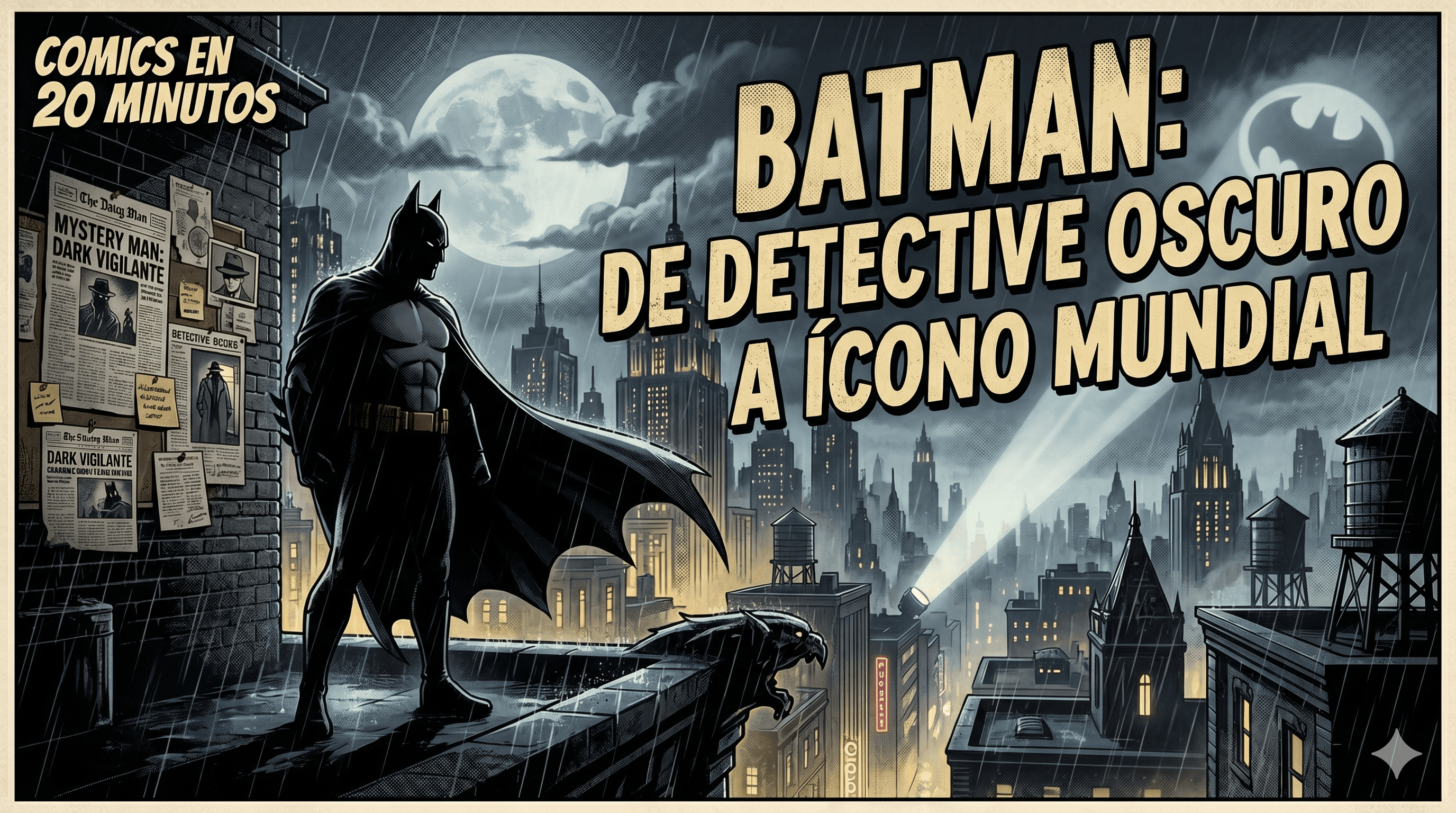
Batman: from dark detective to global icon
 Andres Aguilar
On May 6, 1939, eleven months after Superman appeared in *Action Comics*, readers of that same magazine encountered something different. There was no name on the cover.
On May 6, 1939, eleven months after Superman in Action Comics, readers found something different in the same magazine: in the last pages, a six-page story called The Case of the Chemical Syndicate, with a protagonist with no origin, no backstory, who solved the case with fists and cunning and disappeared into the night. He called himself The Bat-Man.
In those six pages was the DNA of one of the most important characters in popular entertainment. And he was born, basically, in a hurry: a twenty-three-year-old boy who wanted to copy the success of Superman.
DC's assignment
Superman had been such a brutal success that Detective Comics—DC before it was called DC—needed to replicate it. The message to cartoonists and scriptwriters was clear: bring new heroes.
Bob Kane was twenty-two or twenty-three years old, he drew minor humor comics, and he was ambitious. His first sketch mixed references: The Bat, Zorro, adventure serials. The result was a guy dressed in red with angel wings. Literally.
Then he called Bill Finger.
Bill Finger
Finger was quiet, methodical, passionate about noir and 1930s horror. He was everything Kane was not. When he saw the sketch, he took out paper and rewrote: black and gray on the suit, pointed ears on the hood, bat-shaped cape instead of angel wings, gloves, mask without white eyes to make him look more menacing.
Finger wrote much of the stories in the early years. He created the Joker, Catwoman, the Penguin, Two-Face. He invented Gotham City. He wrote the origin of the alley—eight-year-old Bruce Wayne watching Thomas and Martha die—and established that Batman had no superpowers.
In a genre defined by Superman, they created someone who doesn't fly, doesn't stop bullets, doesn't come from another planet. A human trained to the limit. He is not a god: he is a man.
Stolen credit
The problem with Batman's story is that for decades it was told incomplete. Kane introduced the character and made sure only his name appeared in the credits. Finger was not in the deal: he worked for decades on a collaborator's salary, without official recognition. Kane negotiated percentage of profits and exclusive credit.
In his 1989 autobiography, Kane acknowledged Finger's contribution. Bill Finger had died in 1974, in poverty. It wasn't until 2015—seventy-six years after the debut—that DC and Warner officially credited Finger as co-creator.
Batman created by Bob Kane with Bill Finger.
It was late. It was incomplete. But it was something. The story of Batman is also one of what the industry does to those who create it that makes it work.
The Batman of 1939
The first stories are basically police stories. Dark, violent tone for the time: the Batman of 1939 and 1940 used weapons, let villains die, threw them from heights. He was not the hero who does not kill today.
In 1940, Robin appeared—an entry point for young readers—and sales of Detective Comics skyrocketed. That same year the Joker and Catwoman arrived.
The Joker debuted in Batman #1 (Spring 1940), visually inspired by Conrad Veidt in The Man Who Laughs (1928): macabre comedy killer, venom of laughter, grotesque smiles on the victims. He was planned to die in that number; an editor intervened and let him live. It was one of DC's best editorial decisions in decades.
Catwoman arrived as The Cat: self-motivated jewel thief, tension with Batman that went beyond the action—attraction, mutual admiration, two people on opposite sides of a blurred line.
Wertham and the Code
World War II changed all superheroes; Batman stuck Nazis on the covers. But the hardest thing came later.
In the second half of the fifties, psychiatrist Fredric Wertham published Seduction of the Innocent, charging—with little evidence—that comics corrupted children. About Batman and Robin: homosexual fantasy, it said.
Moral panic led to congressional hearings, falling sales, publishing houses going out of business. DC created the Comics Code Authority and, to prove that Batman and Robin were not subversive, introduced Batwoman and Bat-Girl as romantic interests for the Dark Knight and his young sidekick. One of the most embarrassing chapters in DC history.
Rehabilitation
The recovery came from two almost opposite places.
The Adam West series (1966) took the most absurd Batman in history and turned him into a cultural phenomenon: deliberate camp, POW!, BAM!, Adam West playing it dead serious. When it ended in 1968, Batman was a joke; DC considered canceling the titles.
Then Neal Adams and Denny O'Neil (1969-1970) reconverted the character: original darkness, noir tone, detective in the shadows, no-kill rule, humanity and pain. The alley returned to the center. Batman is not a hero because he wants to: he is a hero because he cannot not be.
Miller and Moore
In the eighties, two works changed the character and the industry.
The Dark Knight Returns (Frank Miller, 1986): Retired fifty-something Batman returns to a dystopian Gotham. Violent, political, fascinating vigilante. He faces Superman—established order—in a fight that asks: who decides what justice is? One of the first works of the medium treated as literature.
The Killing Joke (Alan Moore, 1988): twelve dense pages about Batman and the Joker as two sides of the same coin—order and chaos, reason and madness. Brutal in the scene with Barbara Gordon; sophisticated at the narrative level.
At the cinema
Tim Burton (1989), with Michael Keaton and Jack Nicholson as Joker: 411 million over a 35 million budget, highest-grossing film of the year, threatening and nocturnal Batman again.
Then Burton (Batman Returns, Michelle Pfeiffer as Catwoman), Schumacher (more camp, received coldly), and Christopher Nolan's trilogy: almost documentary realism, real corrupt Gotham, real consequences.
The Dark Knight (2008), with Heath Ledger as Joker—posthumous Oscar—is for many the best superhero film ever made. Ledger died before the premiere, at the age of twenty-eight. His dedication turned that Joker into an inevitable reference.
Duality
What makes Batman inexhaustible after more than eighty years is duality.
Bruce Wayne by day—frivolous millionaire—and Batman by night—creature of the shadows. Gotham as a mirror of corruption and inequality. Joker and Batman need each other.
And the question that is never fully answered: what makes someone a hero and not a psychopath? Batman terrorizes, he strikes, he operates outside the law. The only difference with criminals is that he does not kill—a self-imposed, arbitrary rule that defines everything.
The suit does not make the Batman. What does it is the decision not to cross certain lines.
He is the only big superhero without powers. When Superman fights, the question is whether he is strong enough. When Batman fights, the question is how he's going to resolve it. It is the fantasy of the one without superpowers—of all of us—competing with cunning and preparation.
Bill Finger understood it in 1939, in that Manhattan apartment: he took off her angel's wings and gave her a bat's cape. It wasn't a look—it was a way of being. Dark, contradictory, defined by pain.
Eighty-odd years later, we are still looking for what is in that alley in Gotham, when the parents fall and the child is left alone.
Related episodes
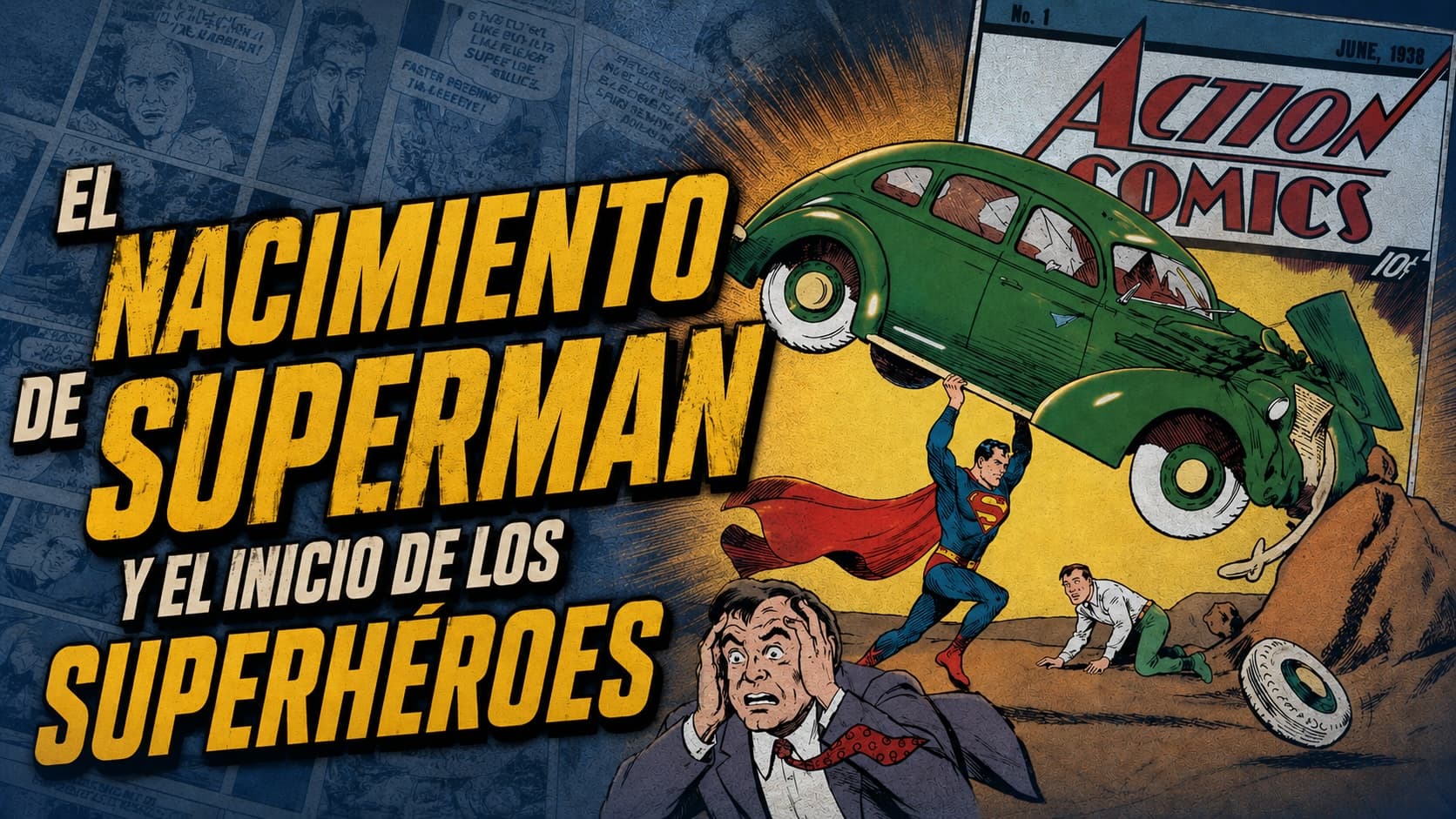
In June 1938, a magazine issue appeared on newsstands across the United States with a cover that no one would forget. A man in a red cape and blue mesh lifted a car above his head while several guys fled in terror.