
The birth of Superman and the beginning of superheroes
 Andres Aguilar
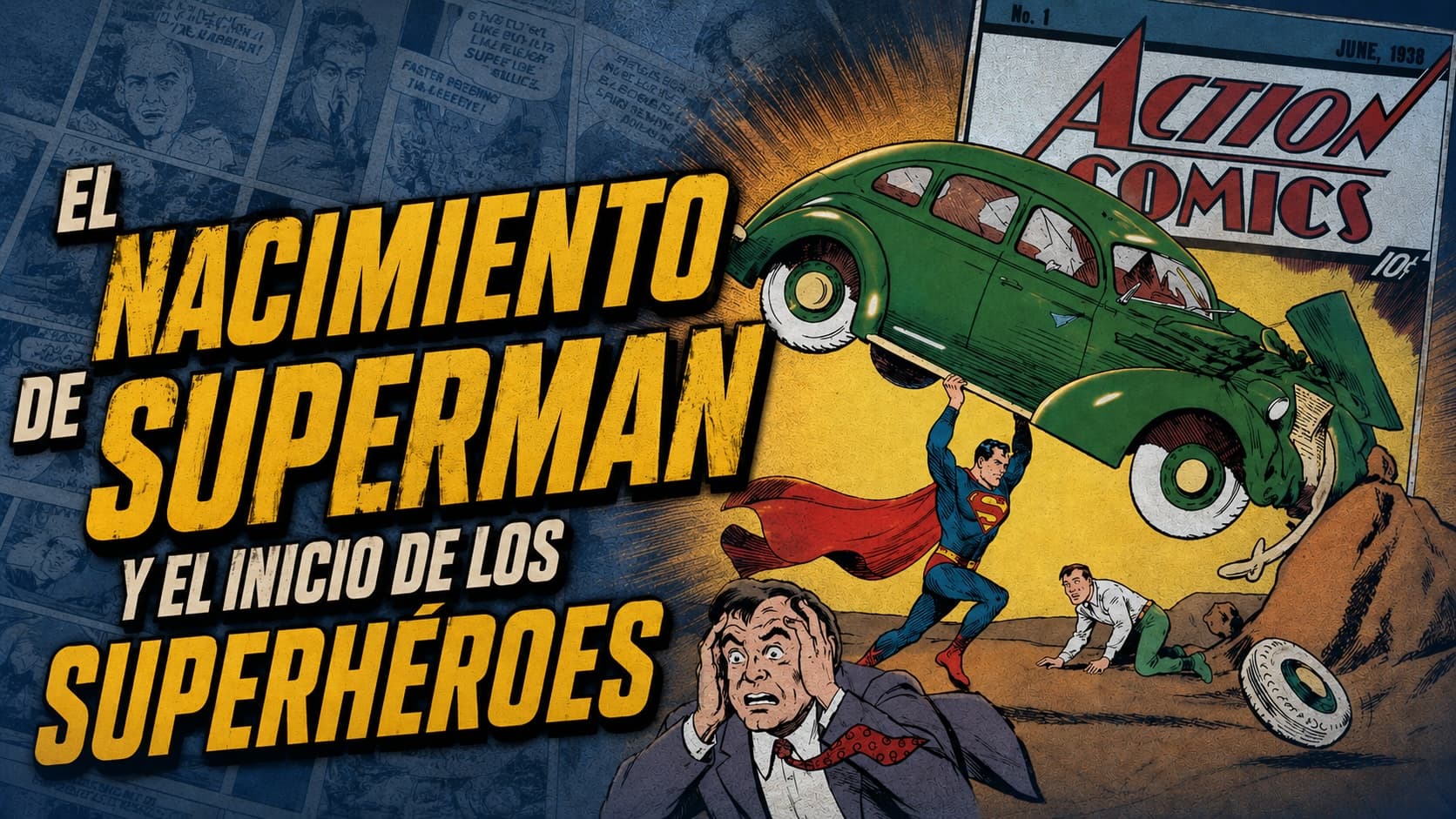
In June 1938, a magazine issue appeared on newsstands across the United States with a cover that no one would forget. A man in a red cape and blue mesh lifted a car above his head while several guys fled in terror.
In June 1938, a magazine issue appeared on newsstands across the United States with an impossible-to-forget cover: a man in a red cape and blue tights lifted a car above his head while several guys fled in terror. The magazine was called Action Comics, it was number one, and it cost ten cents. Nobody yet knew that this gesture inaugurated an entire genre.
Action Comics #1
What was on that cover wasn't just a new character. It was the first time the world had seen a superhero—a word that did not yet exist with the meaning it has today. There were pulps, radio serials, adventure films. But a man who flies, stops bullets, comes from another planet and uses his power to protect the weak was something radically different.
And he was born in the bedroom of two kids in Cleveland, Ohio.
Siegel and Shuster
Jerry Siegel was fifteen years old when he started thinking about Superman. He was not the popular kid at school: thin, introverted, a voracious reader of science fiction and pulps. His best friend, Joe Shuster, had just arrived from Canada with his family, so poor that he drew on wrapping paper when he had nothing better. But he drew incredibly well.
They met in high school, in the science fiction club, and click: they had the same universe in their heads.
The first version of Superman—the one Jerry wrote in 1933, when he was nineteen—was nothing like the character we know. He was a villain: a mad scientist with mental powers who sought to dominate the world. Jerry published it in a fanzine and immediately understood that something was not working. People wanted someone to twist for. Not a bad guy with powers: a good guy.
From villain to hero
The new version arrived in 1934 with the DNA of the classic Superman: an alien sent from a dying planet, adopted by a human family, raised with compassion and with the idea that with great power comes great responsibility. Yes, Marvel would later popularize that phrase with Spider-Man, but the seed was here.
What Jerry saw—and this is key—is that the superhero had to be different from the classic action hero. He was neither Tarzan in the jungle nor the brilliant detective. It was a fantasy of pure power in the service of justice: the shy boy who secretly can do what others cannot.
And who was Jerry Siegel? A marginalized teenager.
There is a biographical fact that usually appears in analyzes of the origin: Jerry's father was murdered in 1932 during a robbery at his business. Jerry was seventeen years old. Some academics link it to the emotional matrix of the character—an invulnerable man who cannot be harmed by anything. It is speculation, but speculation with weight.
Years of rejection
For years, Jerry and Joe knocked on doors in the American publishing industry and slammed them in their faces. The rejection letters piled up: Not sophisticated enough. Adult readers are not going to buy this. It's too fanciful.
The character was in a drawer, reviewed and reformed, always rejected.
Jerry told many times how Clark Kent was born: one sleepless night the full image came to him—the shy journalist, the glasses, the girl who doesn't look at him, the superhero she adores without knowing that he is the same person. Lois Lane was also born there: strong, independent, journalist, revolutionary for a female character of the 30s.
Joe built the aesthetic by looking at bodybuilders in health magazines, most notably Joe Bonomo. The silhouette—broad chest, narrow waist, upright posture—comes from there. The S on the chest, today one of the most recognizable logos on the planet, was initially just a decorative initial. Kryptonian mythology came much later.
The deal with DC
In 1938, after years of rejections, Detective Comics—DC before it was called DC—bought them the character.
Be careful with the contract: Jerry and Joe gave up all rights to Superman for $130. At that moment it seemed reasonable for two kids who had never sold anything; The publisher hired them to continue producing. It seemed like a good deal. It wasn't. But that is another part of the story, one of the saddest in entertainment.
What matters now is June 1938 and Action Comics #1.
The strip was a compressed version of pages they had already made. The origin was shorter than the one afterwards—Krypton, the parents, the ship, the farm—but it was all there. And the action was immediate: on the first page Superman bursts into a governor's office to save an innocent woman sentenced to death. No endless backstory. Action, cause, effect.
An instant success
Sales of Action Comics before Superman were between 200,000 and 300,000 copies. After Superman appeared on the cover, by 1939 nearly 900,000 were sold per issue. Readers wrote letters asking about that man who lifted the car.
Superman was simple—not simplistic—: crystal clear premise. He comes from another planet, he has superpowers, he does good. That freed the writers to tell stories without re-explaining the character every issue.
It was also aspirational in a very concrete way. We are in 1938, in the midst of the Great Depression, with World War II looming. The readers were workers, immigrants, families who were miraculously making ends meet. And along comes this square-jawed guy who can't be corrupted, can't be bought, isn't afraid of anyone, and always does the right thing.
In the first stories the enemy is not a villain with superpowers: he is a corrupt senator, an unscrupulous industrialist, the owner of a mine that exploits workers. Superman of 1938 was almost a left-wing character: an incorruptible worker with superhuman strength putting his body to the powerful.
Jerry Siegel and Joe Shuster were children of Jewish immigrants. There are those who see in Superman's origin the resonance of Moses—the baby sent to escape a doomed world, raised among his own, destined to save—and of the diaspora. Jerry never explicitly claimed it, but the parallels are there.
Radio and flight
The impact was so brutal that in 1939 there was already a daily strip. In 1940 the radio program started, which lasted more than a decade and reached millions of listeners.
In the original comics, Superman didn't fly: he jumped. The opening phrase was "able to leap tall buildings in a single bound". But the radio scriptwriters accompanied these jumps with wind effects, and the public began to imagine flight. The jump became a glide in the audience's heads before anyone made it official.
The decision came in 1941 with Fleischer Studios. Dave Fleischer asked for $100,000 per short—four times the normal amount—convinced he would be rejected. Paramount traded lower. Fleischer found a technical problem: animating jumps didn't look right. He asked DC for permission to let Superman fly. DC said yes. The first short, The Mad Scientist (September 1941), was nominated for an Oscar.
Superman fighting the Klan. On the radio. In 1946.
In 1946, the show's writer—Stetson Kennedy, an activist who had infiltrated the Ku Klux Klan—exposed secret Klan signs and passwords on the show, so that millions of kids would know how to recognize a member. The organization was made ridiculous. Enrollments are said to have dropped markedly after that season.
The Golden Age
The success of Superman immediately created a demand for more of the same characters. Publishers of the late '30s and early '40s as superhero factories: some lasted for decades, many disappeared within two or three issues. They are all children of that guy in blue mesh.
In 1940, more than 150 comics titles were published in the United States; It is estimated that 90% of children between 8 and 14 read them regularly. What today would be a streaming franchise was then a dime magazine on the newsstand.
Historians call this period the Golden Age of comics. It starts in June 1938 with Action Comics.
What defines this stage is not only the number of characters: it is the moral innocence of the genre. Good heroes just because, bad villains just because, a world that makes sense at the end of each issue. That would change decades later. In the 1940s, superhero comics were optimistic entertainment for a country that needed to believe in something.
Expelled from their creation
Jerry Siegel and Joe Shuster continued working on Superman for years, but their relationship with the publisher deteriorated. When they demanded rights and compensation, they were kicked out. In 1948, two men who had created one of the most recognizable characters of the 20th century were fired from their own creation.
Decades passed with varying success. Jerry had some tough times; Joe was losing his sight. They watched Superman become a multi-million dollar franchise without seeing much of it.
In 1975, with Warner preparing the Christopher Reeve film, a campaign by Neal Adams – cartoonist and creators' rights activist – reached an agreement: Jerry and Joe would receive $20,000 a year for life and their names in all credits with the legend Superman created by Jerry Siegel and Joe Shuster.
It wasn't what they deserved. But Joe died in 1992 and Jerry in 1996 knowing that they had created something that transcended contracts and legal disputes.
Why is he still alive
What makes Superman tick almost ninety years later?
The easy answer: it is the first superhero, the template. Everything that follows is taken into account, to imitate it or react against it. The dark heroes of the 80s react to your optimism. Marvel's imperfections in the 60s were born differentiating themselves from the classic model.
The most interesting answer is the idea it represents. Superman is not human: he is an alien. But you are raised human, you adopt human values, you choose to be human where it matters. He is the son of immigrants who integrates so completely that he ends up being a symbol of American identity.
There is tension between absolute power and the choice not to abuse it. Superman can do it all; The drama is not in whether he wins the fight, but in what he protects and why.
The best Superman writers understood that it's not an action story: it's a story about what it means to be good when no one demands it.
Grant Morrison described it as "the first genuinely American idea in world mythology": not the most original or the most complex, but the most Americanly optimistic—with power and will, the world can be better; one person can make a difference; good exists and is worth defending.
That resonates in 1938. It resonates in 2026. It will probably still resonate.
The red cape
The cape has a very curious origin. In early versions of Joe, Superman didn't have a cape: he wore a circus acrobat's leotard. The cape appeared because Joe wanted to show movement in the panels—communicate speed even though the character was still. A graphic trick. A practical solution.
Today it is one of the most recognizable visual icons on the planet. It appears in Hollywood movies and children's t-shirts everywhere. And it was born because a seventeen-year-old cartoonist needed to show that his character moved.
All the monumentality that we carry about Superman—university studies, theories of myth, political and religious readings—began in the daily problem of how to draw movement on a static panel.
The story of the superhero comic began like this: two neighborhood teenagers, years of rejection, and a ten-cent cover that no one expected.
Everything else—Batman, Spider-Man, the X-Men, Marvel, DC, the MCU—is a consequence of that moment.
Related episodes
On May 6, 1939, eleven months after Superman appeared in *Action Comics*, readers of that same magazine encountered something different. There was no name on the cover.